Kashefi Parviz, Montazeri Kamran, Honarmand Azim, Safavi Mohammadreza, Hosseini Hashem Mirzaee
Associate Professor, Department of Anesthesia, Anesthesiology and Critical Care Research Center, Isfahan University of Medical Sciences, Isfahan, Iran.
J Res Med Sci. 2011 Sep;16(9):1139-48.
Midazolam has analgesic properties. The aim of the present study was to assess the analgesic effect of midazolam when added to lidocaine in intravenous regional anesthesia (IVRA).
Sixty patients undergoing hand surgery were randomly allocated into two groups to receive 3 mg/kg 2% lidocaine diluted with saline to a total volume of 40 mL in the control group (group lidocaine saline ~ LS, n=30) or 50 μg/kg midazolam plus 3 mg/kg 2% lidocaine diluted with saline to a total volume of 40 mL in the midazolam group (group lidocaine midazolam ~ LM, n=30). Before and after the tourniquet application, hemodynamic variables, tourniquet pain, sedation, and analgesic use were recorded.
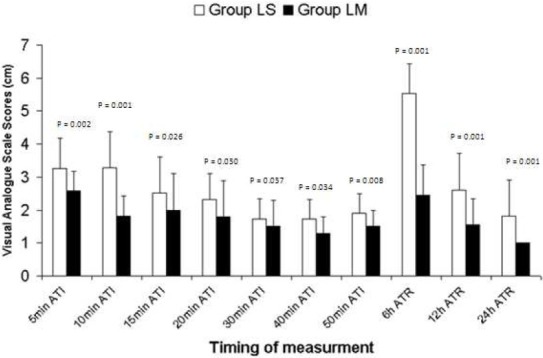
Shortened sensory and motor block onset time [4.20 (0.84) vs. 5.94 (0.83) min, p = 0.001 and 6.99 (0.72) vs. 9.07 (0.99) min, p = 0.001 in LM and LS groups, respectively], prolonged sensory and motor block recovery times [8.41 (0.94) vs. 5.68 (0.90) min, p = 0.001 and 11.85 (1.18) vs. 7.06 (0.82) min, p = 0.001 in LM and LS groups, respectively], shortened visual analog scale (VAS) scores of tourniquet pain (p < 0.05), and improved quality of anesthesia were found in group LM (p < 0.05). VAS scores were lower in group LM in the postoperative period (p = 0.001). Postoperative analgesic requirements were significantly smaller in group LM (p = 0.001).
The addition of 50 μg/kg midazolam to lidocaine for IVRA shortens the onset of sensory and motor block, and improves quality of anesthesia and perioperative analgesia without causing side effects.
咪达唑仑具有镇痛特性。本研究的目的是评估在静脉区域麻醉(IVRA)中,将咪达唑仑添加到利多卡因中时的镇痛效果。
60例行手部手术的患者被随机分为两组,对照组(利多卡因盐水组LS,n = 30)接受用盐水稀释至总体积40 mL的3 mg/kg 2%利多卡因,咪达唑仑组(利多卡因咪达唑仑组LM,n = 30)接受50 μg/kg咪达唑仑加用盐水稀释至总体积40 mL的3 mg/kg 2%利多卡因。在使用止血带前后,记录血流动力学变量、止血带疼痛、镇静情况和镇痛药物使用情况。
在LM组和LS组中,感觉和运动阻滞起效时间缩短[分别为4.20(0.84)分钟对5.94(0.83)分钟,p = 0.001和6.99(0.72)分钟对9.07(0.99)分钟,p = 0.001],感觉和运动阻滞恢复时间延长[分别为8.41(0.94)分钟对5.68(0.90)分钟,p = 0.001和11.85(1.18)分钟对7.06(0.82)分钟,p = 0.001],止血带疼痛的视觉模拟评分(VAS)缩短(p < 0.05),且LM组麻醉质量改善(p < 0.05)。术后LM组的VAS评分更低(p = 0.001)。LM组术后镇痛需求显著更少(p = 0.001)。
在IVRA中,向利多卡因中添加50 μg/kg咪达唑仑可缩短感觉和运动阻滞的起效时间,改善麻醉质量和围手术期镇痛效果,且不产生副作用。