Center for Integrative Research on Cardiovascular Aging, Aurora University of Wisconsin Medical Group, Aurora Health Care, Milwaukee, Wisconsin, United States of American.
PLoS One. 2012;7(9):e44667. doi: 10.1371/journal.pone.0044667. Epub 2012 Sep 4.
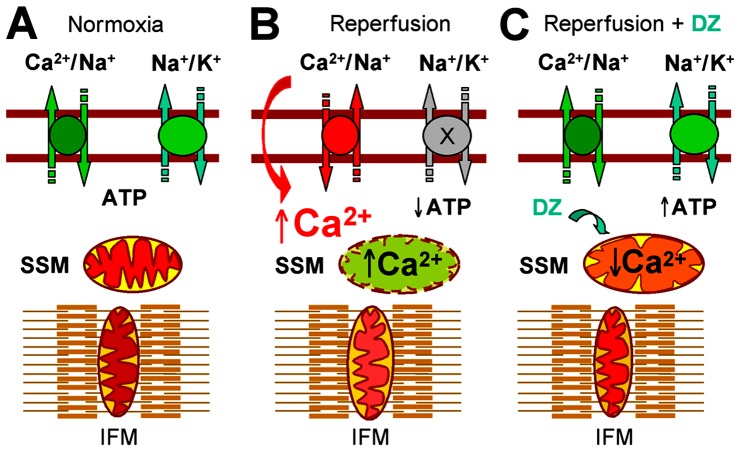
Cardiac subsarcolemmal (SSM) and interfibrillar (IFM) mitochondrial subpopulations possess distinct biochemical properties and differ with respect to their protein and lipid compositions, capacities for respiration and protein synthesis, and sensitivity to metabolic challenge, yet their responsiveness to mitochondrially active cardioprotective therapeutics has not been characterized. This study assessed the differential responsiveness of the two mitochondrial subpopulations to diazoxide, a cardioprotective agent targeting mitochondria.
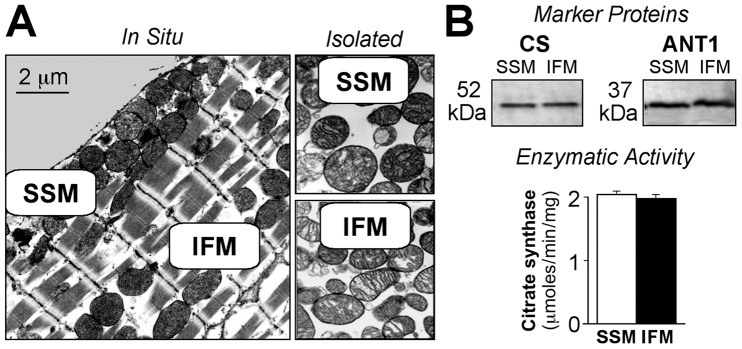
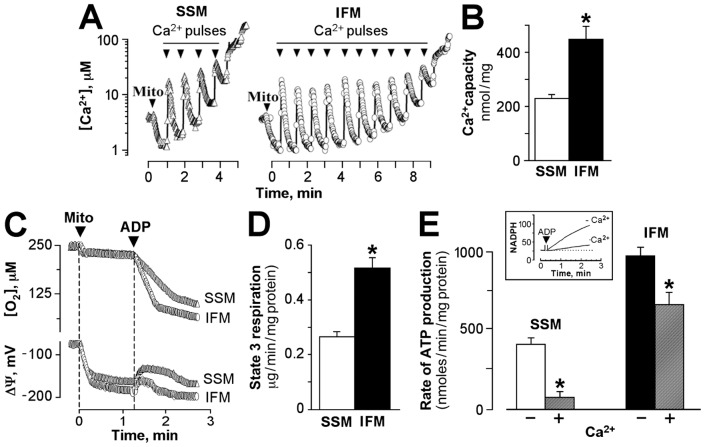
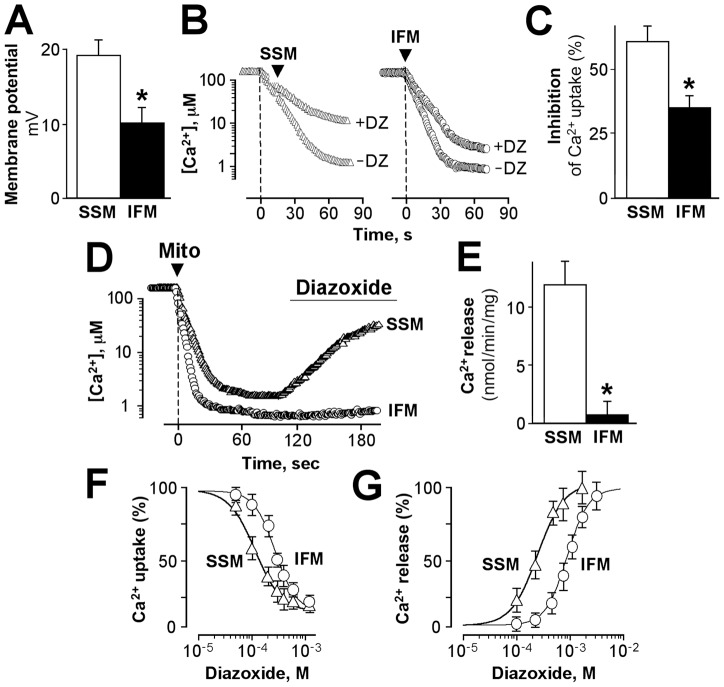
Mitochondrial subpopulations were freshly isolated from rat ventricles and their morphologies assessed by electron microscopy and enzymatic activities determined using standard biochemical protocols with a plate reader. Oxidative phosphorylation was assessed from State 3 respiration using succinate as a substrate. Calcium dynamics and the status of Ca²⁺-dependent mitochondrial permeability transition (MPT) pore and mitochondrial membrane potential were assessed using standard Ca²⁺ and TPP⁺ ion-selective electrodes.
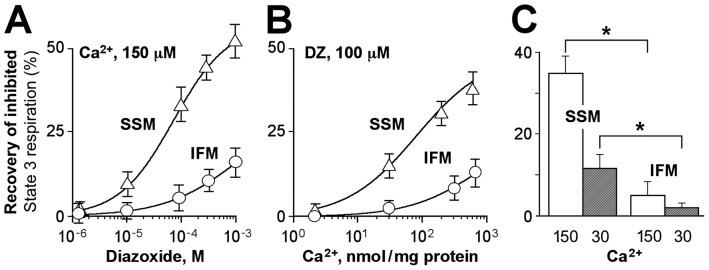
Compared to IFM, isolated SSM exhibited a higher sensitivity to Ca²⁺ overload-mediated inhibition of adenosine triphosphate (ATP) synthesis with decreased ATP production (from 375±25 to 83±15 nmol ATP/min/mg protein in SSM, and from 875±39 to 583±45 nmol ATP/min/mg protein in IFM). In addition, SSM exhibited reduced Ca²⁺-accumulating capacity as compared to IFM (230±13 vs. 450±46 nmol Ca²⁺/mg protein in SSM and IFM, respectively), suggestive of increased Ca²⁺ sensitivity of MPT pore opening. Despite enhanced susceptibility to stress, SSM were more responsive to the protective effect of diazoxide (100 μM) against Ca²⁺ overload-mediated inhibition of ATP synthesis (67% vs. 2% in SSM and IFM, respectively).
These results provide evidence for the distinct sensitivity of cardiac SSM and IFM toward Ca²⁺-dependent metabolic stress and the protective effect of diazoxide on mitochondrial energetics.
心肌亚肌纤维(SSM)和纤维间(IFM)线粒体亚群具有不同的生化特性,在其蛋白质和脂质组成、呼吸和蛋白质合成能力以及对代谢挑战的敏感性方面存在差异,但它们对具有线粒体活性的心脏保护治疗的反应性尚未得到描述。本研究评估了两种线粒体亚群对靶向线粒体的心脏保护剂二氮嗪的不同反应性。
使用电子显微镜评估线粒体亚群的形态,并使用标准生化方案和板读数器确定其酶活性。使用琥珀酸作为底物,通过状态 3 呼吸评估氧化磷酸化。使用标准 Ca²⁺和 TPP⁺离子选择性电极评估 Ca²⁺动力学和 Ca²⁺依赖性线粒体通透性转换(MPT)孔和线粒体膜电位的状态。
与 IFM 相比,分离的 SSM 对 Ca²⁺超负荷介导的三磷酸腺苷(ATP)合成抑制更为敏感,导致 ATP 生成减少(在 SSM 中从 375±25 降至 83±15 nmol ATP/min/mg 蛋白,在 IFM 中从 875±39 降至 583±45 nmol ATP/min/mg 蛋白)。此外,与 IFM 相比,SSM 表现出降低的 Ca²⁺积累能力(在 SSM 和 IFM 中分别为 230±13 和 450±46 nmol Ca²⁺/mg 蛋白),提示 MPT 孔开放的 Ca²⁺敏感性增加。尽管应激易感性增加,但 SSM 对二氮嗪(100 μM)对 Ca²⁺超负荷介导的 ATP 合成抑制的保护作用更敏感(在 SSM 和 IFM 中分别为 67%和 2%)。
这些结果为心肌 SSM 和 IFM 对 Ca²⁺依赖性代谢应激的不同敏感性以及二氮嗪对线粒体能量学的保护作用提供了证据。