Department of Veterinary Pathobiology, Texas A&M University, College Station TX, USA.
Front Cell Infect Microbiol. 2012 Sep 7;2:115. doi: 10.3389/fcimb.2012.00115. eCollection 2012.
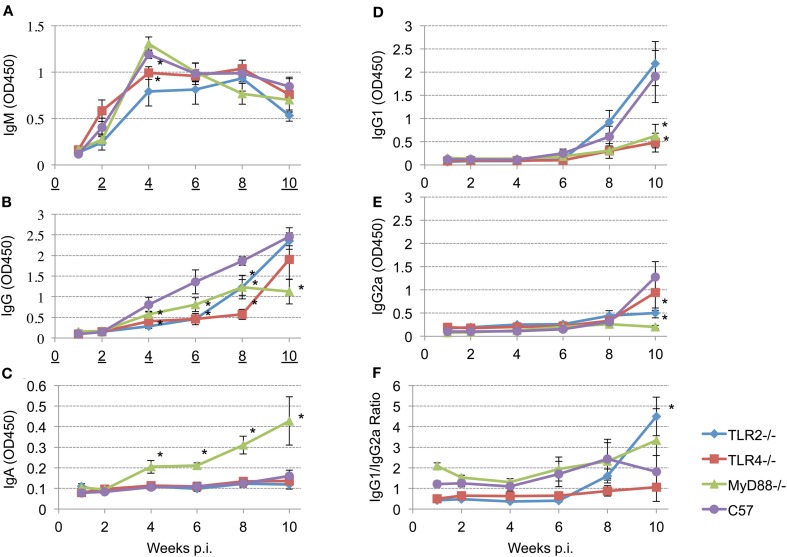
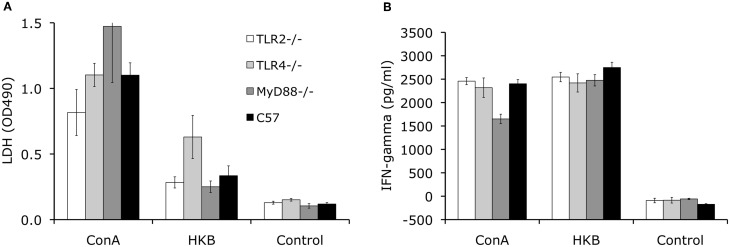
Brucella spp. cause undulant fever in humans and brucellosis in variety of other animals. Both innate and adaptive immunity have been shown to be important in controlling Brucella infection. Toll-like receptors (TLRs) represent a group of pattern recognition receptors (PRRs) that play critical roles in the host innate immune response, as well as development of adaptive immunity. In the current report, we investigated the role of TLR signaling in the clearance of Brucella and development of adaptive immunity in TLR2(-/-), TLR4(-/-), or MyD88(-/-) mice following aerosol exposure to B. melitensis 16 M. Consistent with previous reports, MyD88 is required for efficient clearance of Brucella from all three organs (lung, spleen, and liver). The results reveal Th2-skewed immune responses in TLR2(-/-) mice late in infection and support a TLR2 requirement for efficient clearance of Brucella from the lungs, but not from the spleen or liver. Similarly, TLR4 is required for efficient clearance of Brucella from the lung, but exhibits a minor contribution to clearance from the spleen and no demonstrable contribution to clearance from the liver. Lymphocyte proliferation assays suggest that the TLRs are not involved in the development of cell-mediated memory response to Brucella antigen. Antibody detection reveals that TLR2 and 4 are required to generate early antigen-specific IgG, but not during the late stages of infection. TLR2 and 4 are only transiently required for IgM production and not at all for IgA production. In contrast, MyD88 is essential for antigen specific IgG production late in infection, but is not required for IgM generation over the course of infection. Surprisingly, despite the prominent role for MyD88 in clearance from all tissues, MyD88-knockout mice express significantly higher levels of serum IgA. These results confirm the important role of MyD88 in controlling infection in the spleen while providing evidence of a prominent contribution to protection in other tissues. In addition, although TLR4 and TLR2 contribute little to control of spleen infection, a significant contribution to clearance of lung infection is described.
布鲁氏菌属引起人类波浪热和多种其他动物的布鲁氏菌病。先天免疫和适应性免疫都被证明在控制布鲁氏菌感染中很重要。Toll 样受体 (TLR) 是一组模式识别受体 (PRR),在宿主固有免疫反应以及适应性免疫的发展中起着关键作用。在本报告中,我们研究了 TLR 信号在 TLR2(-/-)、TLR4(-/-)或 MyD88(-/-) 小鼠气溶胶暴露于 B. melitensis 16 M 后清除布鲁氏菌和适应性免疫发展中的作用。与之前的报道一致,MyD88 是从所有三个器官 (肺、脾和肝) 中有效清除布鲁氏菌所必需的。结果表明,TLR2(-/-) 小鼠在感染后期表现出 Th2 偏向性免疫反应,并支持 TLR2 对从肺部有效清除布鲁氏菌的要求,但对从脾脏或肝脏清除则没有要求。同样,TLR4 是从肺部有效清除布鲁氏菌所必需的,但对从脾脏清除则贡献较小,对从肝脏清除则没有表现出贡献。淋巴细胞增殖试验表明,TLR 不参与布鲁氏菌抗原的细胞介导记忆反应的发展。抗体检测表明,TLR2 和 4 是产生早期抗原特异性 IgG 所必需的,但在感染后期则不需要。TLR2 和 4 仅短暂地需要 IgM 产生,而完全不需要 IgA 产生。相比之下,MyD88 是感染后期抗原特异性 IgG 产生所必需的,但在整个感染过程中都不需要 IgM 生成。令人惊讶的是,尽管 MyD88 在所有组织中的清除作用显著,但 MyD88 敲除小鼠的血清 IgA 水平明显升高。这些结果证实了 MyD88 在控制脾脏感染中的重要作用,同时提供了在其他组织中保护作用的显著贡献的证据。此外,尽管 TLR4 和 TLR2 对控制脾脏感染的贡献很小,但描述了对肺部感染清除的显著贡献。