Centre for Research on Inner City Health, The Keenan Research Centre in the Li Ka Shing Knowledge Institute of St, Michael's Hospital, 30 Bond Street, Toronto, Ontario M5B 1W8, Canada.
BMC Public Health. 2012 Sep 14;12:787. doi: 10.1186/1471-2458-12-787.
The At Home/Chez Soi (AH/CS) Project is a randomized controlled trial of a Housing First intervention to meet the needs of homeless individuals with mental illness in five cities across Canada. The objectives of this paper are to examine the approach to participant recruitment and community engagement at the Toronto site of the AH/CS Project, and to describe the baseline demographics of participants in Toronto.
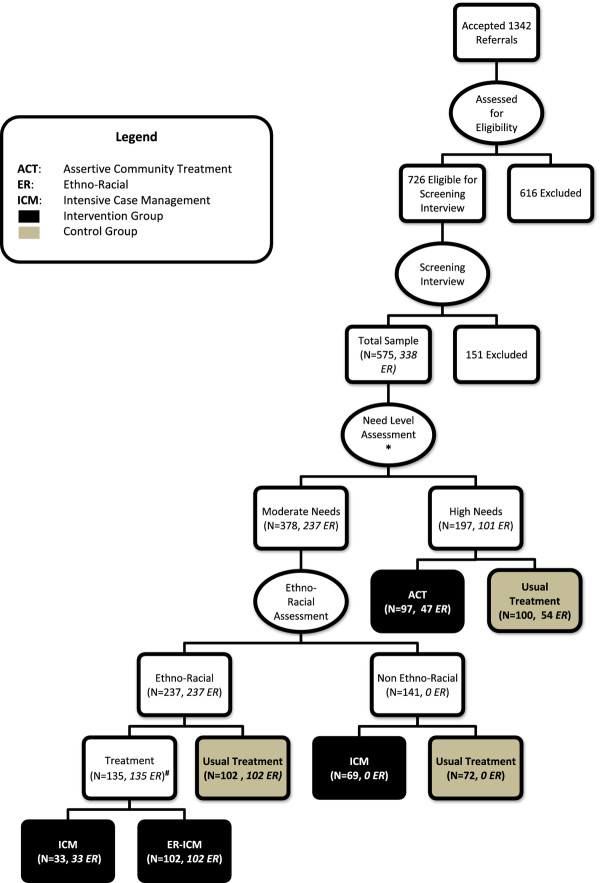
Homeless individuals (n = 575) with either high needs (n = 197) or moderate needs (n = 378) for mental health support were recruited through service providers in the city of Toronto. Participants were randomized to Housing First interventions or Treatment as Usual (control) groups. Housing First interventions were offered at two different mental health service delivery levels: Assertive Community Treatment for high needs participants and Intensive Case Management for moderate needs participants. Demographic data were collected via quantitative questionnaires at baseline interviews.
The effectiveness of the recruitment strategy was influenced by a carefully designed referral system, targeted recruitment of specific groups, and an extensive network of pre-existing services. Community members, potential participants, service providers, and other stakeholders were engaged through active outreach and information sessions. Challenges related to the need for different sectors to work together were resolved through team building strategies. Randomization produced similar demographic, mental health, cognitive and functional impairment characteristics in the intervention and control groups for both the high needs and moderate needs groups. The majority of participants were male (69%), aged >40 years (53%), single/never married (69%), without dependent children (71%), born in Canada (54%), and non-white (64%). Many participants had substance dependence (38%), psychotic disorder (37%), major depressive episode (36%), alcohol dependence (29%), post-traumatic stress disorder (PTSD) (23%), and mood disorder with psychotic features (21%). More than two-thirds of the participants (65%) indicated some level of suicidality.
Recruitment at the Toronto site of AH/CS project produced a sample of participants that reflects the diverse demographics of the target population. This study will provide much needed data on how to best address the issue of homelessness and mental illness in Canada.
“居家/安家(AH/CS)项目”是一项针对住房优先干预措施的随机对照试验,旨在满足加拿大五个城市无家可归的精神病患者的需求。本文的目的是探讨多伦多 AH/CS 项目的参与者招募和社区参与方法,并描述多伦多参与者的基线人口统计学特征。
通过多伦多市的服务提供商,招募了 575 名有高需求(197 名)或中需求(378 名)精神健康支持需求的无家可归者。参与者被随机分配到住房优先干预组或常规治疗(对照组)组。住房优先干预措施在两个不同的精神卫生服务提供水平上提供:高需求参与者提供积极社区治疗,中需求参与者提供强化个案管理。通过基线访谈的定量问卷收集人口统计学数据。
精心设计的转诊系统、有针对性地招募特定群体以及广泛的现有服务网络影响了招募策略的有效性。通过积极的外展和信息会议,让社区成员、潜在参与者、服务提供者和其他利益攸关方参与进来。需要不同部门合作的挑战通过团队建设策略得到解决。对于高需求和中需求组的干预组和对照组,随机分组产生了相似的人口统计学、心理健康、认知和功能障碍特征。大多数参与者为男性(69%),年龄>40 岁(53%),单身/未婚(69%),无子女(71%),在加拿大出生(54%),非白人(64%)。许多参与者有物质依赖(38%)、精神病性障碍(37%)、重性抑郁发作(36%)、酒精依赖(29%)、创伤后应激障碍(23%)和心境障碍伴精神病性特征(21%)。超过三分之二的参与者(65%)表示有一定程度的自杀意念。
多伦多 AH/CS 项目的招募工作产生了一个反映目标人群多样化人口统计学特征的参与者样本。本研究将提供有关如何在加拿大最好地解决无家可归和精神疾病问题的急需数据。