Department of Medicine, Division of Hematology and Medical Oncology, Weill Medical College of Cornell University, New York, NY 10065, USA.
Eur Urol. 2013 May;63(5):920-6. doi: 10.1016/j.eururo.2012.08.053. Epub 2012 Sep 5.
Most personalized cancer care strategies involving DNA sequencing are highly reliant on acquiring sufficient fresh or frozen tissue. It has been challenging to comprehensively evaluate the genome of advanced prostate cancer (PCa) because of limited access to metastatic tissue.
To demonstrate the feasibility of a novel next-generation sequencing (NGS)-based platform that can be used with archival formalin-fixed paraffin-embedded (FFPE) biopsy tissue to evaluate the spectrum of DNA alterations seen in advanced PCa.
DESIGN, SETTING, AND PARTICIPANTS: FFPE samples (including archival prostatectomies and prostate needle biopsies) were obtained from 45 patients representing the spectrum of disease: localized PCa, metastatic hormone-naive PCa, and metastatic castration-resistant PCa (CRPC). We also assessed paired primaries and metastases to understand disease heterogeneity and disease progression.
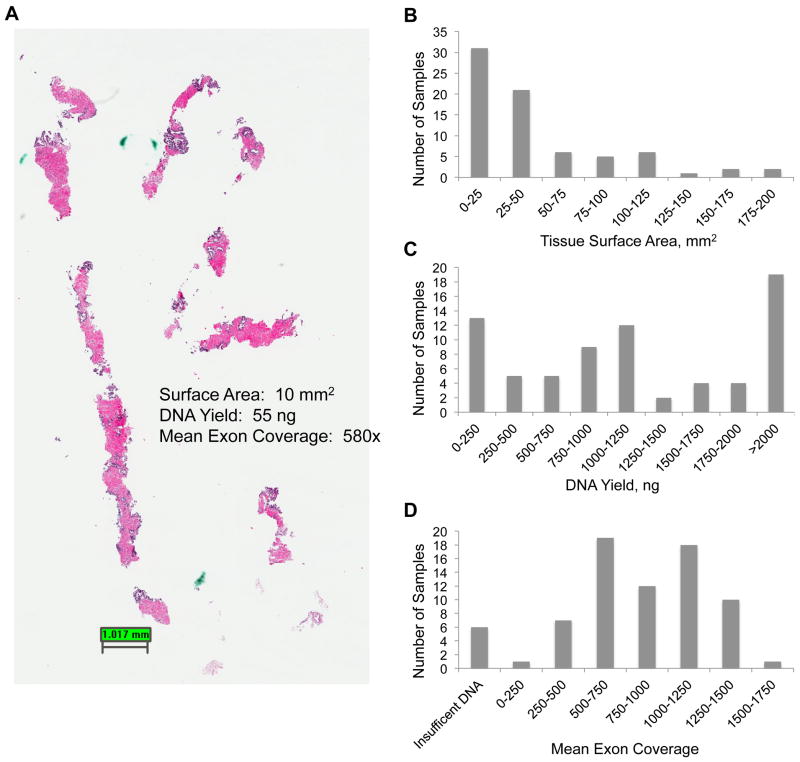
At least 50 ng of tumor DNA was extracted from FFPE samples and used for hybridization capture and NGS using the Illumina HiSeq 2000 platform.
A total of 3320 exons of 182 cancer-associated genes and 37 introns of 14 commonly rearranged genes were evaluated for genomic alterations.
We obtained an average sequencing depth of >900X. Overall, 44% of CRPCs harbored genomic alterations involving the androgen receptor gene (AR), including AR copy number gain (24% of CRPCs) or AR point mutation (20% of CRPCs). Other recurrent mutations included transmembrane protease, serine 2 gene (TMPRSS2):v-ets erythroblastosis virus E26 oncogene homolog (avian) gene (ERG) fusion (44%); phosphatase and tensin homolog gene (PTEN) loss (44%); tumor protein p53 gene (TP53) mutation (40%); retinoblastoma gene (RB) loss (28%); v-myc myelocytomatosis viral oncogene homolog (avian) gene (MYC) gain (12%); and phosphatidylinositol-4,5-bisphosphate 3-kinase, catalytic subunit α gene (PIK3CA) mutation (4%). There was a high incidence of genomic alterations involving key genes important for DNA repair, including breast cancer 2, early onset gene (BRCA2) loss (12%) and ataxia telangiectasia mutated gene (ATM) mutations (8%); these alterations are potentially targetable with poly(adenosine diphosphate-ribose)polymerase inhibitors. A novel and actionable rearrangement involving the v-raf murine sarcoma viral oncogene homolog B1 gene (BRAF) was also detected.
This first-in-principle study demonstrates the feasibility of performing in-depth DNA analyses using FFPE tissue and brings new insight toward understanding the genomic landscape within advanced PCa.
大多数涉及 DNA 测序的个性化癌症治疗策略都高度依赖于获取足够的新鲜或冷冻组织。由于难以全面评估转移性组织中的晚期前列腺癌(PCa)的基因组,因此具有一定的挑战性。
展示一种新型基于下一代测序(NGS)的平台的可行性,该平台可与存档的福尔马林固定石蜡包埋(FFPE)活检组织一起使用,以评估在晚期 PCa 中看到的 DNA 改变谱。
设计、地点和参与者:从代表疾病谱的 45 名患者中获得 FFPE 样本(包括局部 PCa、转移性去势治疗前 PCa 和转移性去势抵抗性 PCa(CRPC))。我们还评估了配对的原发性和转移性肿瘤,以了解疾病异质性和疾病进展。
从 FFPE 样本中提取至少 50ng 的肿瘤 DNA,并使用 Illumina HiSeq 2000 平台进行杂交捕获和 NGS。
共评估了 182 个癌症相关基因的 3320 个外显子和 14 个常见重排基因的 37 个内含子的基因组改变。
我们获得了平均测序深度> 900X。总体而言,44%的 CRPC 存在涉及雄激素受体(AR)基因的基因组改变,包括 AR 拷贝数增加(24%的 CRPC)或 AR 点突变(20%的 CRPC)。其他高频突变包括跨膜蛋白酶,丝氨酸 2 基因(TMPRSS2):v-ets 红细胞增多病毒 E26 癌基因同源物(禽)基因(ERG)融合(44%);磷酸酶和张力蛋白同源物基因(PTEN)缺失(44%);肿瘤蛋白 p53 基因(TP53)突变(40%);视网膜母细胞瘤基因(RB)缺失(28%);v-myc 髓性白血病病毒癌基因同源物(禽)基因(MYC)获得(12%);和磷脂酰肌醇-4,5-二磷酸 3-激酶,催化亚基α基因(PIK3CA)突变(4%)。涉及参与 DNA 修复的关键基因的基因组改变的发生率很高,包括乳腺癌 2,早发基因(BRCA2)缺失(12%)和共济失调毛细血管扩张突变基因(ATM)突变(8%);这些改变可能通过聚(腺苷二磷酸核糖)聚合酶抑制剂靶向。还检测到涉及 v-raf 鼠肉瘤病毒癌基因同源物 B1 基因(BRAF)的新型和可操作的重排。
这项初步研究首次证明了使用 FFPE 组织进行深入 DNA 分析的可行性,并为了解晚期 PCa 中的基因组景观提供了新的见解。