Department of Pathophysiology and Allergy Research, Medical University of Vienna, Währinger Gürtel 18-20, 1090 Vienna, Austria.
J Steroid Biochem Mol Biol. 2013 Jul;136:284-8. doi: 10.1016/j.jsbmb.2012.09.003. Epub 2012 Sep 11.
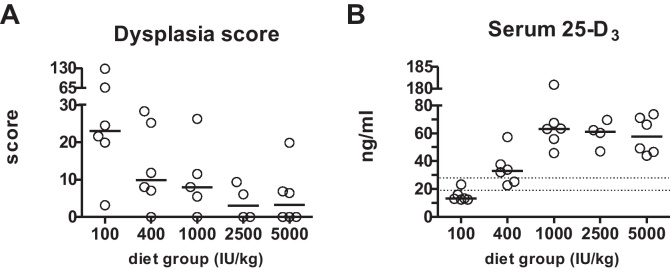
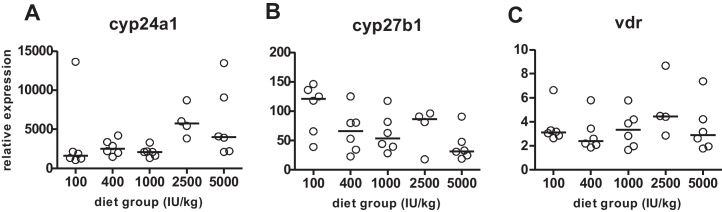
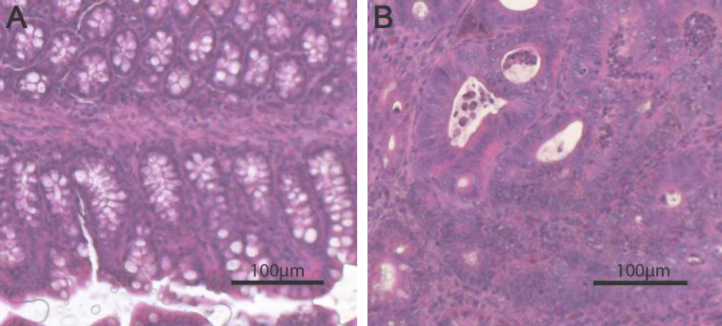
Colorectal cancer (CRC) is one of the leading causes of cancer morbidity and mortality in Western countries. One of the risk factors for colorectal tumorigenesis is vitamin D insufficiency. The aim of this study was to establish whether increasing dietary vitamin D intake can prevent or delay development of chemically induced preneoplastic lesions in the colon of mice. We fed six weeks old female C57BL/6J mice (n=28) with increasing vitamin D3 concentrations (100, 400, 1000, 2500, 5000IU/kg diet). To induce dysplasia, a preneoplastic lesion, we injected mice with the carcinogen azoxymethane (10mg/kg) intraperitoneally, followed by three cycles of 2% dextran sodium sulfate salt, a tumor promoter, in the drinking water. To test our hypothesis that high vitamin D intake prevents formation of preneoplastic lesions, we have investigated the effect of increasing dietary vitamin D on development of premalignant colorectal lesions, serum 25-hydroxyvitamin D3 (25-D3) levels, and expression of renal vitamin D system genes. Dietary vitamin D concentration correlated inversely with dysplasia score (Spearman's correlation coefficient, ρ: -0.579, p=0.002) and positively with serum 25-D3 levels (ρ: 0.752, p=0.001). Increasing dietary vitamin D concentration beyond 1000IU/kg led to no further increase in circulating 25-D3 levels, while the dysplasia score leveled out at ≥2500IU/kg vitamin D. High dietary vitamin D intake led to increased renal mRNA expression of the vitamin D catabolizing enzyme cyp24a1 (ρ: 0.518, p=0.005) and decreased expression of the vitamin D activating enzyme cyp27b1 (ρ: -0.452, p=0.016), protecting the body from toxic serum levels of the active vitamin D metabolite 1,25-dihydroxyvitamin D3 (1,25-D3). Our data showed that increasing dietary vitamin D intake is able to prevent chemically induced preneoplastic lesions. The maximum impact was achieved when the mice consumed more than 2500IU vitamin D/kg diet. This article is part of a Special Issue entitled 'Vitamin D Workshop'.
结直肠癌(CRC)是西方国家癌症发病率和死亡率的主要原因之一。结直肠肿瘤发生的危险因素之一是维生素 D 不足。本研究旨在确定增加膳食维生素 D 摄入是否可以预防或延迟化学诱导的小鼠结肠前肿瘤病变的发展。我们用递增浓度的维生素 D3(100、400、1000、2500、5000IU/kg 饮食)喂养六周龄雌性 C57BL/6J 小鼠(n=28)。为了诱导发育不良,即前肿瘤病变,我们通过腹腔内注射致癌剂氧化偶氮甲烷(10mg/kg),然后在饮用水中给予三个周期的 2%葡聚糖硫酸钠盐,一种肿瘤促进剂。为了验证我们的假设,即高维生素 D 摄入可预防前肿瘤病变的形成,我们研究了增加饮食维生素 D 对发展前结直肠病变、血清 25-羟维生素 D3(25-D3)水平和肾脏维生素 D 系统基因表达的影响。饮食维生素 D 浓度与发育不良评分呈负相关(Spearman 相关系数,ρ:-0.579,p=0.002),与血清 25-D3 水平呈正相关(ρ:0.752,p=0.001)。饮食维生素 D 浓度增加到 1000IU/kg 以上不会导致循环 25-D3 水平进一步增加,而发育不良评分在≥2500IU/kg 维生素 D 时趋于平稳。高饮食维生素 D 摄入导致维生素 D 分解代谢酶 cyp24a1 的肾脏 mRNA 表达增加(ρ:0.518,p=0.005),而维生素 D 激活酶 cyp27b1 的表达减少(ρ:-0.452,p=0.016),从而保护身体免受活性维生素 D 代谢物 1,25-二羟基维生素 D3(1,25-D3)的毒性血清水平的影响。我们的数据表明,增加膳食维生素 D 摄入能够预防化学诱导的前肿瘤病变。当小鼠摄入超过 2500IU 维生素 D/kg 饮食时,效果最佳。本文是特刊“维生素 D 研讨会”的一部分。