MRC Clinical Trials Unit, Aviation House, 125 Kingsway, London WC2B 6NH, UK.
BMJ. 2012 Sep 14;345:e5840. doi: 10.1136/bmj.e5840.
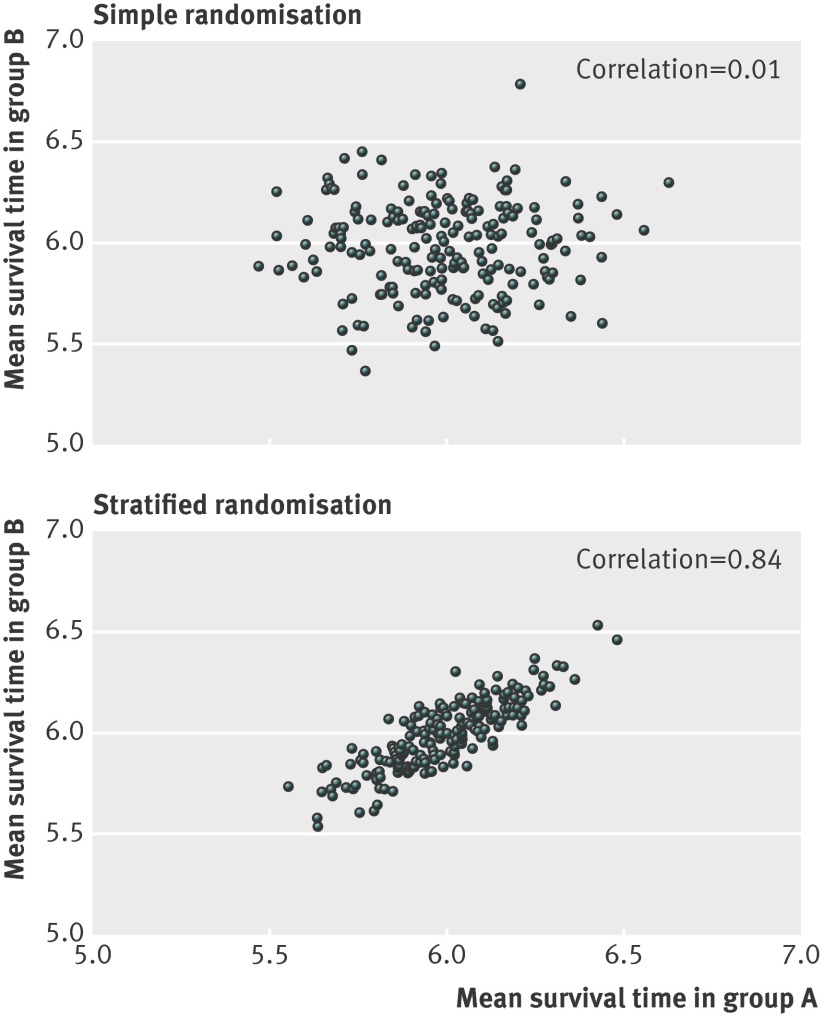
To assess how often stratified randomisation is used, whether analysis adjusted for all balancing variables, and whether the method of randomisation was adequately reported, and to reanalyse a previously reported trial to assess the impact of ignoring balancing factors in the analysis.
Review of published trials and reanalysis of a previously reported trial.
Four leading general medical journals (BMJ, Journal of the American Medical Association, Lancet, and New England Journal of Medicine) and the second Multicenter Intrapleural Sepsis Trial (MIST2).
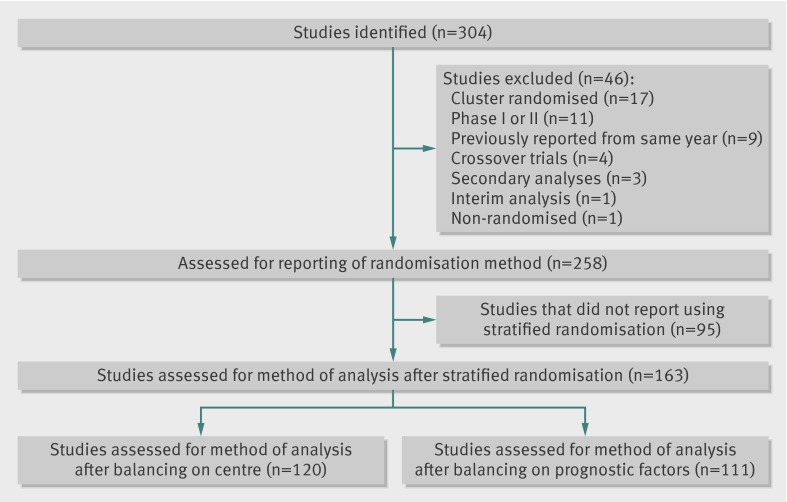
258 trials published in 2010 in the four journals. Cluster randomised, crossover, non-randomised, single arm, and phase I or II trials were excluded, as were trials reporting secondary analyses, interim analyses, or results that had been previously published in 2010.
Whether the method of randomisation was adequately reported, how often balanced randomisation was used, and whether balancing factors were adjusted for in the analysis.
Reanalysis of MIST2 showed that an unadjusted analysis led to larger P values and a loss of power. The review of published trials showed that balanced randomisation was common, with 163 trials (63%) using at least one balancing variable. The most common methods of balancing were stratified permuted blocks (n=85) and minimisation (n=27). The method of randomisation was unclear in 37% of trials. Most trials that balanced on centre or prognostic factors were not adequately analysed; only 26% of trials adjusted for all balancing factors in their primary analysis. Trials that did not adjust for balancing factors in their analysis were less likely to show a statistically significant result (unadjusted 57% v adjusted 78%, P=0.02).
Balancing on centre or prognostic factors is common in trials but often poorly described, and the implications of balancing are poorly understood. Trialists should adjust their primary analysis for balancing factors to obtain correct P values and confidence intervals and to avoid an unnecessary loss in power.
评估分层随机化的使用频率、分析是否调整了所有平衡变量,以及随机化方法是否得到充分报告,并重新分析先前报告的试验,以评估在分析中忽略平衡因素的影响。
已发表试验的回顾和先前报告试验的重新分析。
四本主要的普通医学期刊(《英国医学杂志》、《美国医学会杂志》、《柳叶刀》和《新英格兰医学杂志》)和第二多中心胸腔内感染试验(MIST2)。
2010 年在这四本期刊上发表的 258 项试验。排除了集群随机化、交叉、非随机化、单臂和 I 期或 II 期试验,以及报告次要分析、中期分析或 2010 年已发表结果的试验。
随机化方法是否得到充分报告、平衡随机化的使用频率,以及分析中是否调整了平衡因素。
对 MIST2 的重新分析表明,未经调整的分析导致 P 值更大且失去效力。对已发表试验的回顾表明,平衡随机化很常见,有 163 项试验(63%)使用了至少一个平衡变量。最常见的平衡方法是分层随机区组(n=85)和最小化(n=27)。37%的试验中随机化方法不明确。大多数在中心或预后因素上进行平衡的试验未得到充分分析;只有 26%的试验在其主要分析中调整了所有平衡因素。在分析中未调整平衡因素的试验不太可能显示统计学上显著的结果(未调整为 57%,调整为 78%,P=0.02)。
在试验中,以中心或预后因素进行平衡很常见,但通常描述不足,且平衡的影响理解不足。试验者应在主要分析中调整平衡因素,以获得正确的 P 值和置信区间,并避免不必要的效力损失。