Department of Biomedical Engineering, Cornell University, Ithaca, New York, United States of America.
PLoS One. 2012;7(9):e44639. doi: 10.1371/journal.pone.0044639. Epub 2012 Sep 11.
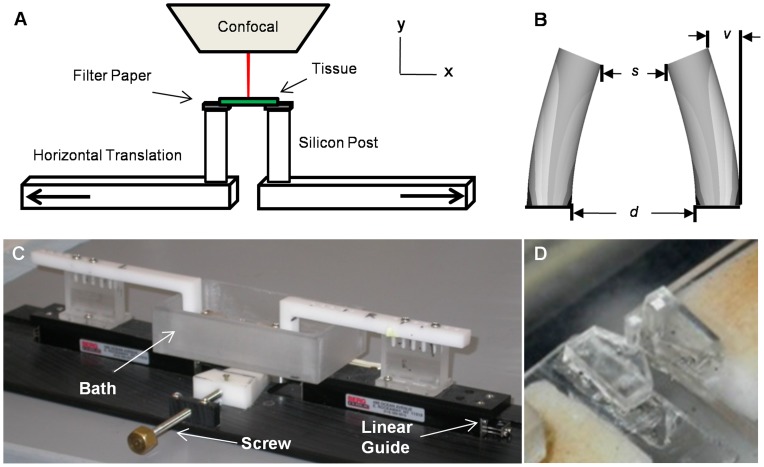
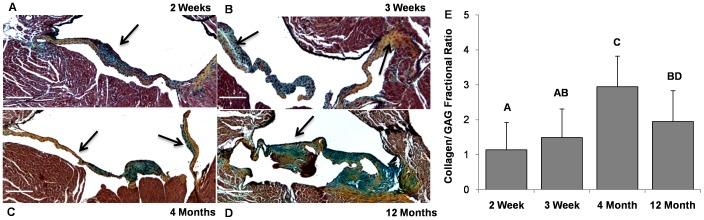
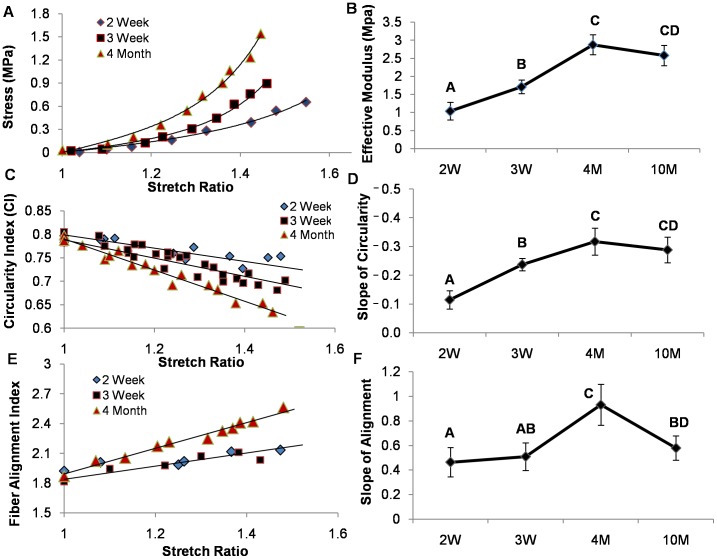
Mitral valve degeneration is a key component of the pathophysiology of Marfan syndrome. The biomechanical consequences of aging and genetic mutation in mitral valves are poorly understood because of limited tools to study this in mouse models. Our aim was to determine the global biomechanical and local cell-matrix deformation relationships in the aging and Marfan related Fbn1 mutated murine mitral valve. To conduct this investigation, a novel stretching apparatus and gripping method was implemented to directly quantify both global tissue biomechanics and local cellular deformation and matrix fiber realignment in murine mitral valves. Excised mitral valve leaflets from wild-type and Fbn1 mutant mice from 2 weeks to 10 months in age were tested in circumferential orientation under continuous laser optical imaging. Mouse mitral valves stiffen with age, correlating with increases in collagen fraction and matrix fiber alignment. Fbn1 mutation resulted in significantly more compliant valves (modulus 1.34 ± 0.12 vs. 2.51 ± 0.31 MPa, respectively, P<.01) at 4 months, corresponding with an increase in proportion of GAGs and decrease in elastin fraction. Local cellular deformation and fiber alignment change linearly with global tissue stretch, and these slopes become more extreme with aging. In comparison, Fbn1 mutated valves have decoupled cellular deformation and fiber alignment with tissue stretch. Taken together, quantitative understanding of multi-scale murine planar tissue biomechanics is essential for establishing consequences of aging and genetic mutations. Decoupling of local cell-matrix deformation kinematics with global tissue stretch may be an important mechanism of normal and pathological biomechanical remodeling in valves.
二尖瓣退行性变是马凡综合征病理生理学的一个关键组成部分。由于缺乏研究小鼠模型中二尖瓣的工具,因此对二尖瓣衰老和基因突变的生物力学后果了解甚少。我们的目的是确定衰老和马凡相关 Fbn1 突变的小鼠二尖瓣的整体生物力学和局部细胞-基质变形关系。为了进行这项研究,我们采用了一种新的拉伸装置和夹持方法,直接定量测量了小鼠二尖瓣的整体组织生物力学和局部细胞变形以及基质纤维重新排列。从 2 周龄到 10 月龄的野生型和 Fbn1 突变型小鼠的离体二尖瓣叶以环向取向在连续激光光学成像下进行测试。随着年龄的增长,小鼠二尖瓣变硬,这与胶原蛋白分数和基质纤维排列的增加有关。Fbn1 突变导致瓣膜明显更柔顺(分别为 1.34 ± 0.12 和 2.51 ± 0.31 MPa,P<.01),这与 GAG 比例增加和弹性蛋白分数减少有关。局部细胞变形和纤维排列与整体组织拉伸呈线性变化,随着年龄的增长,这些斜率变得更加极端。相比之下,Fbn1 突变的瓣膜与组织拉伸的细胞变形和纤维排列脱耦。总之,定量理解多尺度小鼠平面组织生物力学对于确定衰老和遗传突变的后果至关重要。局部细胞-基质变形运动与整体组织拉伸的解耦可能是瓣膜正常和病理生物力学重塑的一个重要机制。