Department of Neuroscience and Center for Neurovirology Temple University School of Medicine, Philadelphia, Pennsylvania, United States of America.
PLoS One. 2012;7(9):e45000. doi: 10.1371/journal.pone.0045000. Epub 2012 Sep 12.
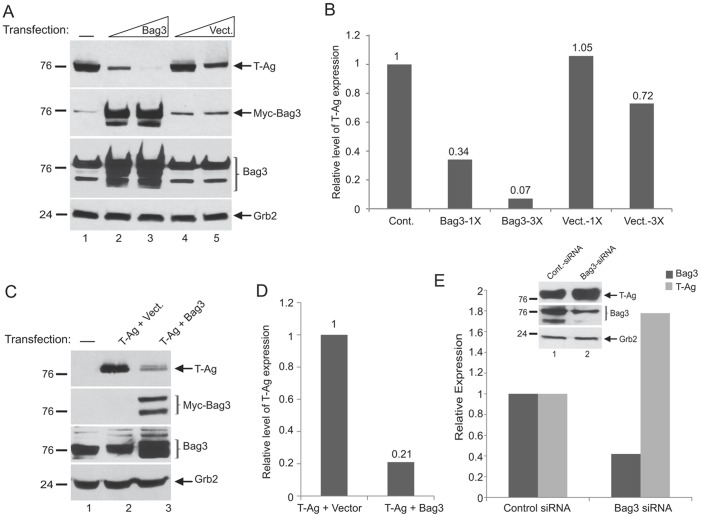
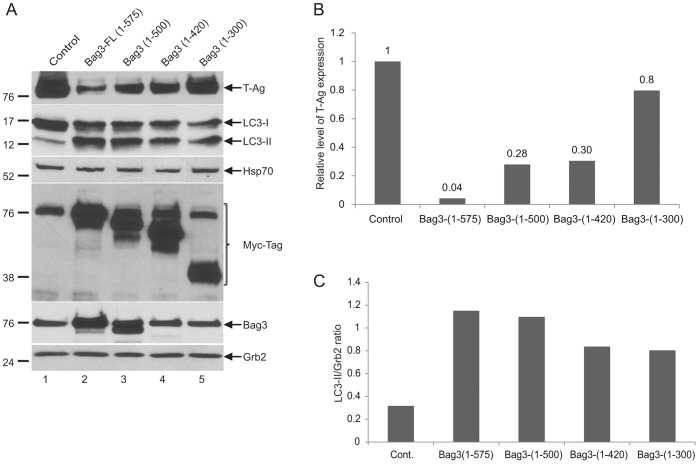
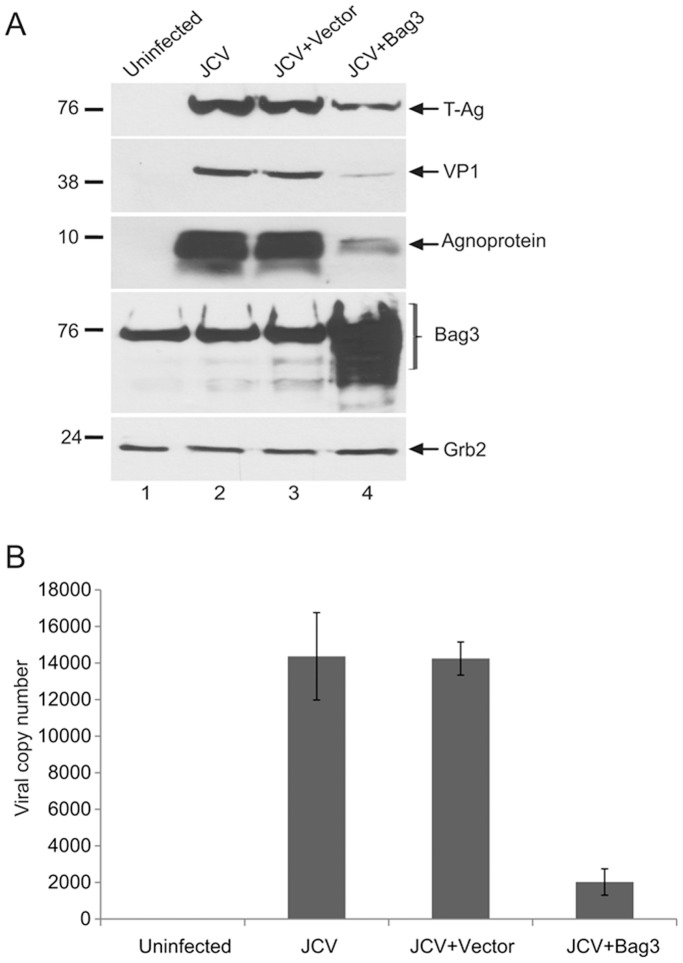
JC virus, JCV, is a human neurotropic polyomavirus whose replication in glial cells causes the fatal demyelinating disease progressive multifocal leukoencephalopathy (PML). In addition, JCV possesses oncogenic activity and expression of its transforming protein, large T-antigen (T-Ag), in several experimental animals induces tumors of neural origin. Further, the presence of JCV DNA and T-Ag have been repeatedly observed in several human malignant tissues including primitive neuroectodermal tumors and glioblastomas. Earlier studies have demonstrated that Bag3, a member of the Bcl-2-associated athanogene (Bag) family of proteins, which is implicated in autophagy and apoptosis, is downregulated upon JCV infection of glial cells and that JCV T-Ag is responsible for suppressing the activity of the BAG3 promoter. Here, we investigated the possible impact of Bag3 on T-Ag expression in JCV-infected human primary glial cells as well as in cells derived from T-Ag-induced medulloblastoma in transgenic animals. Results from these studies revealed that overexpression of Bag3 drastically decreases the level of T-Ag expression by inducing the autophagic degradation of the viral protein. Interestingly, this event leads to the inhibition of JCV infection of glial cells, suggesting that the reduced levels of T-antigen seen upon the overexpression of Bag3 has a biological impact on the viral lytic cycle. Results from protein-protein interaction studies showed that T-Ag and Bag3 physically interact with each other through the zinc-finger of T-Ag and the proline rich domains of Bag3, and this interaction is important for the autophagic degradation of T-Ag. Our observations open a new avenue of research for better understanding of virus-host interaction by investigating the interplay between T-Ag and Bag3, and their impact on the development of JCV-associated diseases.
JC 病毒(JCV)是一种人类神经嗜性多瘤病毒,其在神经胶质细胞中的复制会导致致命的脱髓鞘疾病——进行性多灶性白质脑病(PML)。此外,JCV 具有致癌活性,其转化蛋白大 T 抗原(T-Ag)在几种实验动物中的表达会诱导神经源性肿瘤。此外,JCV DNA 和 T-Ag 已在包括原始神经外胚层肿瘤和神经胶质母细胞瘤在内的几种人类恶性组织中反复观察到。早期研究表明,Bag3 是 Bcl-2 相关抗凋亡基因(Bag)家族的成员之一,该蛋白参与自噬和细胞凋亡,在 JCV 感染神经胶质细胞后下调,而 JCV T-Ag 负责抑制 BAG3 启动子的活性。在这里,我们研究了 Bag3 对 JCV 感染的人原代神经胶质细胞以及转基因动物中 T-Ag 诱导的髓母细胞瘤衍生细胞中 T-Ag 表达的可能影响。这些研究的结果表明,Bag3 的过表达通过诱导病毒蛋白的自噬降解,显著降低 T-Ag 的表达水平。有趣的是,这一事件导致 JCV 对神经胶质细胞的感染受到抑制,这表明 Bag3 过表达时 T 抗原水平的降低对病毒裂解周期有生物学影响。蛋白质-蛋白质相互作用研究的结果表明,T-Ag 和 Bag3 通过 T-Ag 的锌指和 Bag3 的富含脯氨酸结构域相互作用,这种相互作用对于 T-Ag 的自噬降解很重要。我们的观察结果为通过研究 T-Ag 和 Bag3 之间的相互作用及其对 JCV 相关疾病发展的影响,更好地了解病毒-宿主相互作用开辟了一条新的研究途径。