Department of Surgery, University of California, 1600 Divisadero Street, Box 1711, San Francisco, CA 94115, USA.
World J Surg Oncol. 2012 Sep 17;10:192. doi: 10.1186/1477-7819-10-192.
To compare outcomes for patients with recurrent or persistent papillary thyroid cancer (PTC) who had metastatic tumors that were fluorodeoxyglucose-positron emission tomography (FDG-PET) positive or negative, and to determine whether the FDG-PET scan findings changed the outcome of medical and surgical management.
From a prospective thyroid cancer database, we retrospectively identified patients with recurrent or persistent PTC and reviewed data on demographics, initial stage, location and extent of persistent or recurrent disease, clinical management, disease-free survival and outcome. We further identified subsets of patients who had an FDG-PET scan or an FDG-PET/CT scan and whole-body radioactive iodine scans and categorized them by whether they had one or more FDG-PET-avid (PET-positive) lesions or PET-negative lesions. The medical and surgical treatments and outcome of these patients were compared.
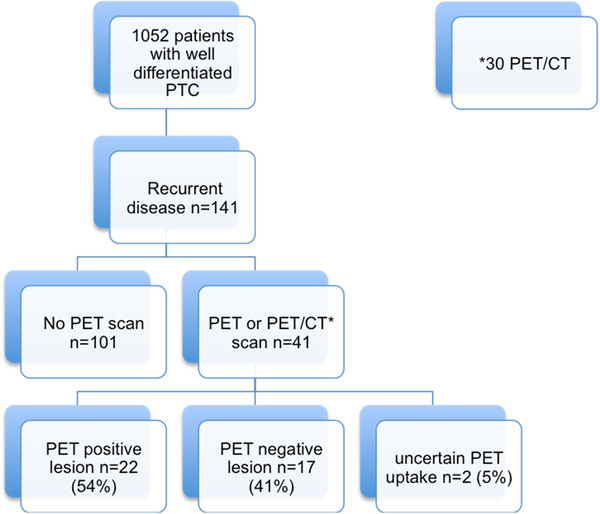
Between 1984 and 2008, 41 of 141 patients who had recurrent or persistent PTC underwent FDG-PET (n = 11) or FDG-PET/CT scans (n = 30); 22 patients (54%) had one or more PET-positive lesion(s), 17 (41%) had PET-negative lesions, and two had indeterminate lesions. Most PET-positive lesions were located in the neck (55%). Patients who had a PET-positive lesion had a significantly higher TNM stage (P = 0.01), higher age (P = 0.03), and higher thyroglobulin (P = 0.024). Only patients who had PET-positive lesions died (5/22 vs. 0/17 for PET-negative lesions; P = 0.04). In two of the seven patients who underwent surgical resection of their PET-positive lesions, loco-regional control was obtained without evidence of residual disease.
Patients with recurrent or persistent PTC and FDG-PET-positive lesions have a worse prognosis. In some patients loco-regional control can be obtained without evidence of residual disease by reoperation if the lesion is localized in the neck or mediastinum.
比较氟脱氧葡萄糖正电子发射断层扫描(FDG-PET)阳性或阴性的复发性或持续性甲状腺乳头状癌(PTC)患者的转移瘤患者的结局,并确定 FDG-PET 扫描结果是否改变了医学和手术治疗的结局。
我们从一个前瞻性甲状腺癌数据库中回顾性地确定了患有复发性或持续性 PTC 的患者,并回顾了人口统计学、初始分期、持续性或复发性疾病的位置和范围、临床管理、无疾病生存和结局的数据。我们进一步确定了进行 FDG-PET 扫描或 FDG-PET/CT 扫描和全身放射性碘扫描的患者亚组,并根据他们是否有一个或多个 FDG-PET 阳性(PET 阳性)病变或 PET 阴性病变对其进行分类。比较了这些患者的医学和手术治疗及结局。
在 1984 年至 2008 年期间,在 141 例患有复发性或持续性 PTC 的患者中,有 41 例(41%)接受了 FDG-PET(n=11)或 FDG-PET/CT 扫描(n=30);22 例(54%)有一个或多个 PET 阳性病变,17 例(41%)有 PET 阴性病变,2 例有不确定病变。大多数 PET 阳性病变位于颈部(55%)。PET 阳性病变患者的 TNM 分期显著更高(P=0.01),年龄更高(P=0.03),且甲状腺球蛋白水平更高(P=0.024)。只有 PET 阳性病变患者死亡(5/22 例比 PET 阴性病变患者 0/17 例;P=0.04)。在 7 例接受 PET 阳性病变手术切除的患者中,有 2 例患者获得了局部区域控制,且无残留疾病的证据。
患有复发性或持续性 PTC 及 FDG-PET 阳性病变的患者预后更差。如果病变位于颈部或纵隔,在某些患者中,如果病变局限,通过再次手术可以获得局部区域控制,且无残留疾病的证据。