Faculty of Health Sciences, American University of Beirut, Beirut, Lebanon.
Int J Equity Health. 2012 Sep 17;11:53. doi: 10.1186/1475-9276-11-53.
Some evidence from high-income countries suggests that self-rated health (SRH) is not a consistent predictor of objective health across social groups, and that its use may lead to inaccurate estimates of the effects of inequities on health. Given increased interest in studying and monitoring social inequities in health worldwide, the aim of the present study was to evaluate the validity of SRH as a consistent measure of health across socioeconomic categories in six Arab countries.
We employed the PAPFAM population-based survey data on women from Morocco, Algeria, Tunisia, Lebanon, Syria, and the Occupied Palestinian Territories (OPT). Multivariate logistic regression analyses were performed to assess the strength of the association between fair/poor SRH and objective health (reporting at least one chronic condition), adjusting for available socio-demographic and health-related variables. Analyses were then stratified by two socioeconomic indicators: education and household economic status.
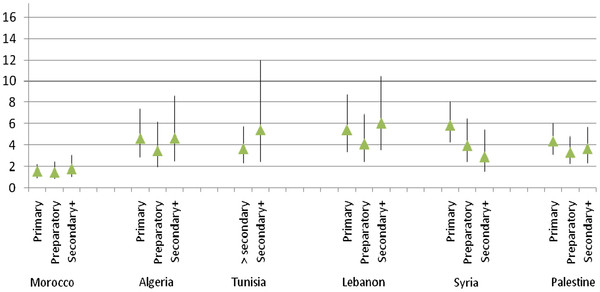
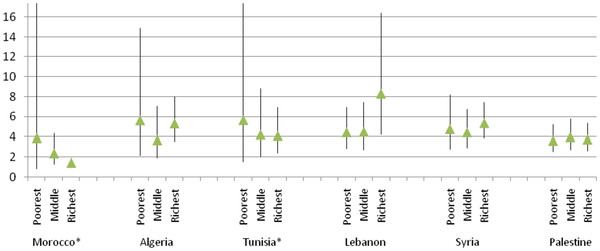
The association between SRH and objective health is strong in Algeria, Tunisia, Lebanon, Syria, and OPT, but weak in Morocco. The strength of the association between reporting fair/poor health and objective health was not moderated by education or household economic status in any of the six countries.
As the SRH-objective health association does not vary across social categories, the use of the measure in social inequities in health research is justified. These results should not preclude the need to carry out other validation studies using longitudinal data on men and women, or the need to advocate for improving the quality of morbidity and mortality data in the Arab region.
一些来自高收入国家的证据表明,自评健康(SRH)并不是社会群体之间客观健康的一致预测指标,其使用可能导致对不平等对健康影响的估计不准确。鉴于全球对研究和监测健康社会不平等的兴趣增加,本研究旨在评估 SRH 在六个阿拉伯国家的社会经济类别中作为健康一致衡量标准的有效性。
我们使用了摩洛哥、阿尔及利亚、突尼斯、黎巴嫩、叙利亚和被占领巴勒斯坦领土(OPT)的 PAPFAM 基于人群的妇女调查数据。使用多变量逻辑回归分析来评估公平/较差的 SRH 与客观健康(报告至少有一种慢性疾病)之间的关联强度,同时调整了可用的社会人口统计学和健康相关变量。然后根据两个社会经济指标对分析进行分层:教育和家庭经济状况。
在阿尔及利亚、突尼斯、黎巴嫩、叙利亚和 OPT 中,SRH 与客观健康之间的关联很强,但在摩洛哥则较弱。在六个国家中,报告健康状况不佳与客观健康之间的关联强度不受教育或家庭经济状况的调节。
由于 SRH-客观健康关联在社会类别中没有变化,因此该措施在健康社会不平等研究中是合理的。这些结果不应排除使用关于男性和女性的纵向数据进行其他验证研究的必要性,也不应排除需要倡导改善阿拉伯地区的发病率和死亡率数据质量。