National Institute for Public Health and the Environment (RIVM), Centre for infectious Disease Control (Cib), Laboratory for Zoonoses and Environmental Microbiology (LZO), PO Box 1, Bilthoven, 3720, BA, the Netherlands.
BMC Vet Res. 2012 Sep 18;8:165. doi: 10.1186/1746-6148-8-165.
The bacterium Coxiella burnetii has caused unprecedented outbreaks of Q fever in the Netherlands between 2007 and 2010. Since 2007, over 4000 human cases have been reported, with 2354 cases in 2009 alone. Dairy goat farms were identified as most probable sources for emerging clusters of human Q fever cases in their vicinity. However, identifying individual farms as primary source for specific clusters of human cases remains a challenge, partly due to limited knowledge of the different C. burnetii strains circulating in livestock, the environment and humans.
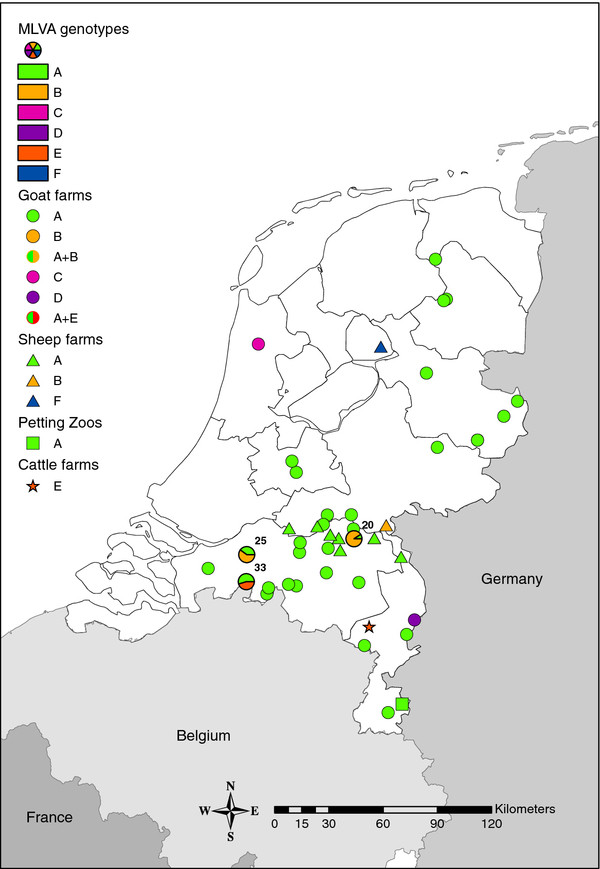
We used a multiplex multi-locus variable number of tandem repeats analysis (MLVA) assay to investigate the genotypic diversity of C. burnetii in different types of samples that were collected nationwide during the Dutch Q fever outbreaks between 2007 and 2010. Typing was performed on C. burnetii positive samples obtained from several independent studies investigating C. burnetii presence in animals and the environment. Six different genotypes were identified on 45 farm locations, based on sequence-confirmed estimates of repeat numbers of six MLVA markers. MLVA genotype A was observed on 38 of the 45 selected farm locations in animals and in environmental samples.
Sequence confirmation of the numbers of tandem repeats within each locus and consensus about repeat identification is essential for accurate MLVA typing of C. burnetii. MLVA genotype A is the most common genotype in animal samples obtained from goat, sheep, and rats, as well as in environmental samples such as (aerosolized) dust, which is considered to be the major transmission route from animals via the environment to humans. The finding of a single dominant MLVA genotype in patients, the environment, and livestock complicates accurate source-finding. Pinpointing individual sources in the Netherlands requires discrimination of genotypes at a higher resolution than attained by using MLVA, as it is likely that the dominant C. burnetii MLVA type will be detected on several farms and in different patients in a particular area of interest.
2007 年至 2010 年间,伯纳特氏立克次体在荷兰引发了前所未有的 Q 热疫情。自 2007 年以来,已报告超过 4000 例人类病例,仅 2009 年就有 2354 例。奶牛场被确定为附近出现的人类 Q 热病例集群的最可能来源。然而,确定个别农场是特定人类病例集群的主要来源仍然具有挑战性,部分原因是对牲畜、环境和人类中循环的不同伯纳特氏立克次体菌株的了解有限。
我们使用了一种多重多位点可变数串联重复分析(MLVA)检测方法,调查了 2007 年至 2010 年荷兰 Q 热疫情期间全国范围内不同类型样本中伯纳特氏立克次体的基因型多样性。对从几个独立研究中获得的 C. burnetii 阳性样本进行了分型,这些研究调查了动物和环境中 C. burnetii 的存在情况。在 45 个农场位置上,根据六个 MLVA 标记的重复数的序列确认估计,确定了六种不同的基因型。在选定的 45 个农场位置中的 38 个位置上观察到 MLVA 基因型 A,这些位置位于动物和环境样本中。
每个基因座内串联重复数的序列确认和重复鉴定的共识对于 C. burnetii 的准确 MLVA 分型至关重要。在从山羊、绵羊和大鼠获得的动物样本以及环境样本(气溶胶化)灰尘中,MLVA 基因型 A 是最常见的基因型,这些环境样本被认为是动物通过环境向人类传播的主要途径。在患者、环境和牲畜中发现单一优势 MLVA 基因型使准确寻找来源变得复杂。在荷兰,需要比使用 MLVA 更高的分辨率来区分基因型,以确定个别来源,因为在特定感兴趣的区域中,很可能会在几个农场和不同患者中检测到优势 C. burnetii MLVA 类型。