School of Medicine, Johns Hopkins University, Baltimore, MD, USA.
J Bone Miner Res. 2013 Mar;28(3):497-504. doi: 10.1002/jbmr.1764.
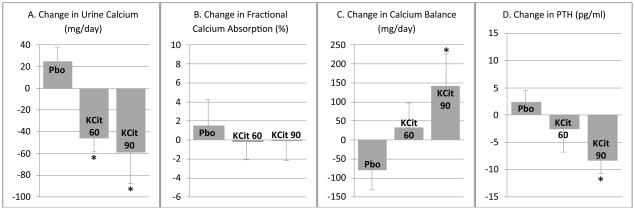
The dietary acid load created by the typical Western diet may adversely impact the skeleton by disrupting calcium metabolism. Whether neutralizing dietary acid with alkaline potassium salts results in sustained improvements in calcium balance remains controversial. In this randomized, double-blind, placebo-controlled study, 52 men and women (mean age 65.2 ± 6.2 years) were randomly assigned to potassium citrate 60 mmol/d, 90 mmol/d, or placebo daily with measurements of bone turnover markers, net acid excretion, and calcium metabolism, including intestinal fractional calcium absorption and calcium balance, obtained at baseline and at 6 months. At 6 months, net acid excretion was significantly lower in both treatment groups compared to placebo and it was negative, meaning subjects' dietary acid was completely neutralized (-11.3 mmol/d on 60 mmol/d; -29.5 mmol/d on 90 mmol/d, p < 0.001 compared to placebo). At 6 months, 24-hour urine calcium was significantly reduced in persons taking potassium citrate 60 mmol/d (-46 ± 15.9 mg/d) and 90 mmol/d (-59 ± 31.6 mg/d) compared with placebo (p < 0.01). Fractional calcium absorption was not changed by potassium citrate supplementation. Net calcium balance was significantly improved in participants taking potassium citrate 90 mmol/d compared to placebo (142 ± 80 mg/d on 90 mmol/d versus -80 ± 54 mg/d on placebo; p = 0.02). Calcium balance was also improved on potassium citrate 60 mmol/d, but this did not reach statistical significance (p = 0.18). Serum C-telopeptide decreased significantly in both potassium citrate groups compared to placebo (-34.6 ± 39.1 ng/L on 90 mmol/d, p = 0.05; -71.6 ± 40.7 ng/L on 60 mmol/d, p = 0.02) whereas bone-specific alkaline phosphatase did not change. Intact parathyroid hormone was significantly decreased in the 90 mmol/d group (p = 0.01). Readily available, safe, and easily administered in an oral form, potassium citrate has the potential to improve skeletal health. Longer-term trials with definitive outcomes such as bone density and fracture are needed.
典型的西方饮食所产生的饮食酸负荷可能通过破坏钙代谢对骨骼产生不利影响。用碱性钾盐来中和饮食酸是否能持续改善钙平衡仍存在争议。在这项随机、双盲、安慰剂对照研究中,52 名男性和女性(平均年龄 65.2±6.2 岁)被随机分配到每天服用柠檬酸钾 60mmol/d、90mmol/d 或安慰剂,测量骨转换标志物、净酸排泄和钙代谢,包括肠钙吸收分数和钙平衡,在基线和 6 个月时获得。6 个月时,与安慰剂相比,两个治疗组的净酸排泄均显著降低,呈负值,这意味着受试者的饮食酸已被完全中和(60mmol/d 组为-11.3mmol/d;90mmol/d 组为-29.5mmol/d,与安慰剂相比,p<0.001)。6 个月时,服用柠檬酸钾 60mmol/d(-46±15.9mg/d)和 90mmol/d(-59±31.6mg/d)的患者 24 小时尿钙明显减少与安慰剂相比(p<0.01)。柠檬酸钾补充剂并未改变钙吸收分数。与安慰剂相比,服用柠檬酸钾 90mmol/d 的参与者的净钙平衡显著改善(90mmol/d 组为 142±80mg/d,安慰剂组为-80±54mg/d;p=0.02)。服用柠檬酸钾 60mmol/d 也能改善钙平衡,但未达到统计学意义(p=0.18)。与安慰剂相比,两个柠檬酸钾组的血清 C 端肽均显著下降(90mmol/d 组为-34.6±39.1ng/L,p=0.05;60mmol/d 组为-71.6±40.7ng/L,p=0.02),而骨特异性碱性磷酸酶没有变化。甲状旁腺激素完整肽在 90mmol/d 组显著下降(p=0.01)。柠檬酸钾易于获得、安全且易于口服给药,具有改善骨骼健康的潜力。需要进行具有明确结果(如骨密度和骨折)的长期试验。