Centre for Health and Social Services, PMB 52 Ministries, Accra, Ghana.
BMC Public Health. 2012;12 Suppl 1(Suppl 1):S10. doi: 10.1186/1471-2458-12-S1-S10. Epub 2012 Jun 22.
Understanding the health policy formulation process over the years has focused on the content of policy to the neglect of context. This had led to several policy initiatives having a still birth or ineffective policy choices with sub-optimal outcomes when implemented. Sometimes, the difficulty has been finding congruence between different values and interests of the various stakeholders. How can policy initiators leverage the various subtle mechanisms that various players draw on to leverage their interests during policy formulation. This paper attempts to conceptualise these levers of policy formulation to enhance an understanding of this field of work based on lived experience.
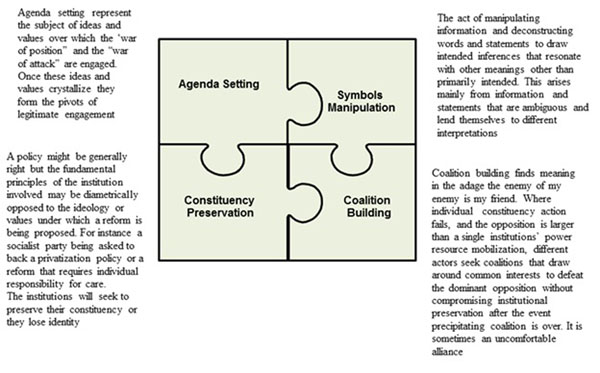
This is a qualitative participant observation case study based on retrospective recollection of the policy process and political levers involved in developing the Ghana National Health Insurance Scheme. The study uses a four-concept framework which is agenda setting, symbols manipulation, constituency preservation and coalition building to capture the various issues, negotiations and nuanced approaches used in arriving at desired outcomes.
Technical experts, civil society, academicians and politicians all had significant influence on setting the health insurance agenda. Each of these various stakeholders carefully engaged in ways that preserved their constituency interests through explicit manoeuvres and subtle engagements. Where proposals lend themselves to various interpretations, stakeholders were quick to latch on the contentious issues to preserve their constituency and will manipulate the symbols that arise from the proposals to their advantage. Where interests are contested and the price of losing out will leave government worse off which will favour its political opponent, it will push for divergent interests outside parliamentary politics through intense negotiations to build coalitions so a particular policy may pass.
This paper has examined the policy environment and the political leverages in retrospect at arriving at Ghana's health insurance policy and design. New perspectives have been brought to the dynamics of the interactions of the 3 streams of problem, policy and politics. It provides lessons which suggest that in understanding the policy process, it is important that actors engage with the content as well as the context to understand viewpoints that may be expressed by interest groups. This will empower policy proponents to achieve easier results and limit the frustrations associated with the policy process. There are no straight and determined pathways for achieving outcomes so appreciating the evidence and basis for design, negotiation process and building coalitions along the way are skills to be mastered.
多年来,人们对卫生政策制定过程的理解一直侧重于政策内容,而忽略了背景。这导致了一些政策倡议胎死腹中,或者政策选择无效,实施效果不佳。有时,困难在于找到不同利益相关者的不同价值观之间的一致性。政策制定者如何利用各种利益相关者在政策制定过程中利用的各种微妙机制来利用他们的利益。本文试图基于经验概念化这些政策制定的杠杆,以增强对这一工作领域的理解。
这是一项基于对加纳国家健康保险计划制定过程中涉及的政策过程和政治杠杆的回顾性回忆的定性参与观察案例研究。该研究使用了一个四概念框架,即议程设置、符号操纵、选区保护和联盟建设,以捕捉各种问题、谈判和细微方法,以达到预期的结果。
技术专家、民间社会、学术界人士和政治家都对设定健康保险议程有重大影响。这些不同的利益相关者都通过明确的策略和微妙的参与,精心地维护自己的选区利益。在提案允许各种解释的情况下,利益相关者会迅速抓住有争议的问题,以维护自己的选区,并利用提案中出现的符号为自己谋利。在利益有争议且失去利益会使政府处境更糟,这对其政治对手有利的情况下,它将通过激烈的谈判建立联盟,将分歧利益推向议会政治之外,以推动特定政策通过。
本文回顾了加纳健康保险政策的制定环境和政治杠杆。本文为问题、政策和政治这三个领域相互作用的动态带来了新的视角。它提供了一些经验教训,表明在理解政策过程时,重要的是,行为者既要关注内容,也要关注背景,以理解利益集团可能表达的观点。这将使政策支持者更容易取得成果,并限制与政策过程相关的挫折感。没有直接和确定的途径来实现结果,因此,了解设计的依据、谈判过程以及沿途建立联盟的能力是需要掌握的技能。
