Abiiro Gilbert Abotisem, Alatinga Kennedy A, Yamey Gavin
Department of Planning, Faculty of Planning and Land Management, Simon Diedong Dombo University of Business and Integrated Development Studies, P. O. Box UPW 3, Wa, Ghana.
University for Development Studies, P. O. Box TL 1350, Tamale, Ghana.
Health Policy Plan. 2021 Jun 25;36(6):869-880. doi: 10.1093/heapol/czab016.
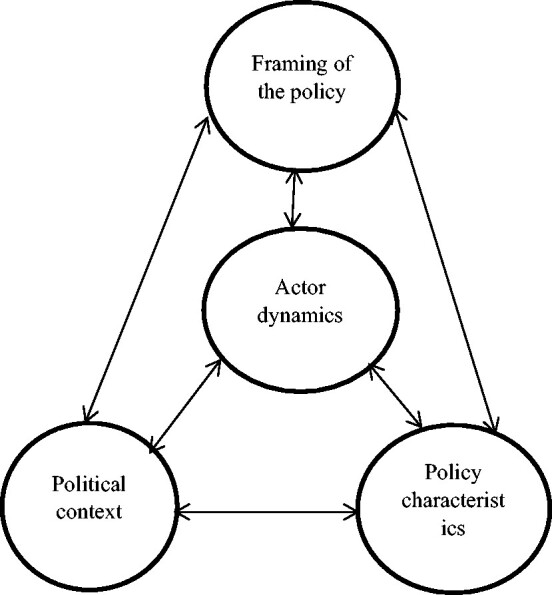
Provider payment reforms, such as capitation, are very contentious. Such reforms can drop off the policy agenda due to political and contextual resistance. Using the Shiffman and Smith (Generation of political priority for global health initiatives: a framework and case study of maternal mortality. Lancet 2007; 370 1370-9) framework, this study explains why Ghana's National Health Insurance capitation payment policy that rose onto the policy agenda in 2012, dropped off the agenda in 2017 during its pilot implementation in the Ashanti region. We conducted a retrospective qualitative policy analysis by collecting field data in December 2019 in the Ashanti region through 18 interviews with regional and district level policy actors and four focus group discussions with community-level policy beneficiaries. The thematically analysed field data were triangulated with media reports on the policy. We discovered that technically framing capitation as a cost-containment strategy with less attention on portraying its health benefits resulted in a politically negative reframing of the policy as a strategy to punish fraudulent providers and opposition party electorates. At the level of policy actors, pilot implementation was constrained by a regional level anti-policy community, weak civil society mobilization and low trust in the then political leadership. Anti-policy campaigners drew on highly contentious and poorly implemented characteristics of the policy to demand cancellation of the policy. A change in government in 2017 created the needed political window for the suspension of the policy. While it was technically justified to pilot the policy in the stronghold of the main opposition party, this decision carried political risks. Other low- and middle-income countries considering capitation reforms should note that piloting potentially controversial policies such as capitation within a politically sensitive location can attract unanticipated partisan political interest in the policy. Such partisan interest can potentially lead to a decline in political attention for the policy in the event of a change in government.
诸如按人头付费等医疗服务提供者支付改革极具争议性。由于政治和环境阻力,此类改革可能会从政策议程上消失。本研究运用希夫曼和史密斯(《全球卫生倡议的政治优先事项产生:孕产妇死亡率的框架与案例研究》。《柳叶刀》2007年;370:1370 - 1379)的框架,解释了加纳的国家健康保险按人头付费政策为何在2012年进入政策议程,却在2017年于阿散蒂地区试点实施期间从议程上消失。2019年12月,我们在阿散蒂地区收集实地数据,通过对地区和区级政策行动者进行18次访谈以及与社区层面政策受益者进行4次焦点小组讨论,开展了一项回顾性定性政策分析。对实地数据进行主题分析,并与关于该政策的媒体报道相互印证。我们发现,从技术层面将按人头付费框架化为一种成本控制策略,而较少关注描绘其健康益处,导致该政策在政治上被负面重新定义为惩罚欺诈性医疗服务提供者和反对党选民的策略。在政策行动者层面,试点实施受到地区层面反政策群体、民间社会动员不力以及对当时政治领导层信任度低的制约。反政策活动人士利用该政策极具争议性且实施不力的特点,要求取消该政策。2017年的政府更迭为暂停该政策创造了必要的政治契机。虽然在主要反对党的大本营试点该政策在技术上有其合理性,但这一决定存在政治风险。其他考虑按人头付费改革的低收入和中等收入国家应注意,在政治敏感地区试点诸如按人头付费等潜在有争议的政策,可能会引发对该政策意想不到的党派政治兴趣。在政府更迭的情况下,这种党派兴趣可能会导致对该政策的政治关注度下降。