Genomic Medicine, Rigshospitalet, University of Copenhagen, Rigshospitalet, Blegdamsvej 9, Copenhagen DK2100, Denmark.
Mol Cancer. 2012 Sep 20;11:71. doi: 10.1186/1476-4598-11-71.
Gastric cancer is the second most common cause of cancer-related death in the world. Inflammatory signals originating from gastric cancer cells are important for recruiting inflammatory cells and regulation of metastasis of gastric cancer. Several microRNAs (miRNA) have been shown to be involved in development and progression of gastric cancer. miRNA-146a (miR-146a) is a modulator of inflammatory signals, but little is known about its importance in gastric cancer. We therefore wanted to identify targets of miR-146a in gastric cancer and examine its biological roles.
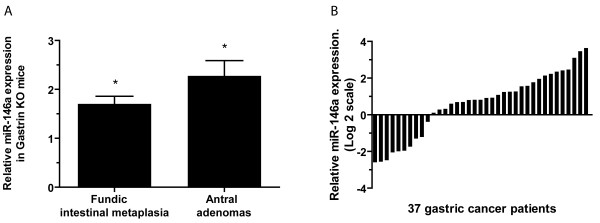
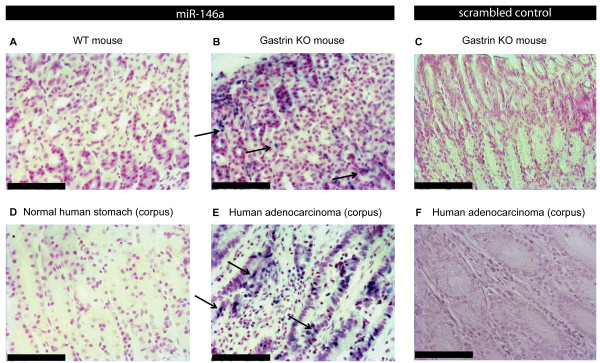
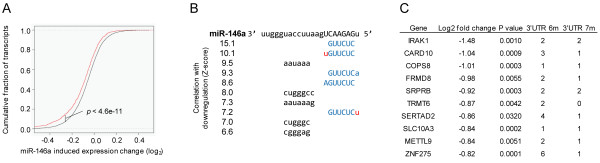
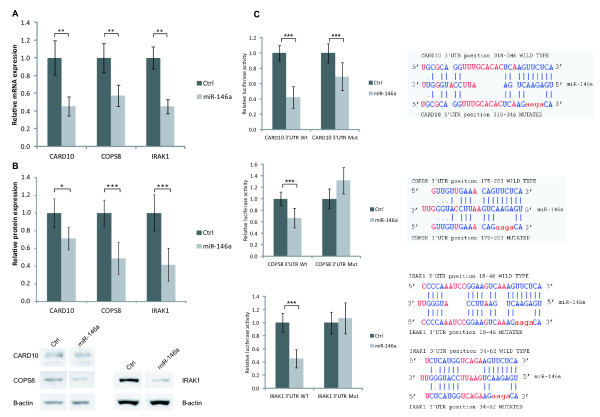
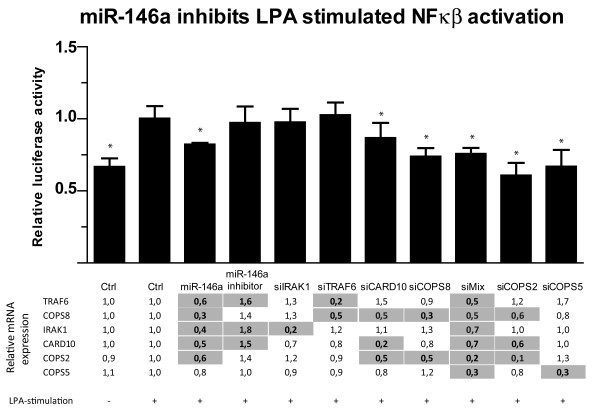
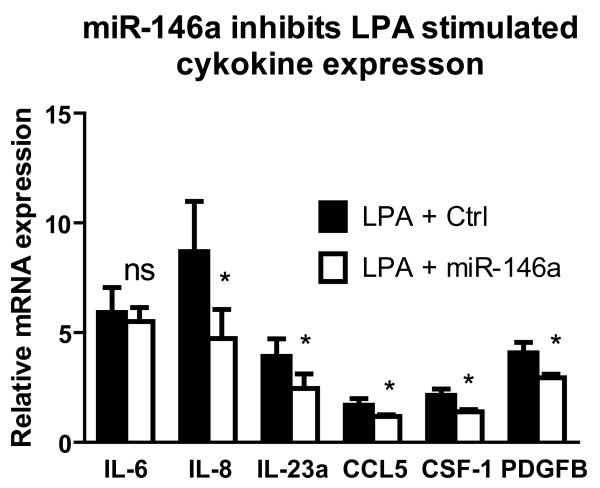
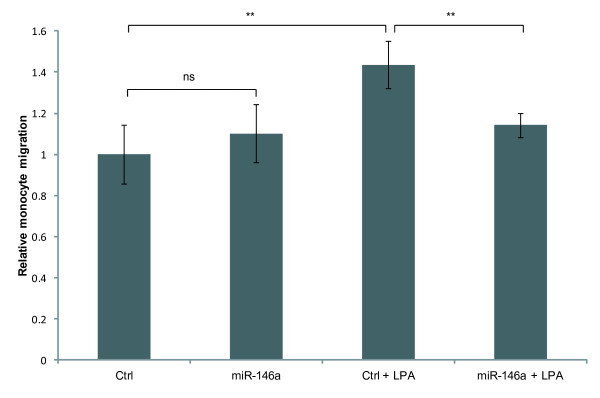
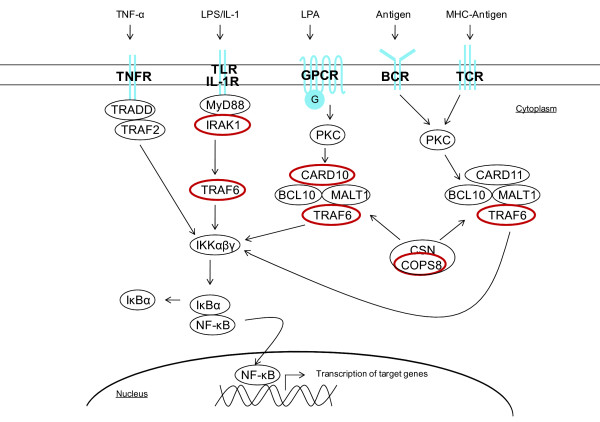
The expression of miR-146a was evaluated by quantitative PCR (qPCR) and found up-regulated in the gastrin knockout mice, a mouse model of gastric cancer, and in 73% of investigated human gastric adenocarcinomas. Expression of miR-146a by gastric cancer cells was confirmed by in situ hybridization. Global analysis of changes in mRNA levels after miR-146a transfection identified two transcripts, caspase recruitment domain-containing protein 10 (CARD10) and COP9 signalosome complex subunit 8 (COPS8), as new miR-146a targets. qPCR, Western blotting and luciferase assays confirmed these transcripts as direct miR-146a targets. CARD10 and COPS8 were shown to be part of the G protein-coupled receptor (GPCR) pathway of nuclear factor-kappaB (NF-kappaB) activation. Lysophosphatidic acid (LPA) induces NF-kappaB activation via this pathway and over-expression of miR-146a inhibited LPA-induced NF-kappaB activation, reduced LPA-induced expression of tumor-promoting cytokines and growth factors and inhibited monocyte attraction.
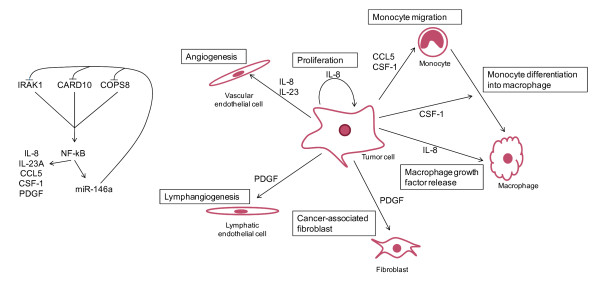
miR-146a expression is up-regulated in a majority of gastric cancers where it targets CARD10 and COPS8, inhibiting GPCR-mediated activation of NF-kappaB, thus reducing expression of NF-kappaB-regulated tumor-promoting cytokines and growth factors. By targeting components of several NF-kappaB-activating pathways, miR-146a is a key component in the regulation of NF-kappaB activity.
胃癌是全球第二大常见的癌症相关死亡原因。源自胃癌细胞的炎症信号对于招募炎症细胞和调节胃癌转移至关重要。一些 microRNA(miRNA)已被证明参与了胃癌的发展和进展。miRNA-146a(miR-146a)是炎症信号的调节剂,但对其在胃癌中的重要性知之甚少。因此,我们希望确定 miR-146a 在胃癌中的靶标并研究其生物学作用。
通过定量 PCR(qPCR)评估 miR-146a 的表达,发现其在胃泌素敲除小鼠(一种胃癌模型)和 73%的人胃腺癌中上调。通过原位杂交证实了胃癌细胞中 miR-146a 的表达。miR-146a 转染后 mRNA 水平变化的全局分析鉴定出两个转录物,即衔接蛋白含有 caspase 募集结构域 10(CARD10)和 COP9 信号体复合物亚基 8(COPS8),作为新的 miR-146a 靶标。qPCR、Western blotting 和荧光素酶报告基因检测证实这些转录物是 miR-146a 的直接靶标。CARD10 和 COPS8 被证明是 G 蛋白偶联受体(GPCR)途径核因子-κB(NF-κB)激活的一部分。溶血磷脂酸(LPA)通过该途径诱导 NF-κB 激活,过表达 miR-146a 抑制 LPA 诱导的 NF-κB 激活,减少 LPA 诱导的促肿瘤细胞因子和生长因子的表达,并抑制单核细胞的吸引。
在大多数胃癌中,miR-146a 的表达上调,其靶标是 CARD10 和 COPS8,抑制 GPCR 介导的 NF-κB 激活,从而减少 NF-κB 调节的促肿瘤细胞因子和生长因子的表达。通过靶向几种 NF-κB 激活途径的组成部分,miR-146a 是 NF-κB 活性调节的关键组成部分。