Departments of Cancer Biology, Thomas Jefferson University, Philadelphia, Pennsylvania, USA.
Cancer Discov. 2012 Dec;2(12):1134-49. doi: 10.1158/2159-8290.CD-12-0120. Epub 2012 Sep 19.
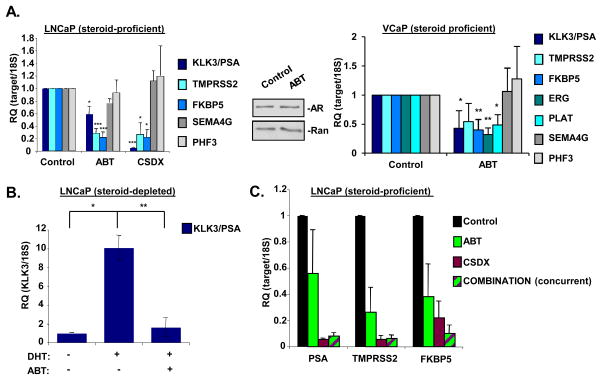
PARP-1 is an abundant nuclear enzyme that modifies substrates by poly(ADP-ribose)-ylation. PARP-1 has well-described functions in DNA damage repair and also functions as a context-specific regulator of transcription factors. With multiple models, data show that PARP-1 elicits protumorigenic effects in androgen receptor (AR)-positive prostate cancer cells, in both the presence and absence of genotoxic insult. Mechanistically, PARP-1 is recruited to sites of AR function, therein promoting AR occupancy and AR function. It was further confirmed in genetically defined systems that PARP-1 supports AR transcriptional function, and that in models of advanced prostate cancer, PARP-1 enzymatic activity is enhanced, further linking PARP-1 to AR activity and disease progression. In vivo analyses show that PARP-1 activity is required for AR function in xenograft tumors, as well as tumor cell growth in vivo and generation and maintenance of castration resistance. Finally, in a novel explant system of primary human tumors, targeting PARP-1 potently suppresses tumor cell proliferation. Collectively, these studies identify novel functions of PARP-1 in promoting disease progression, and ultimately suggest that the dual functions of PARP-1 can be targeted in human prostate cancer to suppress tumor growth and progression to castration resistance.
These studies introduce a paradigm shift with regard to PARP-1 function in human malignancy, and suggest that the dual functions of PARP-1 in DNA damage repair and transcription factor regulation can be leveraged to suppress pathways critical for promalignant phenotypes in prostate cancer cells by modulation of the DNA damage response and hormone signaling pathways. The combined studies highlight the importance of dual PARP-1 function in malignancy and provide the basis for therapeutic targeting.
PARP-1 是一种丰富的核酶,通过聚(ADP-核糖)化修饰底物。PARP-1 在 DNA 损伤修复中具有明确的功能,并且还作为转录因子的特定调节因子发挥作用。通过多种模型,数据表明 PARP-1 在雄激素受体 (AR) 阳性前列腺癌细胞中引发促肿瘤生成效应,无论是在存在还是不存在遗传毒性刺激的情况下。从机制上讲,PARP-1 被募集到 AR 功能的部位,从而促进 AR 占据和 AR 功能。在遗传定义的系统中进一步证实,PARP-1 支持 AR 转录功能,并且在晚期前列腺癌模型中,PARP-1 酶活性增强,进一步将 PARP-1 与 AR 活性和疾病进展联系起来。体内分析表明,PARP-1 活性是 AR 功能在异种移植肿瘤中的必需的,以及肿瘤细胞在体内的生长和去势抵抗的产生和维持。最后,在原发性人类肿瘤的新型外植体系统中,靶向 PARP-1 可有效抑制肿瘤细胞增殖。总的来说,这些研究确定了 PARP-1 在促进疾病进展中的新功能,并最终表明 PARP-1 的双重功能可以在人类前列腺癌中靶向,以抑制肿瘤生长和向去势抵抗的进展。
这些研究在人类恶性肿瘤中 PARP-1 功能方面引入了范式转变,并表明 PARP-1 在 DNA 损伤修复和转录因子调节中的双重功能可以通过调节 DNA 损伤反应和激素信号通路来抑制前列腺癌细胞中促恶性表型的关键途径。联合研究强调了双重 PARP-1 功能在恶性肿瘤中的重要性,并为治疗靶向提供了依据。