Moon Hyung-Sik, Jung Shin, Jang Woo-Youl, Jung Tae-Young, Moon Kyung-Sub, Kim In-Young
Department of Neurosurgery, Chonnam National University Research Institute of Medical Sciences, Chonnam National University Hwasun Hospital & Medical School, Gwangju, Korea.
J Korean Neurosurg Soc. 2012 Jul;52(1):14-20. doi: 10.3340/jkns.2012.52.1.14. Epub 2012 Jul 31.
Intracranial meningiomas are primarily benign tumors with a good prognosis. Although WHO grade II meningiomas are rare (2-10%), WHO grade II meningiomas have higher recurrence and mortality rates than benign. We evaluated the patient recurrence rate and investigated the prognostic factors of WHO grade II meningiomas.
Between 1993 and 2005, 55 patients were diagnosed with WHO grade II meningiomas in our hospital. WHO grade II meningiomas (n=55) were compared with other WHO grades meningiomas (I, n=373; and III, n=20). The patients had a median age of 48.4 years (range, 14-17 years), a male-to-female ratio of 26 : 29, and a mean follow-up time of 45 months (range, 3-175 months).
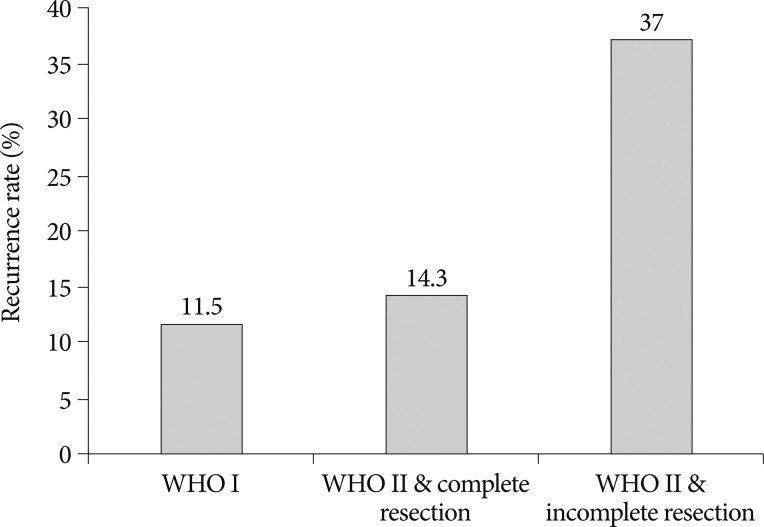
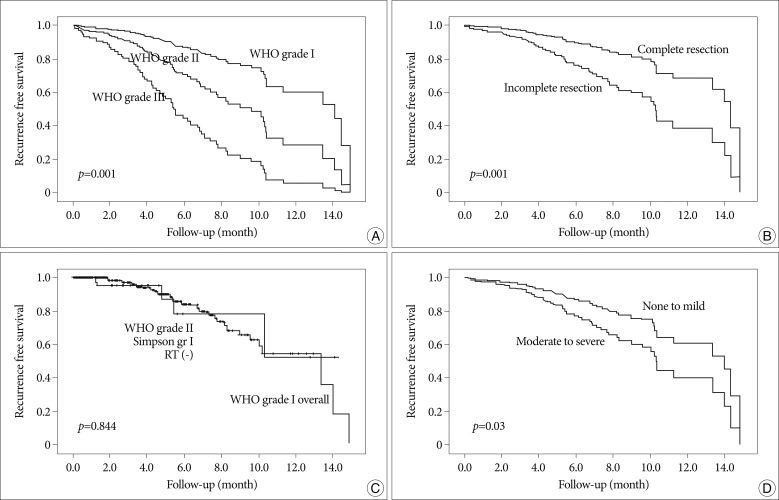
In WHO grade II meningiomas, only the extent of resection was a significant prognostic factor. Post-operative radiotherapy had no significant influence on tumor recurrence (p=0.053). The relative risk of recurrence was significantly higher in WHO grade II meningiomas with incomplete resection (10/27, RR=37%) than in WHO grade II meningiomas with complete resection (4/28, RR=14%) regardless of post-operative radiotherapy. In the incomplete resection group, Simpson grade III or IV had a significantly high risk of recurrence regardless of post-operative RT (n=3, RR=100%) However, if the degree of resection was Simpson grade II, the recurrence rate was similar to the complete resection group even though post-operative RT was not performed.
Complete resection was the most powerful independent predictive factor of the recurrence rate in WHO grade II meningiomas. Post-operative adjuvant RT was not a significant factor in this study.
颅内脑膜瘤主要是良性肿瘤,预后良好。虽然世界卫生组织(WHO)二级脑膜瘤很少见(2%-10%),但其复发率和死亡率高于良性脑膜瘤。我们评估了患者的复发率,并研究了WHO二级脑膜瘤的预后因素。
1993年至2005年期间,我院有55例患者被诊断为WHO二级脑膜瘤。将WHO二级脑膜瘤(n=55)与其他WHO级别的脑膜瘤(I级,n=373;III级,n=20)进行比较。患者的中位年龄为48.4岁(范围14-17岁),男女比例为26:29,平均随访时间为45个月(范围3-175个月)。
在WHO二级脑膜瘤中,只有切除范围是一个重要的预后因素。术后放疗对肿瘤复发没有显著影响(p=0.053)。无论术后是否放疗,WHO二级脑膜瘤不完全切除患者的复发相对风险(10/27,RR=37%)显著高于完全切除患者(4/28,RR=14%)。在不完全切除组中,无论术后是否放疗,辛普森III级或IV级的复发风险显著较高(n=3,RR=100%)。然而,如果切除程度为辛普森II级,即使未进行术后放疗,复发率也与完全切除组相似。
完全切除是WHO二级脑膜瘤复发率最有力的独立预测因素。在本研究中,术后辅助放疗不是一个显著因素。