
微生物和病毒的进化:进化生物学的范式转变?
Evolution of microbes and viruses: a paradigm shift in evolutionary biology?
机构信息
National Center for Biotechnology Information, National Library of Medicine, National Institutes of Health Bethesda, MD, USA.
出版信息
Front Cell Infect Microbiol. 2012 Sep 13;2:119. doi: 10.3389/fcimb.2012.00119. eCollection 2012.
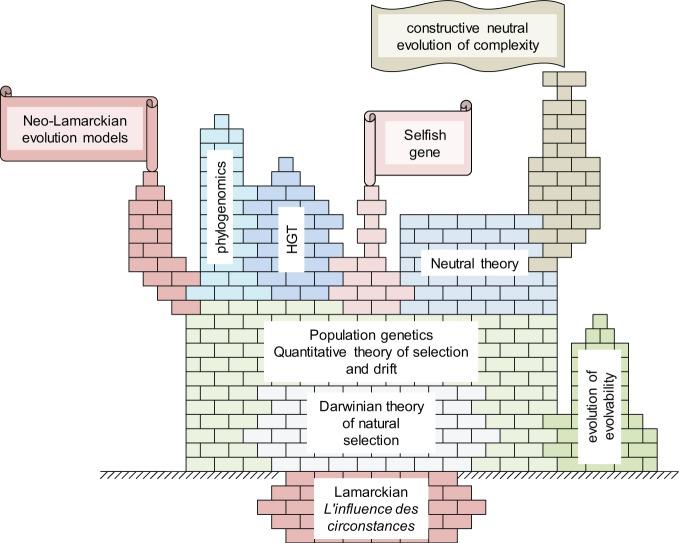
When Charles Darwin formulated the central principles of evolutionary biology in the Origin of Species in 1859 and the architects of the Modern Synthesis integrated these principles with population genetics almost a century later, the principal if not the sole objects of evolutionary biology were multicellular eukaryotes, primarily animals and plants. Before the advent of efficient gene sequencing, all attempts to extend evolutionary studies to bacteria have been futile. Sequencing of the rRNA genes in thousands of microbes allowed the construction of the three- domain "ribosomal Tree of Life" that was widely thought to have resolved the evolutionary relationships between the cellular life forms. However, subsequent massive sequencing of numerous, complete microbial genomes revealed novel evolutionary phenomena, the most fundamental of these being: (1) pervasive horizontal gene transfer (HGT), in large part mediated by viruses and plasmids, that shapes the genomes of archaea and bacteria and call for a radical revision (if not abandonment) of the Tree of Life concept, (2) Lamarckian-type inheritance that appears to be critical for antivirus defense and other forms of adaptation in prokaryotes, and (3) evolution of evolvability, i.e., dedicated mechanisms for evolution such as vehicles for HGT and stress-induced mutagenesis systems. In the non-cellular part of the microbial world, phylogenomics and metagenomics of viruses and related selfish genetic elements revealed enormous genetic and molecular diversity and extremely high abundance of viruses that come across as the dominant biological entities on earth. Furthermore, the perennial arms race between viruses and their hosts is one of the defining factors of evolution. Thus, microbial phylogenomics adds new dimensions to the fundamental picture of evolution even as the principle of descent with modification discovered by Darwin and the laws of population genetics remain at the core of evolutionary biology.
当查尔斯·达尔文在 1859 年的《物种起源》中阐述了进化生物学的核心原则,而现代综合论的设计者们在将近一个世纪后将这些原则与群体遗传学相结合时,进化生物学的主要(如果不是唯一的)对象是多细胞真核生物,主要是动物和植物。在高效基因测序出现之前,所有将进化研究扩展到细菌的尝试都徒劳无功。对数千种微生物的 rRNA 基因进行测序,使得构建了三域“核糖体生命之树”成为可能,这被广泛认为解决了细胞生命形式之间的进化关系。然而,随后对大量微生物完整基因组的大规模测序揭示了新的进化现象,其中最根本的是:(1)普遍存在的水平基因转移(HGT),在很大程度上由病毒和质粒介导,塑造了古菌和细菌的基因组,这要求对生命之树概念进行彻底修订(如果不是完全放弃),(2)拉马克式遗传,似乎对原核生物的抗病毒防御和其他形式的适应至关重要,(3)进化的可进化性,即专门的进化机制,如 HGT 的载体和应激诱导的突变系统。在微生物世界的非细胞部分,病毒和相关自私遗传元件的系统发生基因组学和宏基因组学揭示了巨大的遗传和分子多样性,以及极其丰富的病毒,这些病毒似乎是地球上占主导地位的生物实体。此外,病毒与其宿主之间的常年军备竞赛是进化的决定性因素之一。因此,微生物系统发生基因组学为进化的基本图景增添了新的维度,即使达尔文发现的进化的特征在于遗传和变异,以及群体遗传学的法则仍然是进化生物学的核心。


 Zotero 插件