Department of Zoology, University of Cambridge, Cambridge, UK.
Sci Rep. 2012;2:659. doi: 10.1038/srep00659. Epub 2012 Sep 20.
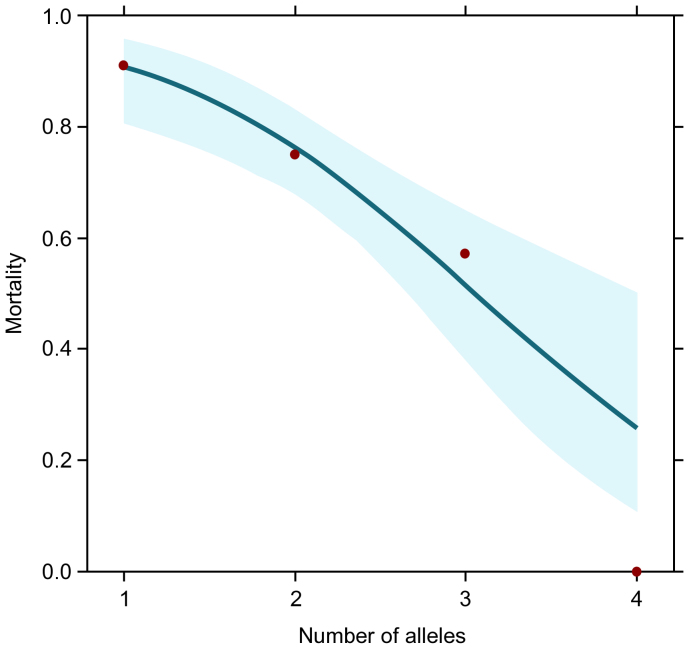
The Major Histocompatability Complex (MHC) is one of the best known and best characterised components of the immune system, yet its functions remain somewhat enigmatic, including both anti-pathogen activity and kin recognition. To explore the importance of the MHC relative to literally hundreds of other components of the immune system, we compared MHC genotype frequencies between pups and adults in the grey seal (Halichoerus grypus), one of many marine mammals that exhibit low allelic diversity. We find that one allele is strongly associated with pup survival, pups being more likely to be found dead if they lack it, while total allele number is a remarkably strong predictor of survivorship to adulthood. We estimate that approximately 70% of mortality can be attributed to the MHC. Our study therefore shows that low MHC allele diversity belies its critical role in determining whether a weaned pup negotiates disease to become a breeding adult.
主要组织相容性复合体 (MHC) 是免疫系统中最著名和特征最明显的成分之一,但它的功能仍然有些神秘,包括抗病原体活性和亲属识别。为了探究 MHC 相对于免疫系统中 literally hundreds of other components 的重要性,我们比较了灰海豹 (Halichoerus grypus) 幼崽和成年个体之间的 MHC 基因型频率,灰海豹是许多表现出低等位基因多样性的海洋哺乳动物之一。我们发现一个等位基因与幼崽的存活率强烈相关,如果它们缺乏该等位基因,幼崽就更有可能死亡,而等位基因总数是一个非常强的成年存活率预测因子。我们估计大约 70%的死亡率归因于 MHC。因此,我们的研究表明,低 MHC 等位基因多样性掩盖了其在决定断奶幼崽是否能通过疾病成为繁殖成年个体方面的关键作用。