Abdullah Shaad E, Haigentz Missak, Piperdi Bilal
Division of Oncology, Department of Medicine, Montefiore Medical Center, Albert Einstein College of Medicine, Bronx, New york, NY 10461, USA.
Chemother Res Pract. 2012;2012:351210. doi: 10.1155/2012/351210. Epub 2012 Sep 11.
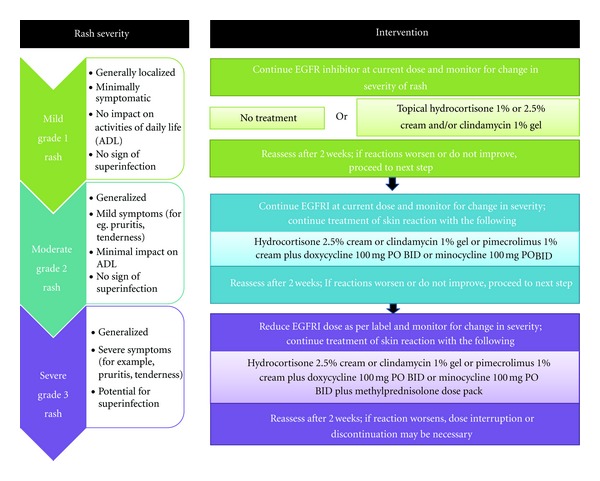
Epidermal growth factor receptor (EGFR) inhibition has now been well established as an effective treatment for various cancers. The EGFR belongs to the ErbB family of tyrosine kinase receptors which regulate tumor cell differentiation, survival and proliferation. Activation of EGFR drives tumorigenesis in lung, head and neck, colorectal and pancreatic cancers. Irrespective of the type of cancer being treated and the mechanism by which tumor EGFR drives tumorigenesis, the major side effect of EGFR inhibition is a papulopustular (also described as maculopapular or acneiform) rash which occurs in about two thirds of treated patients. Interestingly, this rash has been commonly correlated with better clinical outcomes (objective tumor response and patient survival). The pathophysiology of dermatological toxicity from EGFR inhibitors is an important area of clinical research, and the proper management of the rash is essential to increase the therapeutic index from this class of drugs. In this paper, we review the dermatologic toxicities associated with EGFR inhibitors with an emphasis on its pathophysiology and clinical management.
表皮生长因子受体(EGFR)抑制现已被确认为治疗多种癌症的有效方法。EGFR属于酪氨酸激酶受体的ErbB家族,该家族调节肿瘤细胞的分化、存活和增殖。EGFR的激活驱动肺癌、头颈癌、结直肠癌和胰腺癌的肿瘤发生。无论所治疗的癌症类型以及肿瘤EGFR驱动肿瘤发生的机制如何,EGFR抑制的主要副作用是丘疹脓疱性(也称为斑丘疹或痤疮样)皮疹,约三分之二的接受治疗的患者会出现这种皮疹。有趣的是,这种皮疹通常与更好的临床结果(客观肿瘤反应和患者生存)相关。EGFR抑制剂引起的皮肤毒性的病理生理学是临床研究的一个重要领域,正确处理皮疹对于提高这类药物的治疗指数至关重要。在本文中,我们综述了与EGFR抑制剂相关的皮肤毒性,重点关注其病理生理学和临床管理。