Department of Neurology & Center for Lysosomal and Metabolic Diseases, Erasmus MC University Medical Center, Rotterdam, the Netherlands.
Orphanet J Rare Dis. 2012 Sep 26;7:73. doi: 10.1186/1750-1172-7-73.
Enzyme replacement therapy (ERT) in adults with Pompe disease, a progressive neuromuscular disorder, is of promising but variable efficacy. We investigated whether it alters the course of disease, and also identified potential prognostic factors.
Patients in this open-label single-center study were treated biweekly with 20 mg/kg alglucosidase alfa. Muscle strength, muscle function, and pulmonary function were assessed every 3-6 months and analyzed using repeated-measures ANOVA.
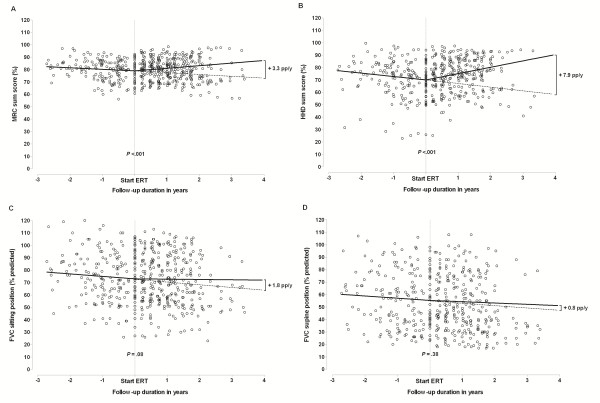
Sixty-nine patients (median age 52.1 years) were followed for a median of 23 months. Muscle strength increased after start of ERT (manual muscle testing 1.4 percentage points per year (pp/y); hand-held dynamometry 4.0 pp/y; both p < 0.001). Forced vital capacity (FVC) remained stable when measured in upright, but declined in supine position (-1.1 pp/y; p = 0.03). Muscle function did not improve in all patients (quick motor function test 0.7 pp/y; p = 0.14), but increased significantly in wheelchair-independent patients and those with mild and moderate muscle weakness.Relative to the pre-treatment period (49 patients with 14 months pre-ERT and 22 months ERT median follow-up), ERT affected muscle strength positively (manual muscle testing +3.3 pp/y, p < 0.001 and hand-held dynamometry +7.9 pp/y, p < 0.001). Its effect on upright FVC was +1.8 pp/y (p = 0.08) and on supine FVC +0.8 (p = 0.38). Favorable prognostic factors were female gender for muscle strength, and younger age and better clinical status for supine FVC.
We conclude that ERT positively alters the natural course of Pompe disease in adult patients; muscle strength increased and upright FVC stabilized. Functional outcome is probably best when ERT intervention is timely.
酶替代疗法(ERT)在进行性神经肌肉疾病庞贝病成人患者中具有一定疗效,但疗效存在差异。我们研究了ERT 是否能改变疾病进程,并确定了潜在的预后因素。
在这项开放标签的单中心研究中,69 名患者(中位年龄 52.1 岁)接受了每周 2 次 20mg/kg 的阿糖苷酶α治疗。每 3-6 个月评估一次肌肉力量、肌肉功能和肺功能,并使用重复测量方差分析进行分析。
69 名患者(中位年龄 52.1 岁)随访中位时间为 23 个月。ERT 开始后肌肉力量增加(徒手肌力测试每年增加 1.4 个百分点(pp/y);手握力计每年增加 4.0pp/y;均 p<0.001)。直立位时用力肺活量(FVC)保持稳定,但仰卧位时下降(每年-1.1pp/y;p=0.03)。并非所有患者的肌肉功能都有改善(快速运动功能测试每年增加 0.7pp/y;p=0.14),但在无轮椅依赖的患者以及肌肉无力较轻和中度的患者中显著增加。与治疗前相比(49 名患者有 14 个月的 ERT 前和 22 个月的 ERT 中位随访),ERT 对肌肉力量有积极影响(徒手肌力测试增加 3.3pp/y,p<0.001;手握力计增加 7.9pp/y,p<0.001)。对直立位 FVC 的影响为+1.8pp/y(p=0.08),对仰卧位 FVC 的影响为+0.8pp/y(p=0.38)。有利的预后因素为女性的肌肉力量,以及年轻的年龄和更好的临床状况对仰卧位 FVC 的影响。
我们得出结论,ERT 可积极改变成年庞贝病患者的自然病程;肌肉力量增加,直立位 FVC 稳定。ERT 干预及时时,功能结果可能最好。