• 文献检索
  • 文档翻译
  • 深度研究
  • 学术资讯
  • Suppr Zotero 插件Zotero 插件
  • 邀请有礼
  • 套餐&价格
  • 历史记录
应用&插件
Suppr Zotero 插件Zotero 插件浏览器插件Mac 客户端Windows 客户端微信小程序
定价
高级版会员购买积分包购买API积分包
服务
文献检索文档翻译深度研究API 文档MCP 服务
关于我们
关于 Suppr公司介绍联系我们用户协议隐私条款
关注我们

Suppr 超能文献

核心技术专利:CN118964589B侵权必究
粤ICP备2023148730 号-1Suppr @ 2026

文献检索

告别复杂PubMed语法,用中文像聊天一样搜索,搜遍4000万医学文献。AI智能推荐,让科研检索更轻松。

立即免费搜索

文件翻译

保留排版,准确专业,支持PDF/Word/PPT等文件格式,支持 12+语言互译。

免费翻译文档

深度研究

AI帮你快速写综述,25分钟生成高质量综述,智能提取关键信息,辅助科研写作。

立即免费体验

全国大学体育协会第一分部运动员使用非处方药物。

National collegiate athletic association division I athletes' use of nonprescription medication.

机构信息

Nationwide Children's Hospital, Columbus, Ohio.

出版信息

Sports Health. 2011 Jan;3(1):25-8. doi: 10.1177/1941738110387515.

DOI:10.1177/1941738110387515
PMID:23015987
原文链接:https://pmc.ncbi.nlm.nih.gov/articles/PMC3445194/
Abstract

BACKGROUND

Athletes are known to use over-the-counter pain medication. However, the frequency of such use among National Collegiate Athletic Association (NCAA) Division I-A football athletes is unknown.

HYPOTHESIS

NCAA Division I-A football athletes who use nonprescription analgesics for pain misuse these medications.

STUDY DESIGN

Cross-sectional study.

METHODS

The football players (N, 144) who met the criteria and agreed to participate were from 8 NCAA Division I-A schools. The participants were administered the Over the Counter Drug Screen for Athletes, which measures attitudes toward the use of a spectrum of substances.

RESULTS

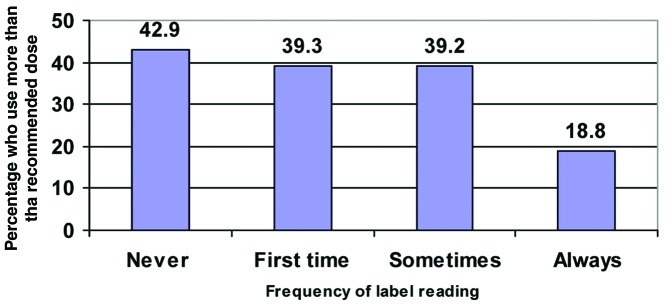
Among football athletes surveyed who took nonprescription analgesics for football-related pain, 37% reported taking more than the recommended dose. This was slightly higher than the 28% of players who stated they have not taken nonprescription analgesics for football-related pain. Thirty-four percent of all athletes reported using more than the recommended dose of nonprescription analgesics. Athletes who purchased their own nonprescription analgesics communicated poorly regarding nonprescription analgesics use. Those lacking knowledge about nonprescription analgesics and those using nonprescription analgesics in anticipation of pain or to avoid missing a practice or game were most likely to misuse nonprescription analgesics.

CONCLUSION

NCAA Division I-A football athletes who use nonprescription analgesics for athletic competition do not misuse nonprescription analgesics.

摘要

背景

运动员常使用非处方止痛药。然而,全美大学体育协会(NCAA)一级分区 I-A 美式足球运动员使用此类药物的频率尚不清楚。

假设

使用非处方镇痛药缓解运动相关疼痛的 NCAA 一级分区 I-A 美式足球运动员可能会滥用这些药物。

研究设计

横断面研究。

方法

本研究选取了符合条件并同意参与的来自 8 所 NCAA 一级分区 I-A 学校的 144 名美式足球运动员。研究参与者接受了运动员非处方药物使用筛查问卷,该问卷用于评估对一系列物质使用的态度。

结果

在所调查的因足球相关疼痛而使用非处方镇痛药的足球运动员中,有 37%的人报告服用了超过推荐剂量的药物。这略高于 28%的报告因足球相关疼痛而未服用非处方镇痛药的运动员比例。34%的运动员报告使用了超过推荐剂量的非处方镇痛药。自行购买非处方镇痛药的运动员在非处方镇痛药使用方面沟通不良。那些缺乏非处方镇痛药知识以及出于预防疼痛或避免错过练习或比赛而使用非处方镇痛药的运动员最有可能滥用非处方镇痛药。

结论

为参加竞技比赛而使用非处方镇痛药的 NCAA 一级分区 I-A 美式足球运动员并未滥用非处方镇痛药。
https://cdn.ncbi.nlm.nih.gov/pmc/blobs/5419/3445194/a7184f228a6f/10.1177_1941738110387515-fig1.jpg

相似文献

1
National collegiate athletic association division I athletes' use of nonprescription medication.全国大学体育协会第一分部运动员使用非处方药物。
Sports Health. 2011 Jan;3(1):25-8. doi: 10.1177/1941738110387515.
2
Nonprescription pain medication use in collegiate athletes: a comparison of samples.大学生运动员中非处方止痛药物的使用:样本比较。
Phys Sportsmed. 2014 May;42(2):19-26. doi: 10.3810/psm.2014.05.2054.
3
Hydration and Fluid Replacement Knowledge, Attitudes, Barriers, and Behaviors of NCAA Division 1 American Football Players.美国大学体育协会第一分区美式橄榄球运动员的水合作用与补液知识、态度、障碍及行为
J Strength Cond Res. 2016 Nov;30(11):2972-2978. doi: 10.1519/JSC.0000000000001397.
4
Elevations in MicroRNA Biomarkers in Serum Are Associated with Measures of Concussion, Neurocognitive Function, and Subconcussive Trauma over a Single National Collegiate Athletic Association Division I Season in Collegiate Football Players.血清中 microRNA 生物标志物的升高与大学生足球运动员单个全国大学体育协会 I 赛区脑震荡、神经认知功能和亚临床创伤的评估指标相关。
J Neurotrauma. 2019 Apr 15;36(8):1343-1351. doi: 10.1089/neu.2018.6072. Epub 2018 Dec 5.
5
Incidence of Knee Injuries on Artificial Turf Versus Natural Grass in National Collegiate Athletic Association American Football: 2004-2005 Through 2013-2014 Seasons.美国大学生体育协会美式足球项目中人工草皮与天然草皮的膝盖损伤发生率:2004-2005 赛季至 2013-2014 赛季。
Am J Sports Med. 2019 May;47(6):1294-1301. doi: 10.1177/0363546519833925. Epub 2019 Apr 17.
6
The Evolving Treatment Patterns of NCAA Division I Football Players by Orthopaedic Team Physicians Over the Past Decade, 2008-2016.过去十年(2008-2016 年),NCAA 一级足球运动员的骨科队医治疗模式不断演变。
Sports Health. 2018 May/Jun;10(3):234-243. doi: 10.1177/1941738117745488. Epub 2018 Jan 3.
7
Nutrition practices and knowledge among NCAA Division III football players.美国大学体育协会(NCAA)第三分区橄榄球运动员的营养习惯与知识
J Int Soc Sports Nutr. 2017 May 19;14:13. doi: 10.1186/s12970-017-0170-2. eCollection 2017.
8
Epidemiology of Cervical Muscle Strains in Collegiate and High School Football Athletes, 2011-2012 Through 2013-2014 Academic Years.大学生和高中生足球运动员中颈部肌肉拉伤的流行病学研究,2011-2012 学年至 2013-2014 学年。
J Athl Train. 2019 Jul;54(7):780-786. doi: 10.4085/1062-6050-229-18. Epub 2019 Jul 23.
9
Creatine kinase levels during preseason camp in National Collegiate Athletic Association Division I football athletes.美国国家大学体育协会第一分区橄榄球运动员季前训练营期间的肌酸激酶水平。
Clin J Sport Med. 2014 Sep;24(5):438-40. doi: 10.1097/JSM.0000000000000057.
10
Epidemiology of Sport-Related Concussion in an NCAA Division I Football Bowl Subdivision Sample.美国大学体育协会第一分区橄榄球碗赛细分赛区样本中与运动相关脑震荡的流行病学
Am J Sports Med. 2016 Sep;44(9):2269-75. doi: 10.1177/0363546516645070. Epub 2016 May 3.

引用本文的文献

1
Knowledge and Attitudes Regarding the Self-Use of Pain Medications in Saudi Arabia: A Cross-Sectional Study.沙特阿拉伯关于自行使用止痛药物的知识与态度:一项横断面研究。
J Microsc Ultrastruct. 2021 Jan 22;10(1):15-19. doi: 10.4103/JMAU.JMAU_47_20. eCollection 2022 Jan-Mar.
2
A descriptive study of self-medication practices among Sri Lankan national level athletes.斯里兰卡国家级运动员自我药疗行为的描述性研究。
BMC Res Notes. 2017 Jul 6;10(1):257. doi: 10.1186/s13104-017-2579-8.
3
Use and abuse of medication during 2014 FIFA World Cup Brazil: a retrospective survey.

本文引用的文献

1
Adherence to Drug-Dispensation and Drug-Administration Laws and Guidelines in Collegiate Athletic Training Rooms.高校体育训练室中对药品配发与用药法律及指南的遵守情况。
J Athl Train. 2003 Sep;38(3):252-258.
2
Effects of nonsteroidal anti-inflammatory drug therapy on blood pressure and peripheral edema.
Am J Cardiol. 2002 Mar 21;89(6A):18D-25D. doi: 10.1016/s0002-9149(02)02233-6.
3
Prevalence, attitudes, and behaviors related to the use of nonsteroidal anti-inflammatory drugs (NSAIDs) in student athletes.学生运动员使用非甾体抗炎药(NSAIDs)的患病率、态度及行为
2014年巴西世界杯期间药物的使用与滥用:一项回顾性调查。
BMJ Open. 2015 Sep 10;5(9):e007608. doi: 10.1136/bmjopen-2015-007608.
J Adolesc Health. 2002 Mar;30(3):150-3. doi: 10.1016/s1054-139x(01)00325-1.
4
Exercise-associated hyponatremia in marathon runners: a two-year experience.马拉松运动员运动相关低钠血症:两年经验
J Emerg Med. 2001 Jul;21(1):47-57. doi: 10.1016/s0736-4679(01)00320-1.
5
Gastrointestinal complications of prescription and over-the-counter nonsteroidal anti-inflammatory drugs: a view from the ARAMIS database. Arthritis, Rheumatism, and Aging Medical Information System.处方和非处方非甾体抗炎药的胃肠道并发症:来自ARAMIS数据库的观点。关节炎、风湿病和衰老医学信息系统。
Am J Ther. 2000 Mar;7(2):115-21. doi: 10.1097/00045391-200007020-00008.
6
College students' use of widely advertised medications.大学生对广泛宣传药物的使用。
J Am Coll Health. 2000 Nov;49(3):118-21. doi: 10.1080/07448480009596293.
7
Painkilling drugs in collegiate athletics: knowledge, attitudes, and use of student athletes.大学体育中的止痛药物:学生运动员的知识、态度及使用情况
J Drug Educ. 2000;30(3):313-24. doi: 10.2190/N1K3-V8BK-90GH-TTHU.
8
Nonunion of the femoral diaphysis. The influence of reaming and non-steroidal anti-inflammatory drugs.股骨干骨不连。扩髓和非甾体类抗炎药的影响。
J Bone Joint Surg Br. 2000 Jul;82(5):655-8. doi: 10.1302/0301-620x.82b5.9899.
9
Over-the-counter medications and self-care.非处方药与自我护理。
Nurse Pract. 1999 Dec;24(12):34-44.
10
ASHP therapeutic position statement on the safe use of oral nonprescription analgesics. American Society of Health-System Pharmacists.
Am J Health Syst Pharm. 1999 Jun 1;56(11):1126-31. doi: 10.1093/ajhp/56.11.1126.