Intensive Care Unit, Hospital Israelita Albert Einstein, Av, Albert Einstein, 627/701 - 5º Andar - Bloco B, São Paulo, CEP 05651-901, Brazil.
BMC Infect Dis. 2012 Sep 29;12:234. doi: 10.1186/1471-2334-12-234.
Ventilator-associated pneumonia (VAP) is a common infection in the intensive care unit (ICU) and associated with a high mortality.
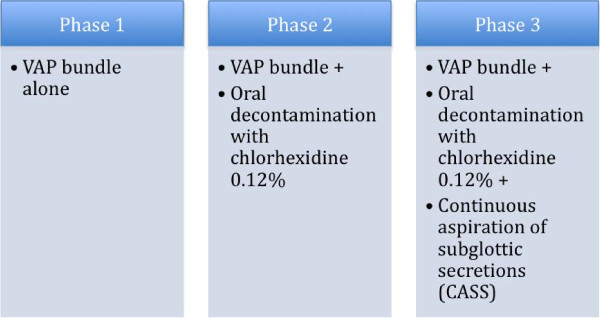
A quasi-experimental study was conducted in a medical-surgical ICU. Multiple interventions to optimize VAP prevention were performed from October 2008 to December 2010. All of these processes, including the Institute for Healthcare Improvement's (IHI) ventilator bundle plus oral decontamination with chlorhexidine and continuous aspiration of subglottic secretions (CASS), were adopted for patients undergoing mechanical ventilation.
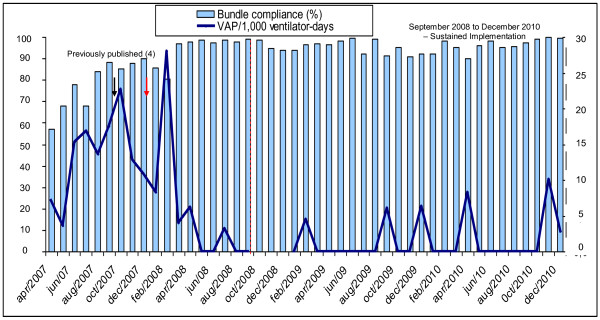
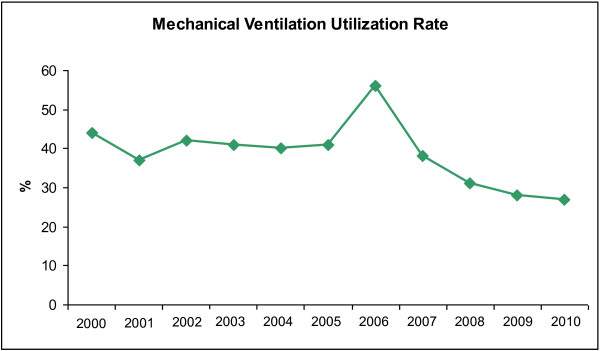
We evaluated a total of 21,984 patient-days, and a total of 6,052 ventilator-days (ventilator utilization rate of 0.27). We found VAP rates of 1.3 and 2.0 per 1,000 ventilator days respectively in 2009 and 2010, achieving zero incidence of VAP several times during 12 months, whenever VAP bundle compliance was over 90%.
These results suggest that it is possible to reduce VAP rates to near zero and sustain these rates, but it requires a complex process involving multiple performance measures and interventions that must be permanently monitored.
呼吸机相关性肺炎(VAP)是重症监护病房(ICU)中常见的感染,与高死亡率相关。
在一个外科重症监护病房进行了一项准实验研究。从 2008 年 10 月至 2010 年 12 月,实施了多项优化 VAP 预防的干预措施。所有这些过程,包括医疗保健改进研究所(IHI)的呼吸机捆绑包加氯己定口腔消毒和持续抽吸声门下分泌物(CASS),都用于接受机械通气的患者。
我们评估了总共 21984 个患者日和 6052 个呼吸机日(呼吸机使用率为 0.27)。我们发现 2009 年和 2010 年的 VAP 发生率分别为每 1000 个呼吸机日 1.3 和 2.0,在 12 个月内,每当 VAP 捆绑包的依从性超过 90%时,就有几次 VAP 的发生率为零。
这些结果表明,有可能将 VAP 发生率降低到接近零,并维持这些率,但需要一个涉及多个绩效措施和干预的复杂过程,必须永久监测。