Department of Food Safety and Food Quality, Ghent University, Ghent,
PLoS Med. 2012;9(9):e1001313. doi: 10.1371/journal.pmed.1001313. Epub 2012 Sep 18.
Recently, operational organizations active in child nutrition in developing countries have suggested that blanket feeding strategies be adopted to enable the prevention of child wasting. A new range of nutritional supplements is now available, with claims that they can prevent wasting in populations at risk of periodic food shortages. Evidence is lacking as to the effectiveness of such preventive interventions. This study examined the effect of a ready-to-use supplementary food (RUSF) on the prevention of wasting in 6- to 36-mo-old children within the framework of a general food distribution program.
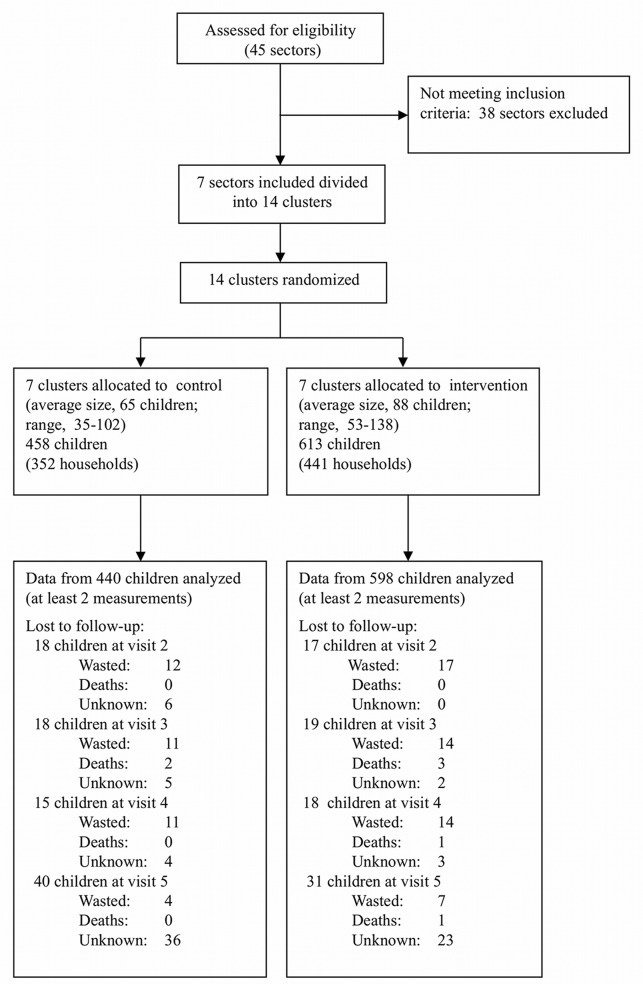
We conducted a two-arm cluster-randomized controlled pragmatic intervention study in a sample of 1,038 children aged 6 to 36 mo in the city of Abeche, Chad. Both arms were included in a general food distribution program providing staple foods. The intervention group was given a daily 46 g of RUSF for 4 mo. Anthropometric measurements and morbidity were recorded monthly. Adding RUSF to a package of monthly household food rations for households containing a child assigned to the intervention group did not result in a reduction in cumulative incidence of wasting (incidence risk ratio: 0.86; 95% CI: 0.67, 1.11; p = 0.25). However, the intervention group had a modestly higher gain in height-for-age (+0.03 Z-score/mo; 95% CI: 0.01, 0.04; p<0.001). In addition, children in the intervention group had a significantly higher hemoglobin concentration at the end of the study than children in the control group (+3.8 g/l; 95% CI: 0.6, 7.0; p = 0.02), thereby reducing the odds of anemia (odds ratio: 0.52; 95% CI: 0.34, 0.82; p = 0.004). Adding RUSF also resulted in a significantly lower risk of self-reported diarrhea (-29.3%; 95% CI: 20.5, 37.2; p<0.001) and fever episodes (-22.5%; 95% CI: 14.0, 30.2; p<0.001). Limitations of this study include that the projected sample size was not fully attained and that significantly fewer children from the control group were present at follow-up sessions.
Providing RUSF as part of a general food distribution resulted in improvements in hemoglobin status and small improvements in linear growth, accompanied by an apparent reduction in morbidity.
ClinicalTrials.gov NCT01154595 Please see later in the article for the Editors' Summary.
最近,发展中国家从事儿童营养工作的运营机构建议采用普遍喂养策略,以预防儿童消瘦。现在有一系列新的营养补充剂,据称它们可以预防有周期性食物短缺风险的人群发生消瘦。然而,这些预防干预措施的效果尚缺乏证据。本研究在普遍食物分发方案的框架内,考察了一种即食补充食品(RUSF)对 6-36 月龄儿童预防消瘦的效果。
我们在乍得阿贝歇市进行了一项 1038 名 6-36 月龄儿童的两臂整群随机对照实用干预研究。两组均纳入普遍食物分发方案,提供主食。干预组每日给予 46 克 RUSF,持续 4 个月。每月记录人体测量和发病率数据。在包含被分配到干预组的儿童的家庭的每月家庭口粮中添加 RUSF,并未导致消瘦的累积发生率降低(发生率风险比:0.86;95%CI:0.67,1.11;p=0.25)。然而,干预组的身高增长速度略高(每月+0.03 个 Z 评分;95%CI:0.01,0.04;p<0.001)。此外,与对照组相比,干预组儿童在研究结束时的血红蛋白浓度显著升高(+3.8 g/L;95%CI:0.6,7.0;p=0.02),从而降低了贫血的风险(比值比:0.52;95%CI:0.34,0.82;p=0.004)。添加 RUSF 还显著降低了腹泻(-29.3%;95%CI:20.5,37.2;p<0.001)和发热(-22.5%;95%CI:14.0,30.2;p<0.001)的发生率。本研究的局限性包括预期的样本量未完全达到,并且对照组中明显较少的儿童参加了随访。
在普遍食物分发中添加 RUSF 可改善血红蛋白状况,并使线性生长略有改善,同时发病率明显降低。
ClinicalTrials.gov NCT01154595 请在文章稍后查看编辑摘要。