Department of Physiology, University of Oslo, Oslo, Norway.
PLoS One. 2012;7(9):e44740. doi: 10.1371/journal.pone.0044740. Epub 2012 Sep 28.
All-trans retinoic acid (atRA), an active derivative of vitamin A, regulates cell differentiation, proliferation and cardiac morphogenesis via transcriptional activation of retinoic acid receptors (RARs) acting on retinoic acid response elements (RARE). We hypothesized that the retinoic acid (RA) signalling pathway is activated in myocardial ischemia and postischemic remodelling.
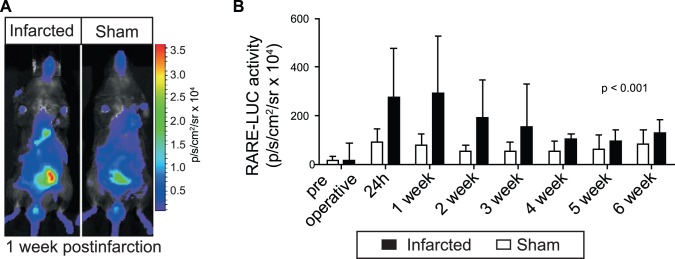
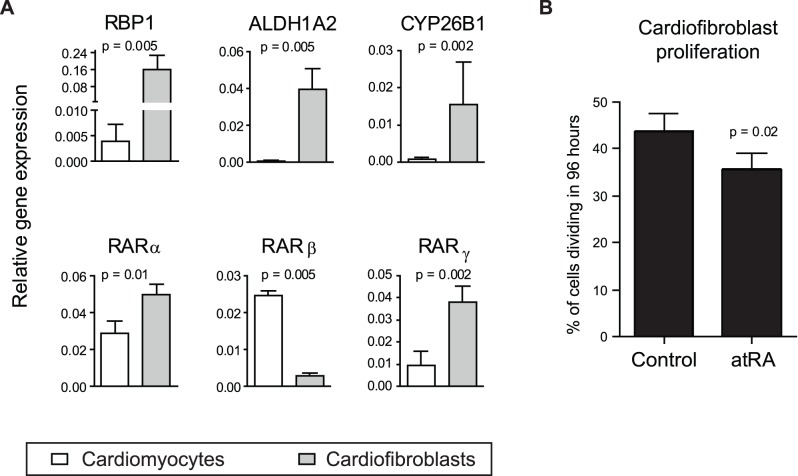
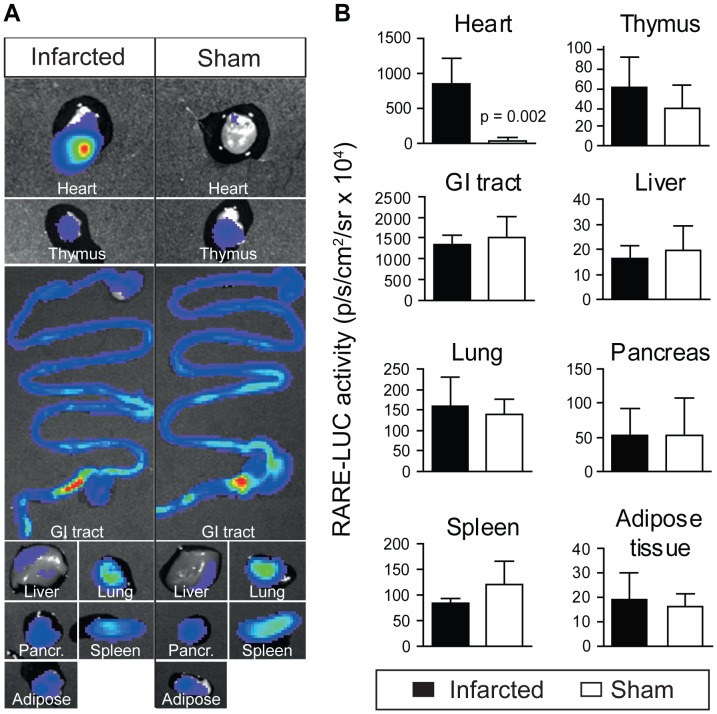
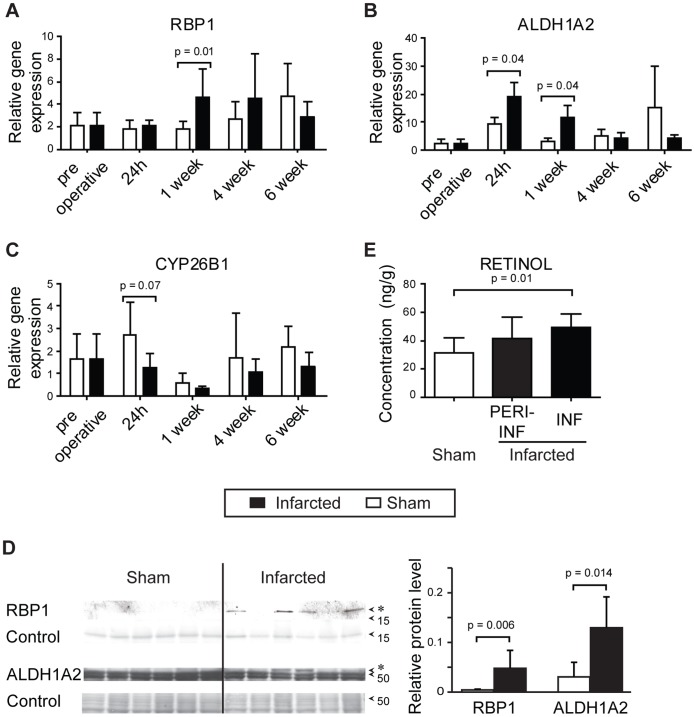
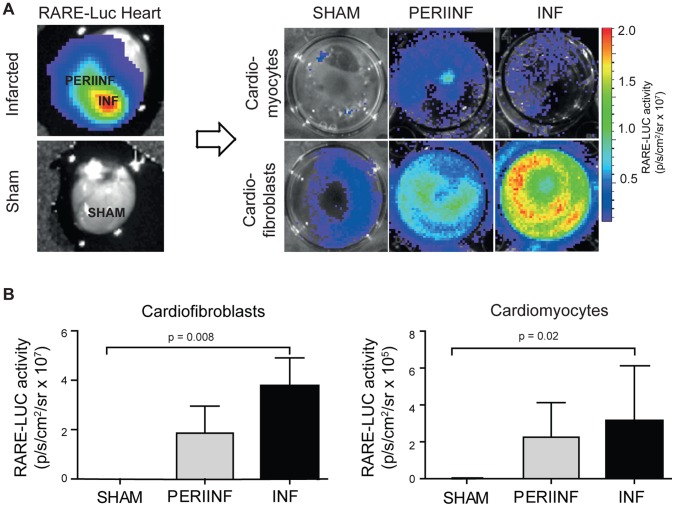
Myocardial infarction was induced through ligating the left coronary artery in mice. In vivo cardiac activation of the RARs was measured by imaging RARE-luciferase reporter mice, and analysing expression of RAR target genes and proteins by real time RT-PCR and western blot. Endogenous retinoids in postinfarcted hearts were analysed by triple-stage liquid chromatography/tandem mass spectrometry. Cardiomyocytes (CM) and cardiofibroblasts (CF) were isolated from infarcted and sham operated RARE luciferase reporter hearts and monitored for RAR activity and expression of target genes. The effect of atRA on CF proliferation was evaluated by EdU incorporation. Myocardial infarction increased thoracic RAR activity in vivo (p<0.001), which was ascribed to the heart through ex vivo imaging (p = 0.002) with the largest signal 1 week postinfarct. This was accompanied by increased cardiac gene and protein expression of the RAR target genes retinol binding protein 1 (p = 0.01 for RNA, p = 0,006 for protein) and aldehyde dehydrogenase 1A2 (p = 0.04 for RNA, p = 0,014 for protein), while gene expression of cytochrome P450 26B1 was downregulated (p = 0.007). Concomitantly, retinol accumulated in the infarcted zone (p = 0.02). CM and CF isolated from infarcted hearts had higher luminescence than those from sham operated hearts (p = 0.02 and p = 0.008). AtRA inhibited CF proliferation in vitro (p = 0.02).
The RA signalling pathway is activated in postischemic hearts and may play a role in regulation of damage and repair during remodelling.
全反式视黄酸(atRA)是维生素 A 的一种活性衍生物,通过激活视黄酸受体(RARs)并作用于视黄酸反应元件(RARE)来调节细胞分化、增殖和心脏形态发生。我们假设视黄酸(RA)信号通路在心肌缺血和缺血后重塑中被激活。
通过结扎小鼠左冠状动脉诱导心肌梗死。通过对 RARE 荧光素酶报告小鼠进行成像,分析实时 RT-PCR 和 Western blot 检测的 RAR 靶基因和蛋白的表达,来测量体内 RAR 的激活。通过三阶段液相色谱/串联质谱分析梗死心脏中的内源性视黄醇。从梗死和假手术 RARE 荧光素酶报告心脏中分离心肌细胞(CM)和心成纤维细胞(CF),并监测 RAR 活性和靶基因的表达。通过 EdU 掺入评估 atRA 对 CF 增殖的影响。心肌梗死增加了体内胸 RAR 活性(p<0.001),通过体外成像(p=0.002)确定该信号来源于心脏,最大信号出现在梗死 1 周后。这伴随着 RAR 靶基因视黄醇结合蛋白 1(p=0.01 为 RNA,p=0.006 为蛋白)和醛脱氢酶 1A2(p=0.04 为 RNA,p=0.014 为蛋白)的心脏基因和蛋白表达增加,而细胞色素 P450 26B1 的基因表达下调(p=0.007)。同时,视黄醇在梗死区积累(p=0.02)。与假手术心脏相比,来自梗死心脏的 CM 和 CF 的发光强度更高(p=0.02 和 p=0.008)。AtRA 在体外抑制 CF 增殖(p=0.02)。
RA 信号通路在缺血后心脏中被激活,可能在重塑过程中调节损伤和修复。