Neurology Department, Parkinson Disease Research Laboratory, Baylor College of Medicine, Houston, Texas, USA.
PLoS One. 2012;7(9):e45183. doi: 10.1371/journal.pone.0045183. Epub 2012 Sep 19.
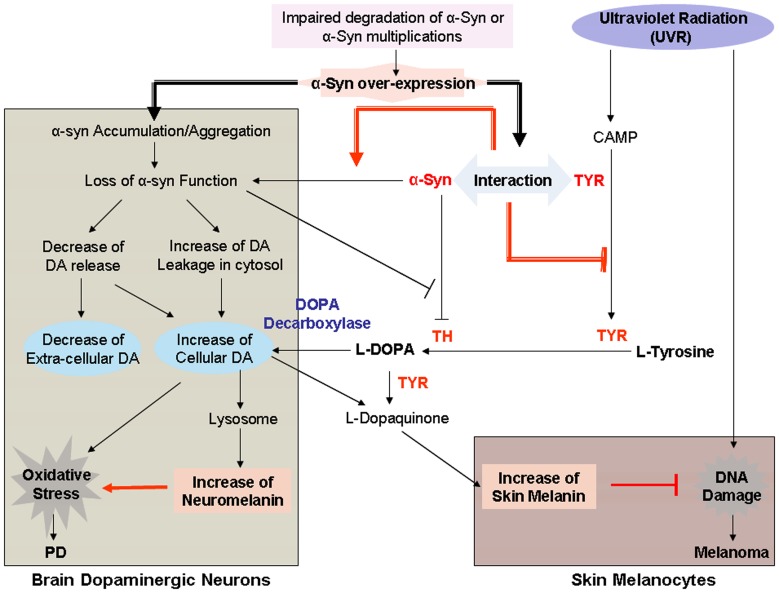
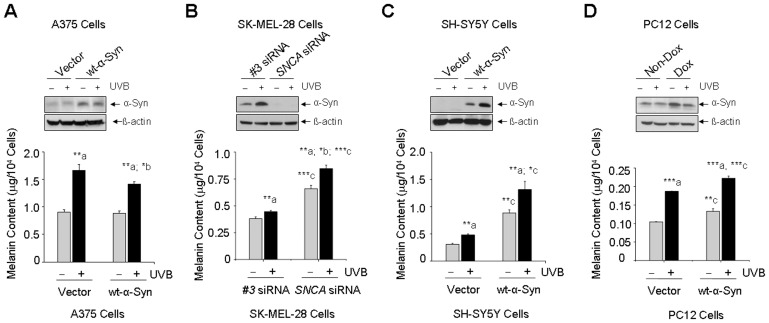
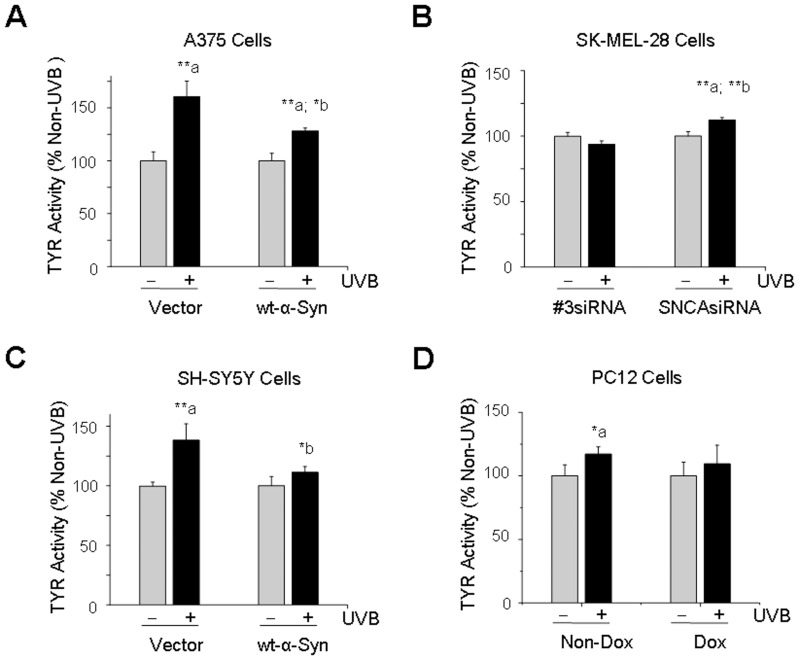
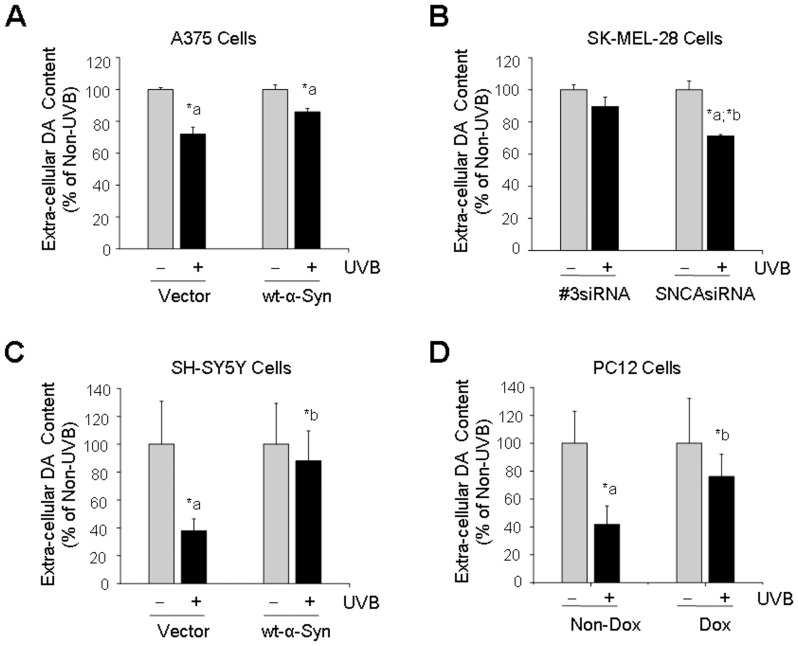
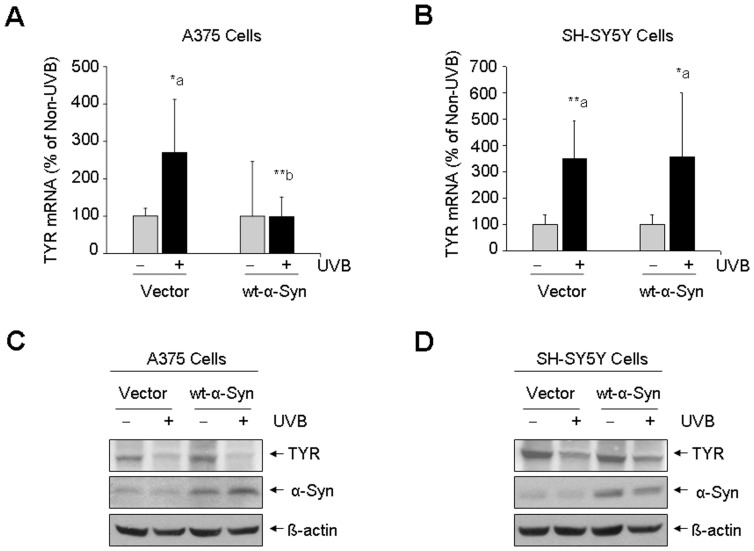
The relatively high co-occurrence of Parkinson's disease (PD) and melanoma has been established by a large number of epidemiological studies. However, a clear biological explanation for this finding is still lacking. Ultra-violet radiation (UVR)-induced skin melanin synthesis is a defense mechanism against UVR-induced damage relevant to the initiation of melanoma, whereas, increased neuromelanin (NM), the melanin synthesized in dopaminergic neurons, may enhance the susceptibility to oxidative stress-induced neuronal injury relevant to PD. SNCA is a PD-causing gene coding for alpha-Synuclein (α-Syn) that expresses not only in brain, but also in skin as well as in tumors, such as melanoma. The findings that α-Syn can interact with tyrosinase (TYR) and inhibit tyrosine hydroxylase (TH), both of which are enzymes involved in the biosynthesis of melanin and dopamine (DA), led us to propose that α-Syn may participate in the regulation of melanin synthesis. In this study, by applying ultraviolet B (UVB) light, a physiologically relevant stimulus of melanogenesis, we detected melanin synthesis in A375 and SK-MEL-28 melanoma cells and in SH-SY5Y and PC12 dopaminergic neuronal cells and determined effects of α-Syn on melanin synthesis. Our results showed that UVB light exposure increased melanin synthesis in all 4 cell lines. However, we found that α-Syn expression reduced UVB light-induced increase of melanin synthesis and that melanin content was lower when melanoma cells were expressed with α-Syn, indicating that α-Syn may have inhibitory effects on melanin synthesis in melanoma cells. Different from melanoma cells, the melanin content was higher in α-Syn-over-expressed dopaminergic neuronal SH-SY5Y and PC12 cells, cellular models of PD, than that in non-α-Syn-expressed control cells. We concluded that α-Syn could be one of the points responsible for the positive association between PD and melanoma via its differential roles in melanin synthesis in melanoma cells and in dopaminergic neuronal cells.
大量的流行病学研究已经证实帕金森病 (PD) 和黑色素瘤的发病率较高。然而,对于这一发现,目前仍然缺乏明确的生物学解释。紫外线 (UVR) 诱导的皮肤黑色素合成是一种对抗 UVR 诱导损伤的防御机制,与黑色素瘤的发生有关,而多巴胺能神经元中合成的神经黑色素 (NM) 增加,可能会增加氧化应激诱导的神经元损伤的易感性,与 PD 有关。SNCA 是一个导致帕金森病的基因,编码α-突触核蛋白 (α-Syn),它不仅在大脑中表达,而且在皮肤和肿瘤(如黑色素瘤)中也有表达。α-Syn 可以与酪氨酸酶 (TYR) 相互作用并抑制酪氨酸羟化酶 (TH) 的发现,这两种酶都参与黑色素和多巴胺 (DA) 的生物合成,这使我们提出 α-Syn 可能参与黑色素合成的调节。在这项研究中,我们应用紫外线 B (UVB) 光作为黑色素生物合成的生理相关刺激物,检测了 A375 和 SK-MEL-28 黑色素瘤细胞以及 SH-SY5Y 和 PC12 多巴胺能神经元细胞中的黑色素合成,并确定了 α-Syn 对黑色素合成的影响。我们的结果表明,UVB 光照射增加了这 4 种细胞系中的黑色素合成。然而,我们发现 α-Syn 表达降低了 UVB 光诱导的黑色素合成增加,并且当黑色素瘤细胞表达 α-Syn 时黑色素含量较低,表明 α-Syn 可能对黑色素瘤细胞中的黑色素合成具有抑制作用。与黑色素瘤细胞不同,α-Syn 过表达的多巴胺能神经元 SH-SY5Y 和 PC12 细胞(PD 的细胞模型)中的黑色素含量高于非 α-Syn 表达的对照细胞。我们得出结论,α-Syn 可能通过其在黑色素瘤细胞和多巴胺能神经元细胞中黑色素合成的不同作用,成为 PD 和黑色素瘤之间正相关的原因之一。