Max von Pettenkofer-Institut für Hygiene und Medizinische Mikrobiologie, Ludwig-Maximilians-Universität, München, Germany.
PLoS One. 2012;7(9):e45623. doi: 10.1371/journal.pone.0045623. Epub 2012 Sep 20.
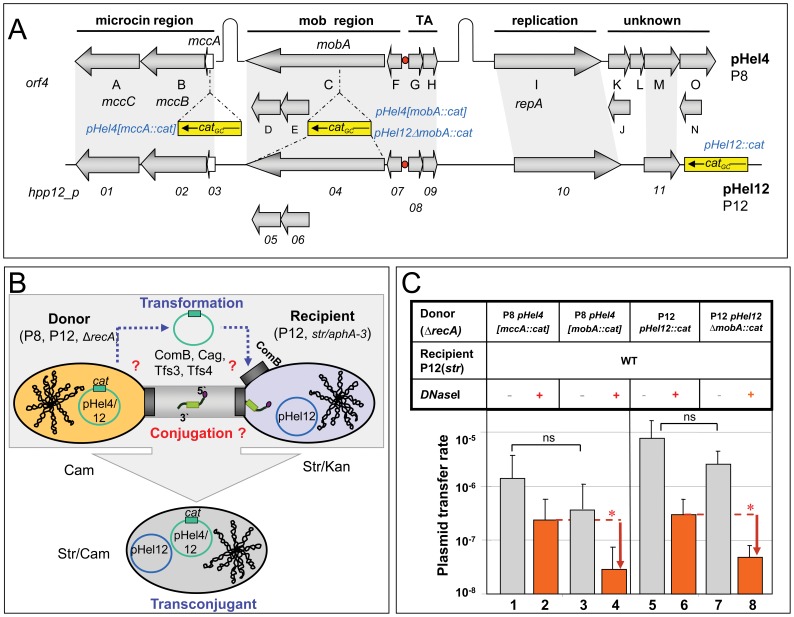
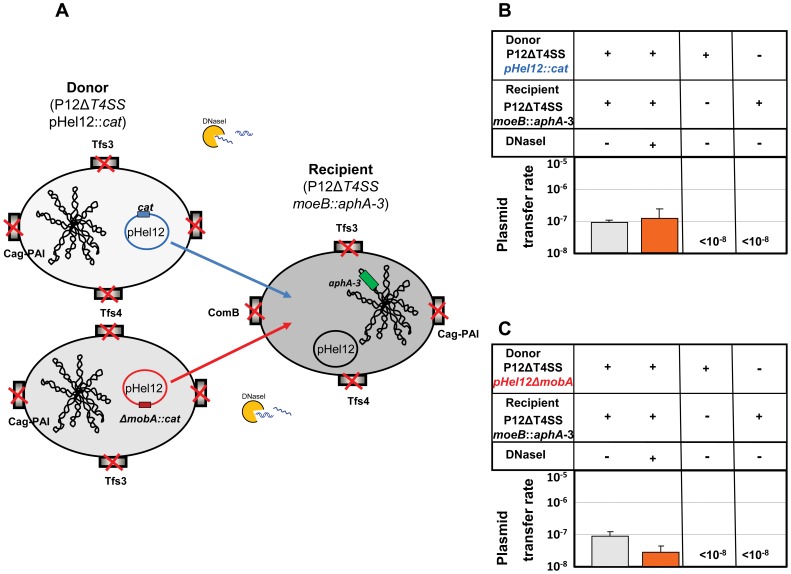
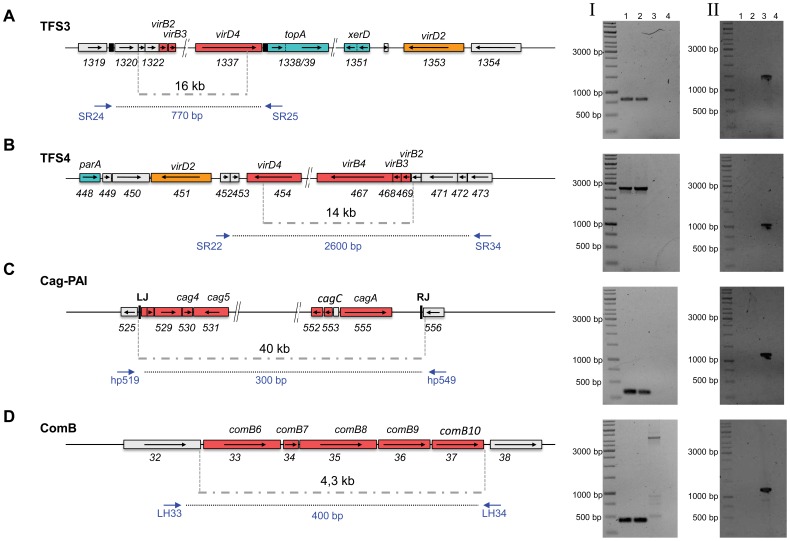
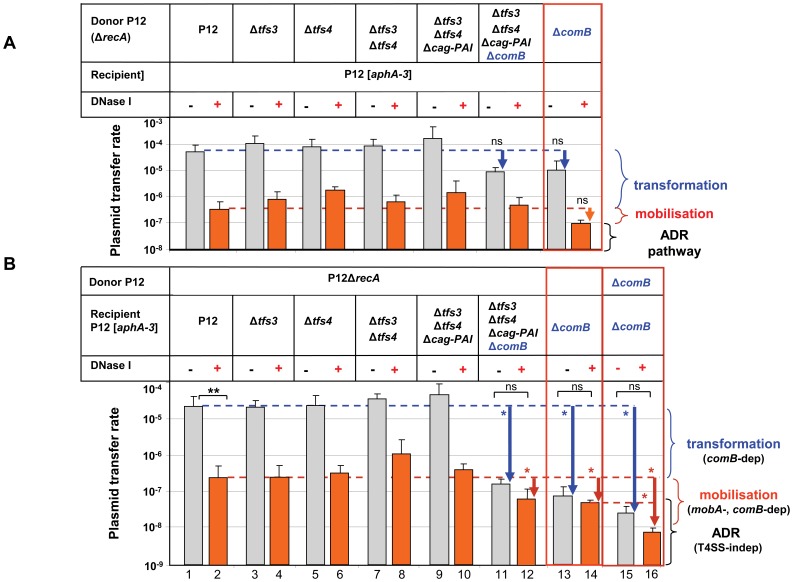
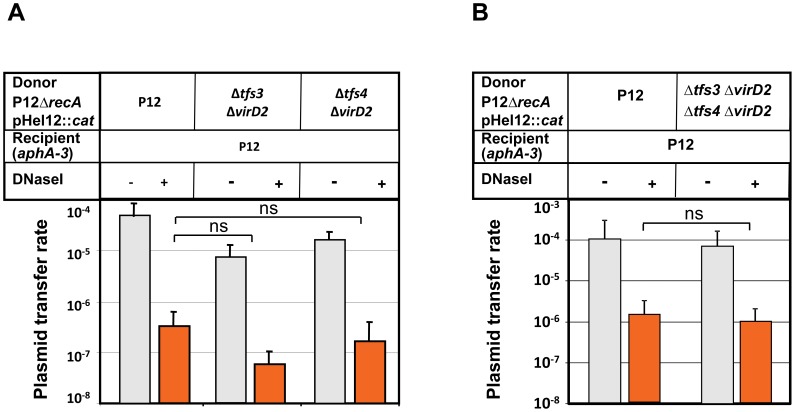
Many Helicobacter pylori (Hp) strains carry cryptic plasmids of different size and gene content, the function of which is not well understood. A subgroup of these plasmids (e.g. pHel4, pHel12), contain a mobilisation region, but no cognate type IV secretion system (T4SS) for conjugative transfer. Instead, certain H. pylori strains (e.g. strain P12 carrying plasmid pHel12) can harbour up to four T4SSs in their genome (cag-T4SS, comB, tfs3, tfs4). Here, we show that such indigenous plasmids can be efficiently transferred between H. pylori strains, even in the presence of extracellular DNaseI eliminating natural transformation. Knockout of a plasmid-encoded mobA relaxase gene significantly reduced plasmid DNA transfer in the presence of DNaseI, suggesting a DNA conjugation or mobilisation process. To identify the T4SS involved in this conjugative DNA transfer, each individual T4SS was consecutively deleted from the bacterial chromosome. Using a marker-free counterselectable gene deletion procedure (rpsL counterselection method), a P12 mutant strain was finally obtained with no single T4SS (P12ΔT4SS). Mating experiments using these mutants identified the comB T4SS in the recipient strain as the major mediator of plasmid DNA transfer between H. pylori strains, both in a DNaseI-sensitive (natural transformation) as well as a DNaseI-resistant manner (conjugative transfer). However, transfer of a pHel12::cat plasmid from a P12ΔT4SS donor strain into a P12ΔT4SS recipient strain provided evidence for the existence of a third, T4SS-independent mechanism of DNA transfer. This novel type of plasmid DNA transfer, designated as alternate DNaseI-Resistant (ADR) mechanism, is observed at a rather low frequency under in vitro conditions. Taken together, our study describes for the first time the existence of three distinct pathways of plasmid DNA transfer between H. pylori underscoring the importance of horizontal gene transfer for this species.
许多幽门螺杆菌(Hp)菌株携带大小和基因组成不同的隐秘质粒,其功能尚不清楚。这些质粒的亚组(例如 pHel4、pHel12)包含一个可移动区域,但没有用于共轭转移的同源 IV 型分泌系统(T4SS)。相反,某些幽门螺杆菌菌株(例如携带质粒 pHel12 的菌株 P12)可以在其基因组中携带多达四个 T4SS(cag-T4SS、comB、tfs3、tfs4)。在这里,我们表明,即使在存在消除天然转化的细胞外 DNaseI 的情况下,这种内源性质粒也可以在幽门螺杆菌菌株之间有效地转移。在存在 DNaseI 的情况下,质粒编码的 mobA 松弛酶基因的敲除显著降低了质粒 DNA 的转移,表明存在 DNA 共轭或移动过程。为了确定参与这种共轭 DNA 转移的 T4SS,我们依次从细菌染色体中删除了每个单独的 T4SS。使用无标记可选择基因缺失程序(rpsL 选择方法),最终获得了一种没有单个 T4SS 的 P12 突变株(P12ΔT4SS)。使用这些突变体进行的交配实验鉴定了受体菌株中的 comB T4SS 是幽门螺杆菌菌株之间质粒 DNA 转移的主要介导者,无论是在 DNaseI 敏感(天然转化)还是 DNaseI 抗性(共轭转移)的情况下。然而,从 P12ΔT4SS 供体菌株转移到 P12ΔT4SS 受体菌株的 pHel12::cat 质粒提供了存在第三种 T4SS 独立的 DNA 转移机制的证据。这种新型质粒 DNA 转移,称为替代 DNaseI-Resistant (ADR) 机制,在体外条件下以相当低的频率观察到。总之,我们的研究首次描述了幽门螺杆菌之间质粒 DNA 转移的三种不同途径的存在,强调了水平基因转移对该物种的重要性。