Laboratory of Virology, Faculty of Veterinary Medicine, Ghent University, Salisburylaan 133, Merelbeke, 9820, Belgium.
BMC Vet Res. 2012 Oct 3;8:182. doi: 10.1186/1746-6148-8-182.
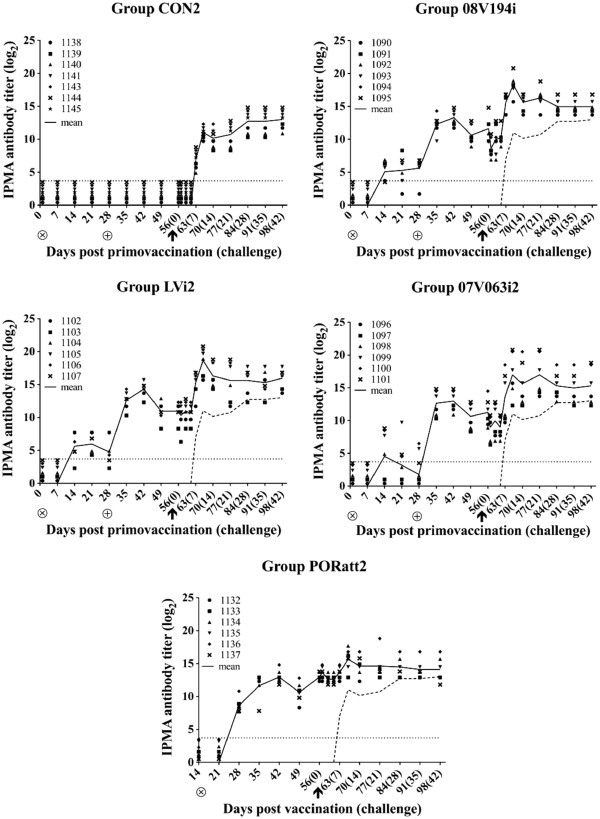
The porcine reproductive and respiratory syndrome virus (PRRSV) is a rapidly evolving pathogen of swine. At present, there is a high demand for safe and more effective vaccines that can be adapted regularly to emerging virus variants. A recent study showed that, by the use of a controlled inactivation procedure, an experimental BEI-inactivated PRRSV vaccine can be developed that offers partial protection against homologous challenge with the prototype strain LV. At present, it is however not known if this vaccine can be adapted to currently circulating virus variants. In this study, two recent PRRSV field isolates (07 V063 and 08 V194) were used for BEI-inactivated vaccine production. The main objective of this study was to assess the efficacy of these experimental BEI-inactivated vaccines against homologous and heterologous challenge and to compare it with an experimental LV-based BEI-inactivated vaccine and commercial inactivated and attenuated vaccines. In addition, the induction of challenge virus-specific (neutralizing) antibodies by the different vaccines was assessed.
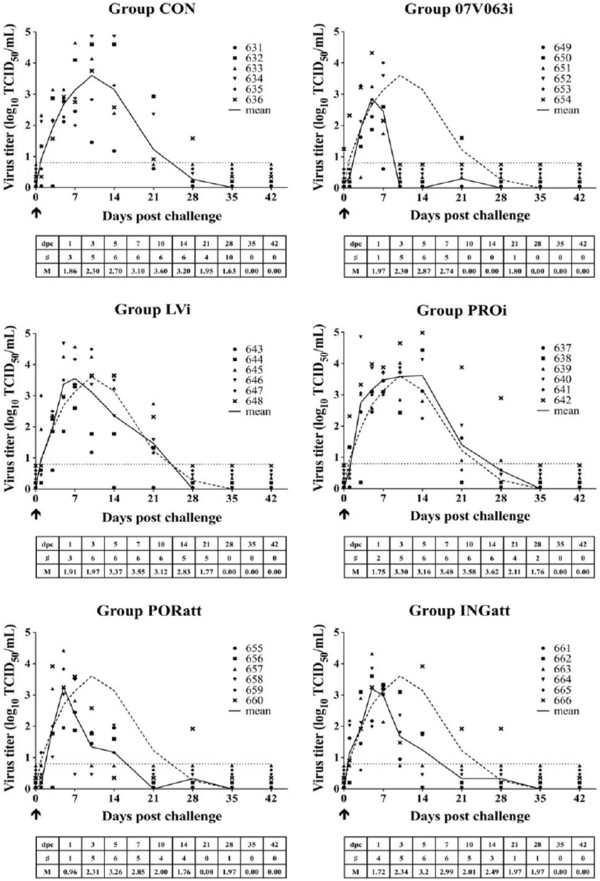
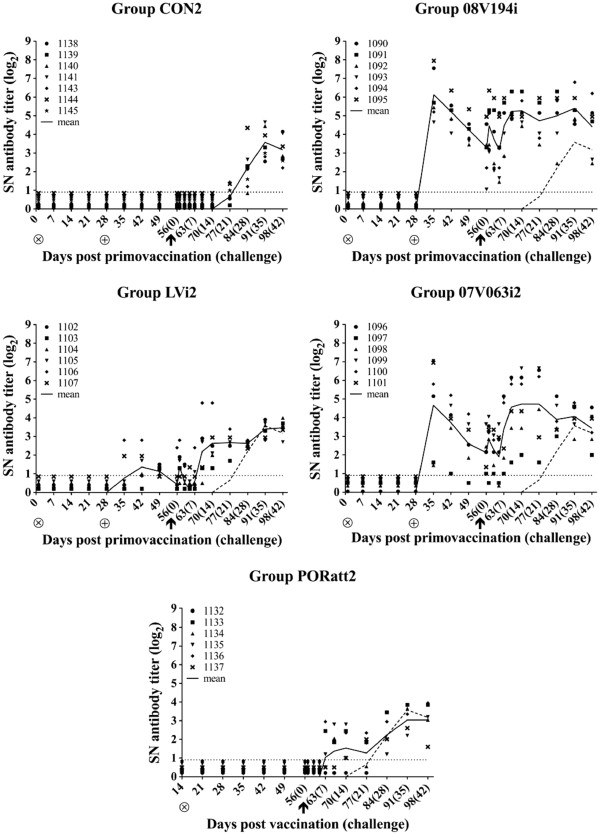
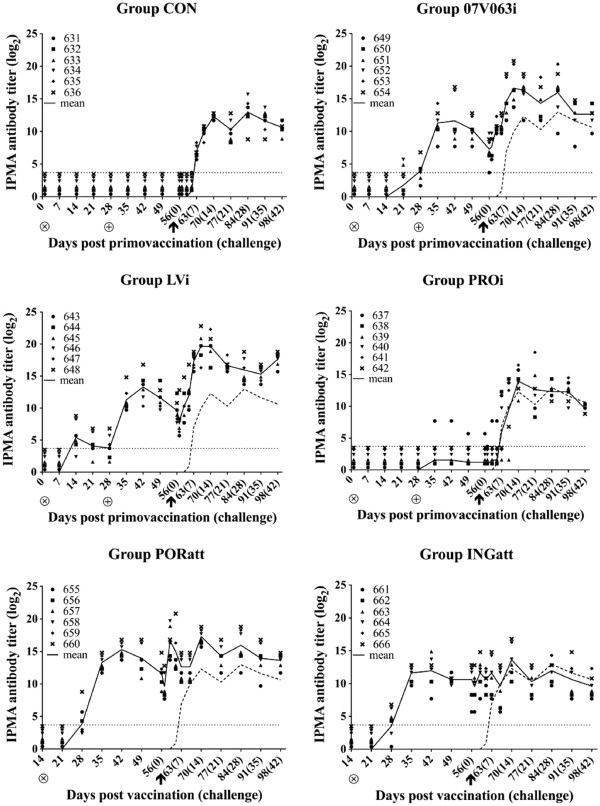
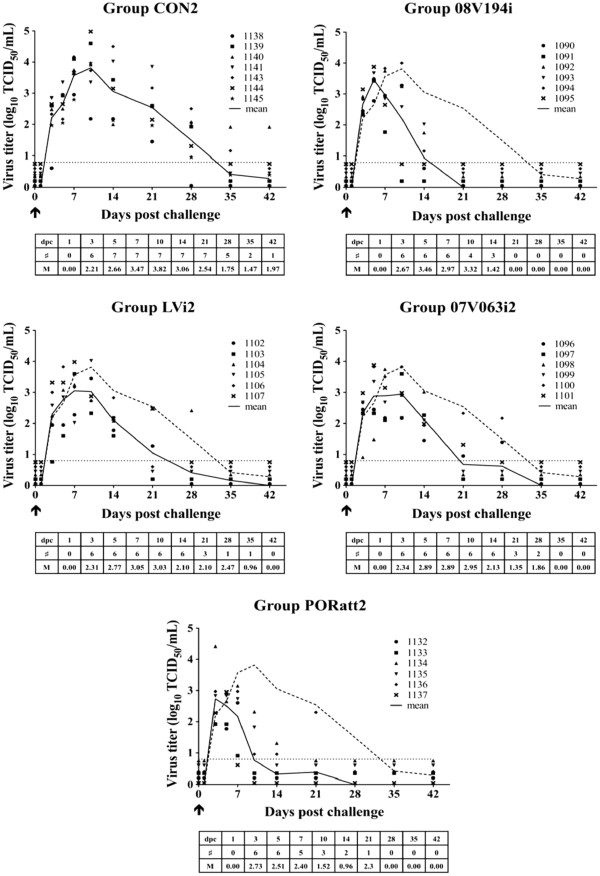
In a first experiment (challenge with 07 V063), vaccination with the experimental homologous (07 V063) inactivated vaccine shortened the viremic phase upon challenge with approximately 2 weeks compared to the mock-vaccinated control group. Vaccination with the commercial attenuated vaccines reduced the duration of viremia with approximately one week compared to the mock-vaccinated control group. In contrast, the experimental heterologous (LV) inactivated vaccine and the commercial inactivated vaccine did not influence viremia. Interestingly, both the homologous and the heterologous experimental inactivated vaccine induced 07 V063-specific neutralizing antibodies upon vaccination, while the commercial inactivated and attenuated vaccines failed to do so.In the second experiment (challenge with 08 V194), use of the experimental homologous (08 V194) inactivated vaccine shortened viremia upon challenge with approximately 3 weeks compared to the mock-vaccinated control group. Similar results were obtained with the commercial attenuated vaccine. The experimental heterologous (07 V063 and LV) inactivated vaccines did not significantly alter viremia. In this experiment, 08 V194-specific neutralizing antibodies were induced by the experimental homologous and heterologous inactivated vaccines and a faster appearance post challenge was observed with the commercial attenuated vaccine.
The experimental homologous inactivated vaccines significantly shortened viremia upon challenge. Despite the concerns regarding the efficacy of the commercial attenuated vaccines used on the farms where the field isolates were obtained, use of commercial attenuated vaccines clearly shortened the viremic phase upon challenge. In contrast, the experimental heterologous inactivated vaccines and the commercial inactivated vaccine had no or only a limited influence on viremia. The observation that homologous BEI-inactivated vaccines can provide a more or less standardized, predictable degree of protection against a specific virus variant suggests that such vaccines may prove useful in case virus variants emerge that escape the immunity induced by the attenuated vaccines.
猪繁殖与呼吸综合征病毒(PRRSV)是一种快速进化的猪病原体。目前,人们对安全且更有效的疫苗有很高的需求,这些疫苗能够定期适应新兴的病毒变异株。最近的一项研究表明,通过使用受控的失活程序,可以开发出一种实验性的 BEI 失活 PRRSV 疫苗,该疫苗能为同源性攻毒提供部分保护,原型株为 LV。目前,尚不清楚该疫苗是否能适应目前流行的病毒变异株。在本研究中,使用了最近的两个 PRRSV 田间分离株(07V063 和 08V194)来生产 BEI 失活疫苗。本研究的主要目的是评估这些实验性 BEI 失活疫苗对同源性和异源性攻毒的疗效,并与实验性基于 LV 的 BEI 失活疫苗和商业灭活和减毒疫苗进行比较。此外,还评估了不同疫苗诱导的攻毒病毒特异性(中和)抗体的产生情况。
在第一个实验(用 07V063 攻毒)中,与模拟疫苗接种组相比,用同源性(07V063)实验性灭活疫苗接种可将攻毒后的病毒血症期缩短约 2 周。与模拟疫苗接种组相比,商业减毒疫苗接种可将病毒血症期缩短约 1 周。相比之下,实验性异源性(LV)灭活疫苗和商业灭活疫苗并不影响病毒血症。有趣的是,同源性和异源性实验性灭活疫苗均可诱导产生针对 07V063 的特异性中和抗体,而商业灭活和减毒疫苗则不能。在第二个实验(用 08V194 攻毒)中,用同源性(08V194)实验性灭活疫苗接种可将攻毒后的病毒血症期缩短约 3 周,与模拟疫苗接种组相比。商业减毒疫苗也得到了类似的结果。实验性异源性(07V063 和 LV)灭活疫苗对病毒血症无显著影响。在本实验中,实验性同源性和异源性灭活疫苗均可诱导产生针对 08V194 的特异性中和抗体,且在商业减毒疫苗接种后更快地出现。
实验性同源性灭活疫苗在攻毒后可显著缩短病毒血症期。尽管人们对在田间分离株获得的农场中使用的商业减毒疫苗的疗效存在担忧,但商业减毒疫苗的使用明显缩短了病毒血症期。相比之下,实验性异源性灭活疫苗和商业灭活疫苗对病毒血症的影响较小或有限。同源性 BEI 灭活疫苗能在一定程度上提供针对特定病毒变异株的标准化、可预测的保护作用,这表明在出现逃避减毒疫苗诱导免疫的病毒变异株时,此类疫苗可能具有一定的应用价值。