University of Vienna, Institute of Inorganic Chemistry, Währinger Straße 42, A-1090 Vienna, Austria.
J Inorg Biochem. 2012 Nov;116(5):180-7. doi: 10.1016/j.jinorgbio.2012.06.003. Epub 2012 Jun 13.
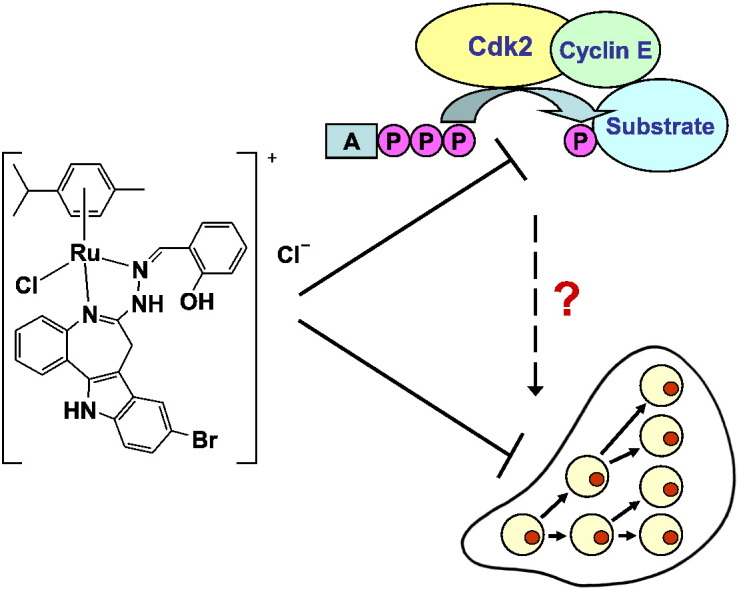
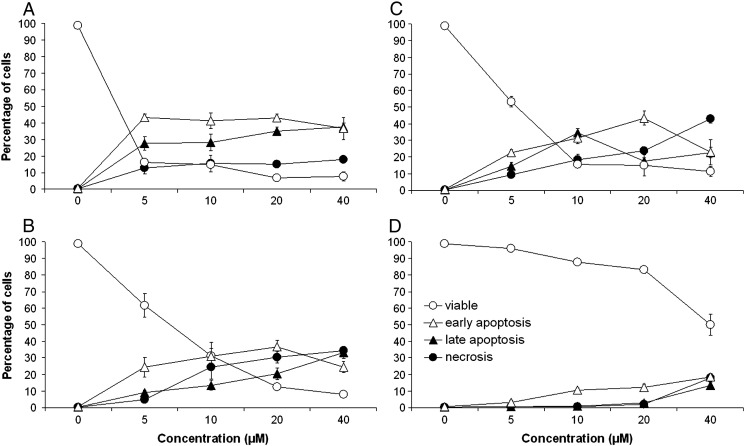
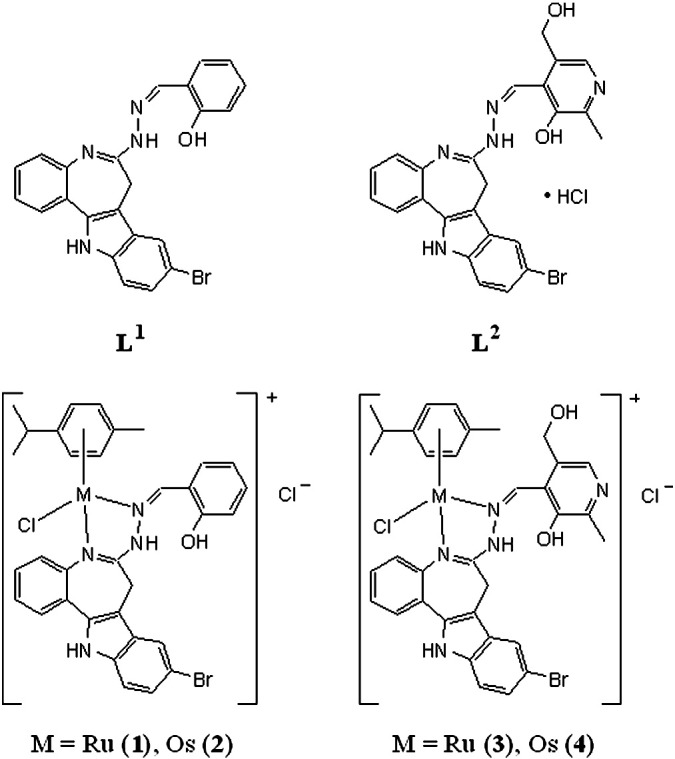
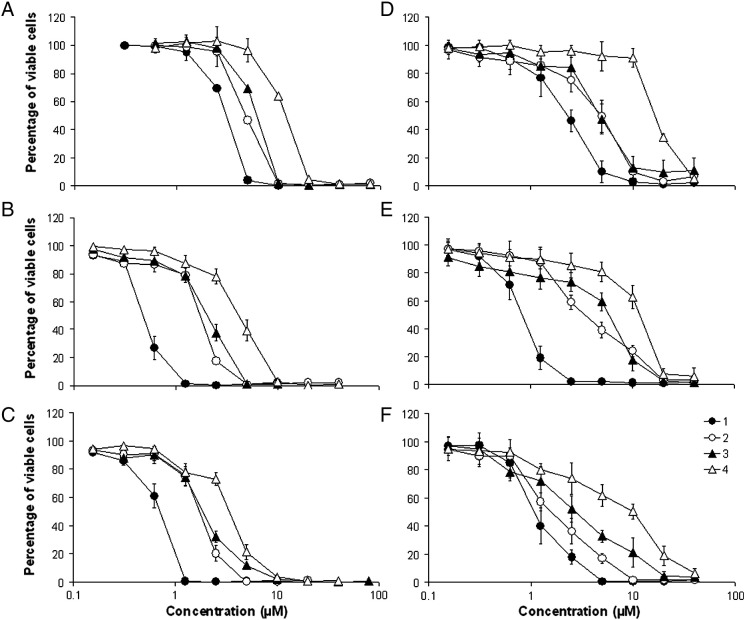
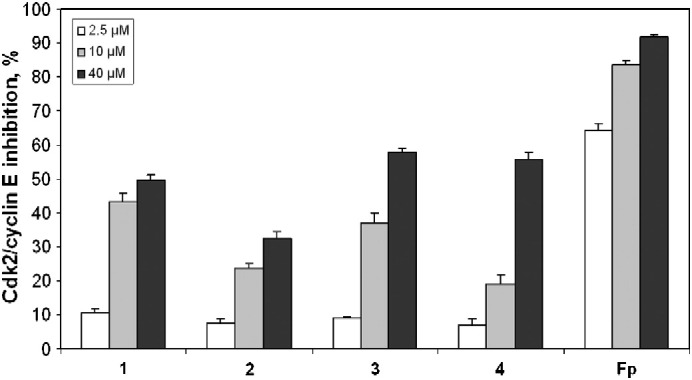
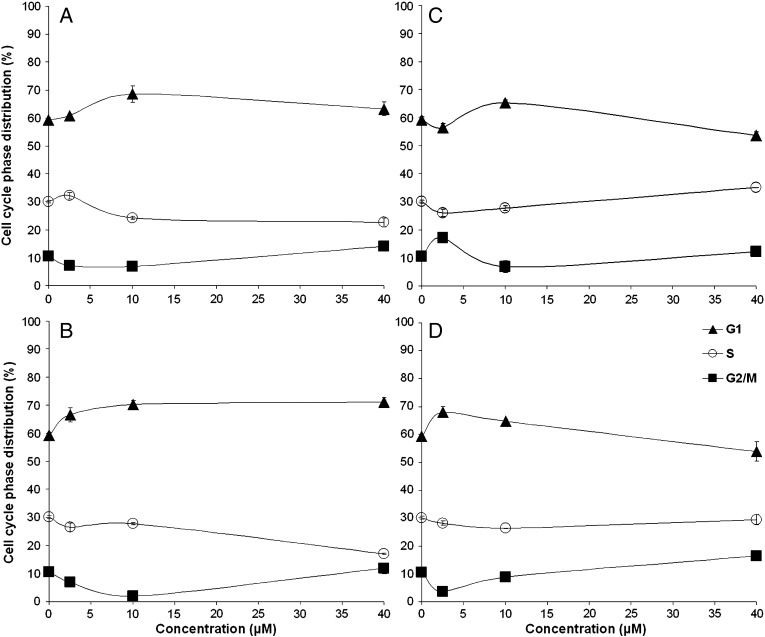
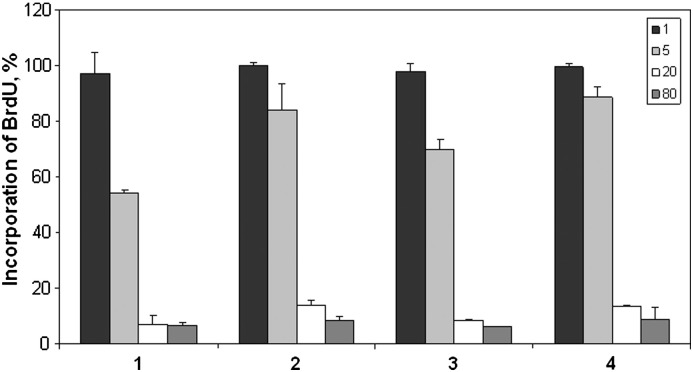
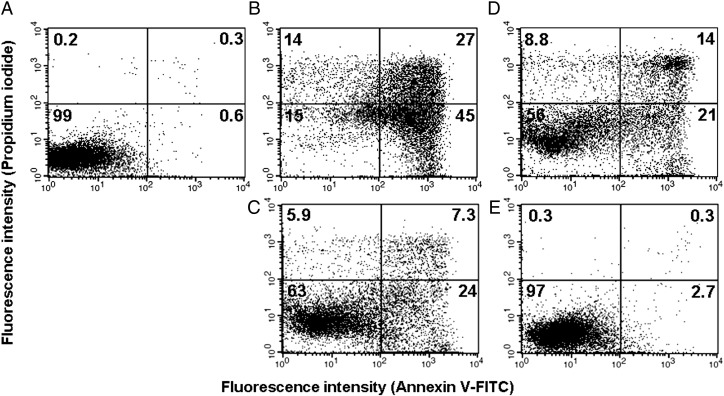
In an attempt to combine the ability of indolobenzazepines (paullones) to inhibit cyclin-dependent kinases (Cdks) and that of platinum-group metal ions to interact with proteins and DNA, ruthenium(II) and osmium(II) arene complexes with paullones were prepared, expecting synergies and an increase of solubility of paullones. Complexes with the general formula [M(II)Cl(η(6)-p-cymene)L]Cl, where M=Ru (1, 3) or Os (2, 4), and L=L(1) (1, 2) or L(2) (3, 4), L(1)=N-(9-bromo-7,12-dihydroindolo[3,2-d][1]-benzazepin-6(5H)-yliden-N'-(2-hydroxybenzylidene)azine and L(2)=N-(9-bromo-7,12-dihydroindolo[3,2-d][1]benzazepin-6-yl)-N'-[3-hydroxy-5-(hydroxymethyl)-2-methylpyridin-4-yl-methylene]azinium chloride (L(2)(*)HCl), were now investigated regarding cytotoxicity and accumulation in cancer cells, impact on the cell cycle, capacity of inhibiting DNA synthesis and inducing apoptosis as well as their ability to inhibit Cdk activity. The MTT (3-(4,5-dimethyl-2-thiazolyl)-2,5-diphenyl-2H-tetrazolium bromide) assay yielded IC(50) values in the nanomolar to low micromolar range. In accordance with cytotoxicity data, the BrdU assay showed that 1 is the most and 4 the least effective of these compounds regarding inhibition of DNA synthesis. Effects on the cell cycle are minor, although concentration-dependent inhibition of Cdk2/cyclin E activity was observed in cell-free experiments. Induction of apoptosis is most pronounced for complex 1, accompanied by a low fraction of necrotic cells, as observed by annexin V-fluorescein isothiocyanate/propidium iodide staining and flow cytometric analysis.
为了结合吲哚并苯并氮杂卓(保罗酮)抑制细胞周期蛋白依赖性激酶(Cdks)的能力和铂族金属离子与蛋白质和 DNA 相互作用的能力,制备了钌(II)和锇(II)芳烃与保罗酮的配合物,期望协同作用并增加保罗酮的溶解度。具有通式[M(II)Cl(η(6)-p-cymene)L]Cl 的配合物,其中 M=Ru(1、3)或 Os(2、4),和 L=L(1)(1、2)或 L(2)(3、4),L(1)=N-(9-溴-7,12-二氢吲哚并[3,2-d][1]-苯并氮杂卓-6(5H)-亚基-N'-(2-羟基亚苄基)嗪和 L(2)=N-(9-溴-7,12-二氢吲哚并[3,2-d][1]苯并氮杂卓-6-基)-N'-[3-羟基-5-(羟甲基)-2-甲基吡啶-4-基-亚甲基]嗪盐酸盐(L(2)(*)HCl),现在对其细胞毒性和在癌细胞中的积累、对细胞周期的影响、抑制 DNA 合成和诱导细胞凋亡的能力以及抑制 Cdk 活性的能力进行了研究。MTT(3-(4,5-二甲基-2-噻唑基)-2,5-二苯基-2H-四唑溴盐)测定法得出的 IC(50)值在纳摩尔至低微摩尔范围内。与细胞毒性数据一致,BrdU 测定法表明,在这些化合物中,1 是抑制 DNA 合成最有效的,而 4 是最无效的。对细胞周期的影响较小,尽管在无细胞实验中观察到对 Cdk2/细胞周期蛋白 E 活性的浓度依赖性抑制。复合物 1 诱导细胞凋亡的作用最为明显,同时伴有较低比例的坏死细胞,如通过 Annexin V-荧光素异硫氰酸酯/碘化丙啶染色和流式细胞术分析观察到的。