Social Epidemiology and Evaluation Research Group, Sansom Institute for Health Research and School of Health Sciences, University of South Australia, Adelaide, SA 5001, Australia.
J Environ Public Health. 2012;2012:589409. doi: 10.1155/2012/589409. Epub 2012 Sep 25.
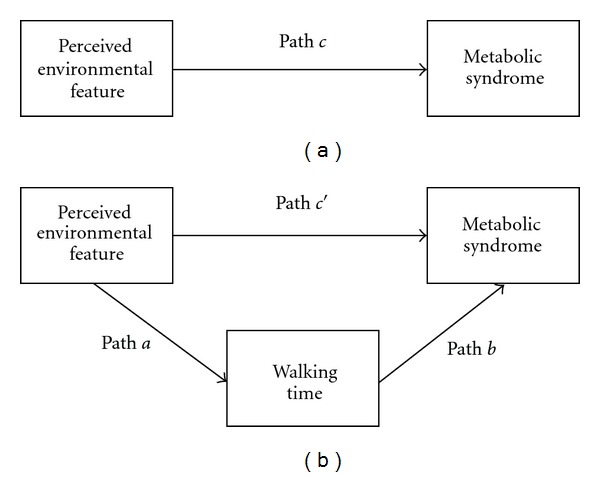
A substantial body of research has arisen concerning the relationships between objective residential area features, particularly area-level socioeconomic status and cardiometabolic outcomes. Little research has explored residents' perceptions of such features and how these might relate to cardiometabolic outcomes. Perceptions of environments are influenced by individual and societal factors, and may not correspond to objective reality. Understanding relations between environmental perceptions and health is important for the development of environment interventions. This study evaluated associations between perceptions of local built and social environmental attributes and metabolic syndrome, and tested whether walking behaviour mediated these associations. Individual-level data were drawn from a population-based biomedical cohort study of adults in Adelaide, South Australia (North West Adelaide Health Study). Participants' local-area perceptions were analysed in cross-sectional associations with metabolic syndrome using multilevel regression models (n = 1, 324). A nonparametric bootstrapping procedure evaluated whether walking mediated these associations. Metabolic syndrome was negatively associated with greater local land-use mix, positive aesthetics, and greater infrastructure for walking, and was positively associated with greater perceived crime and barriers to walking. Walking partially mediated associations between metabolic syndrome and perceived environmental features. Initiatives targeting residents' perceptions of local areas may enhance the utility of environmental interventions to improve population health.
大量研究探讨了客观居住区域特征(特别是区域社会经济地位)与心血管代谢结局之间的关系。但很少有研究探讨居民对这些特征的感知,以及这些感知如何与心血管代谢结局相关。环境感知受个体和社会因素的影响,可能与客观现实不符。了解环境感知与健康之间的关系对于环境干预措施的制定非常重要。本研究评估了个体对当地建筑和社会环境属性的感知与代谢综合征之间的关系,并检验了步行行为是否在这些关联中起中介作用。个体水平的数据来自澳大利亚阿德莱德(南澳大利亚西北部)的一项基于人群的成年人生物医学队列研究(西北阿德莱德健康研究)。使用多层次回归模型(n = 1,324)分析了参与者的局部区域感知与代谢综合征的横断面关联。非参数自举程序评估了步行是否在这些关联中起中介作用。代谢综合征与更高的局部土地利用混合、积极的美学和更多的步行基础设施呈负相关,与更高的感知犯罪和步行障碍呈正相关。步行部分中介了代谢综合征与感知环境特征之间的关联。针对居民对当地环境的感知的举措可能会增强环境干预措施改善人群健康的效果。