Danish Research Centre for Magnetic Resonance, Copenhagen University Hospital, Hvidovre, Denmark.
Eur Neuropsychopharmacol. 2013 Aug;23(8):919-30. doi: 10.1016/j.euroneuro.2012.09.006. Epub 2012 Oct 7.
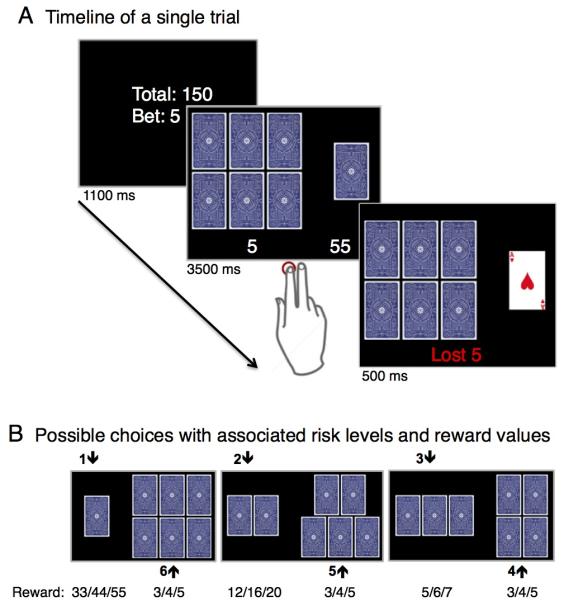
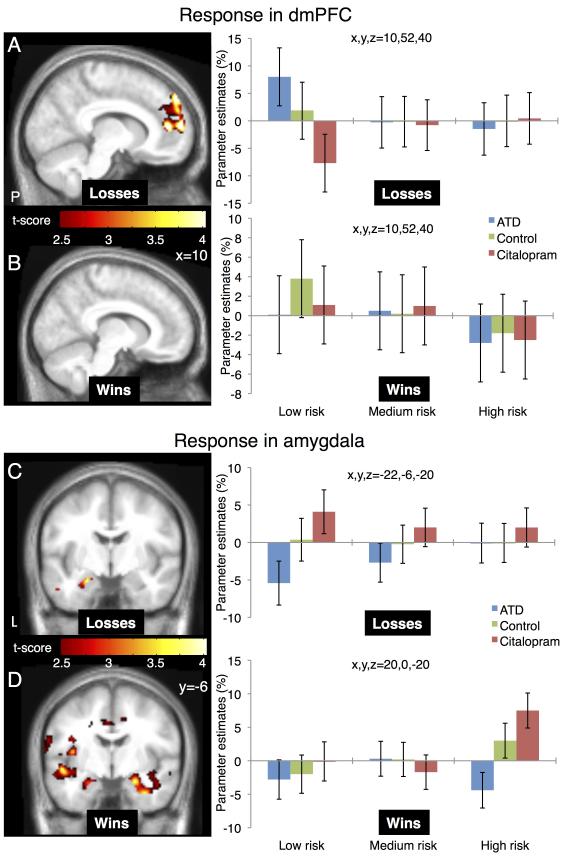
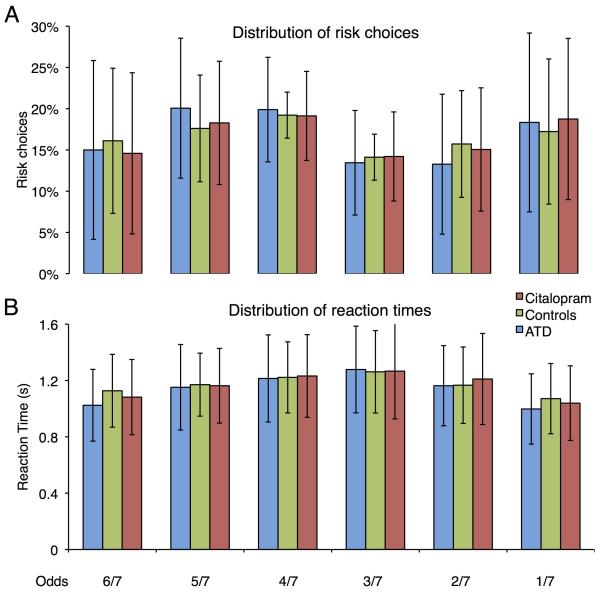
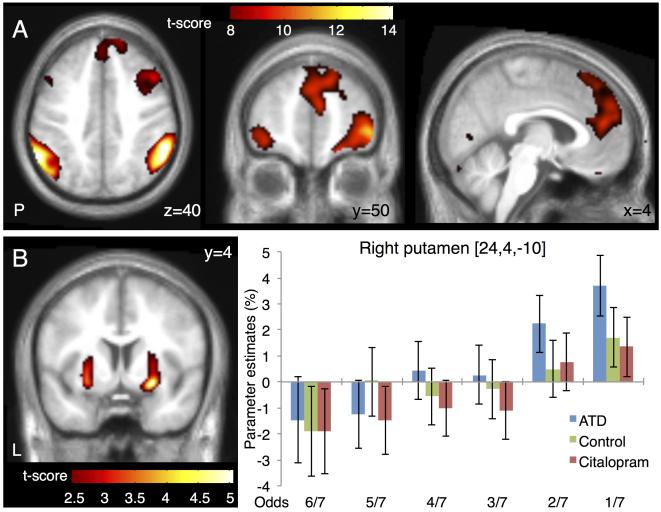
Risk avoidance is an important determinant of human behavior. The neurotransmitter serotonin has been implicated in processing negative outcomes caused by risky decisions. However, it is unclear whether serotonin provides a neurobiological link between making a risk aversive decision and the response to a negative outcome. Using pharmacological fMRI, we manipulated the availability of serotonin in healthy volunteers while performing a gambling task. The same group of participants was studied in three fMRI sessions: (i) during intravenous administration of the SSRI citalopram to increase the serotonergic tone, (ii) after acute tryptophan depletion (ATD) to reduce central serotonin levels, or (iii) without interventions. ATD and citalopram had opposite effects on outcome related activity in dorsomedial prefrontal cortex (dmPFC) and amygdala. Relative to the control condition, ATD increased and citalopram decreased the neural response to negative outcomes in dmPFC. Conversely, ATD decreased and citalopram increased the neural response to negative outcomes in left amygdala. Critically, these pharmacological effects were restricted to negative outcomes that were caused by low-risk decisions and led to a high missed reward. ATD and citalopram did not alter the neural response to positive outcomes in dmPFC, but relative to ATD, citalopram produced a bilateral increase in the amygdala response to large wins caused by high-risk choices. The results show a selective involvement of the serotonergic system in neocortical processing of negative outcomes resulting from risk-averse decisions, thereby linking risk aversion and processing of negative outcomes in goal-directed behaviors.
风险规避是人类行为的一个重要决定因素。神经递质 5-羟色胺(serotonin)被认为参与了处理由风险决策引起的负面结果。然而,目前尚不清楚 5-羟色胺是否为做出风险规避决策和对负面结果做出反应之间提供了神经生物学联系。我们使用药理学 fMRI 技术,在健康志愿者执行赌博任务时操纵 5-羟色胺的可利用性。同一组参与者在三个 fMRI 会话中进行了研究:(i)静脉内给予 SSRI 西酞普兰以增加 5-羟色胺能神经递质的张力,(ii)急性色氨酸耗竭(ATD)以降低中枢 5-羟色胺水平,或(iii)无干预。与对照条件相比,ATD 增加而西酞普兰减少了 dmPFC 和杏仁核中与负面结果相关的活动的神经反应。相反,ATD 减少而西酞普兰增加了 dmPFC 中负面结果的神经反应。重要的是,这些药物作用仅限于由低风险决策引起并导致高错过奖励的负面结果。ATD 和西酞普兰没有改变 dmPFC 中对正性结果的神经反应,但与 ATD 相比,西酞普兰增加了双侧杏仁核对高风险选择导致的大赢的反应。结果表明,5-羟色胺系统选择性地参与了风险规避决策导致的负性结果的新皮层处理,从而将风险规避与目标导向行为中对负性结果的处理联系起来。