CIMMYT, Apdo Postal 6-641, 06600, Mexico, D. F., Mexico.
Theor Appl Genet. 2013 Feb;126(2):389-99. doi: 10.1007/s00122-012-1987-3. Epub 2012 Oct 2.
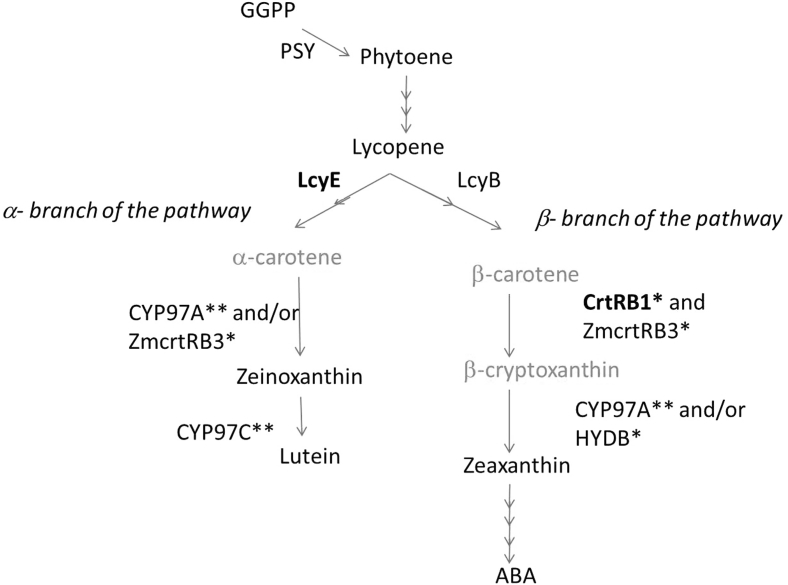
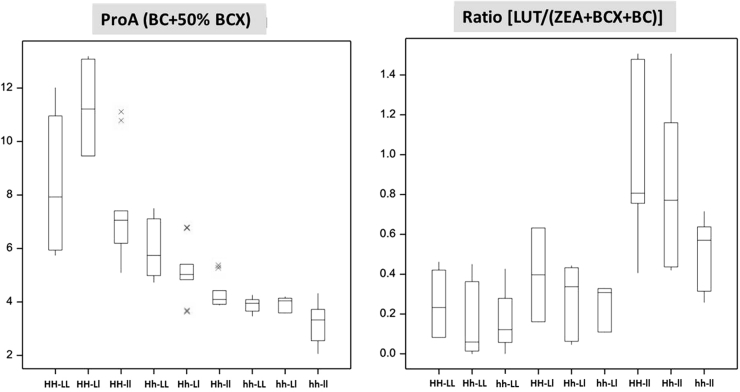
Vitamin A deficiency (VAD) compromises immune function and is the leading cause of preventable blindness in children in many developing countries. Biofortification, or breeding staple food crops that are rich in micronutrients, provides a sustainable way to fight VAD and other micronutrient malnutrition problems. Polymorphisms, with associated molecular markers, have recently been identified for two loci, LcyE (lycopene epsilon cyclase) and CrtRB1 (β-carotene hydroxylase 1) that govern critical steps in the carotenoid biosynthetic pathway in maize endosperm, thereby enabling the opportunity to integrate marker-assisted selection (MAS) into carotenoid breeding programs. We validated the effects of 3 polymorphisms (LcyE5'TE, LcyE3'Indel and CrtRB1-3'TE) in 26 diverse tropical genetic backgrounds. CrtRB1-3'TE had a two-ten fold effect on enhancing beta-carotene (BC) and total provitamin A (proA) content. Reduced-function, favorable polymorphisms within LcyE resulted in 0-30 % reduction in the ratio of alpha- to beta-branch carotenoids, and increase in proA content (sometimes statistically significant). CrtRB1-3'TE had large, significant effect on enhancing BC and total ProA content, irrespective of genetic constitution for LcyE5'TE. Genotypes with homozygous favorable CrtRB1-3'TE alleles had much less zeaxanthin and an average of 25 % less total carotenoid than other genotypes, suggesting that feedback inhibition may be reducing the total flux into the carotenoid pathway. Because this feedback inhibition was most pronounced in the homozygous favorable LcyE (reduced-function) genotypes, and because maximum total proA concentrations were achieved in genotypes with homozygous unfavorable or heterozygous LcyE, we recommend not selecting for both reduced-function genes in breeding programs. LcyE exhibited significant segregation distortion (SD) in all the eight, while CrtRB1 in five of eight digenic populations studied, with favorable alleles of both the genes frequently under-represented. MAS using markers reported herein can efficiently increase proA carotenoid concentration in maize.
维生素 A 缺乏症(VAD)会损害免疫功能,是许多发展中国家儿童可预防失明的主要原因。生物强化,或者培育富含微量营养素的主食作物,为对抗 VAD 和其他微量营养素营养不良问题提供了一种可持续的方法。最近,在玉米胚乳中负责类胡萝卜素生物合成途径的两个基因座 LcyE(番茄红素ε环化酶)和 CrtRB1(β-胡萝卜素羟化酶 1)上,已经确定了与相关分子标记相关的多态性,从而使标记辅助选择(MAS)有机会整合到类胡萝卜素的选育计划中。我们在 26 个不同的热带遗传背景中验证了 3 个多态性(LcyE5'TE、LcyE3'Indel 和 CrtRB1-3'TE)的影响。CrtRB1-3'TE 使β-胡萝卜素(BC)和总维生素 A 前体(proA)含量增加了 2 到 10 倍。LcyE 内功能降低的有利多态性导致α-分支与β-分支类胡萝卜素的比例降低 0-30%,并增加 proA 含量(有时具有统计学意义)。CrtRB1-3'TE 对增强 BC 和总 ProA 含量有很大的、显著的影响,与 LcyE5'TE 的遗传组成无关。具有纯合有利 CrtRB1-3'TE 等位基因的基因型的玉米所含的玉米黄质和总类胡萝卜素平均比其他基因型少 25%,这表明反馈抑制可能会减少进入类胡萝卜素途径的总通量。由于这种反馈抑制在纯合有利 LcyE(功能降低)基因型中最为明显,并且在 LcyE 基因型为纯合不利或杂合时达到最大的总 proA 浓度,因此我们建议在选育计划中不要同时选择这两个功能降低的基因。LcyE 在所有 8 个双基因群体中表现出显著的分离失真(SD),而 CrtRB1 在研究的 8 个双基因群体中的 5 个中表现出显著的分离失真,两个基因的有利等位基因经常代表不足。使用本文报道的标记进行 MAS 可以有效地提高玉米中 proA 类胡萝卜素的浓度。