Ethicon Endo-Surgery (Europe), European Surgical Institute, Hamburg, Germany.
Obes Surg. 2013 Feb;23(2):184-96. doi: 10.1007/s11695-012-0765-2.
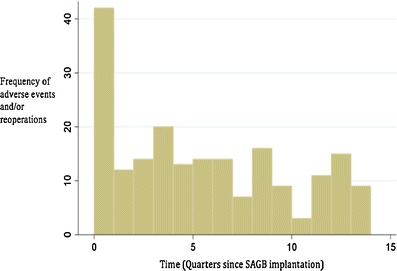
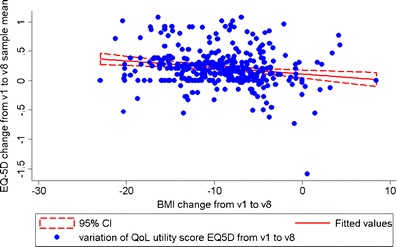
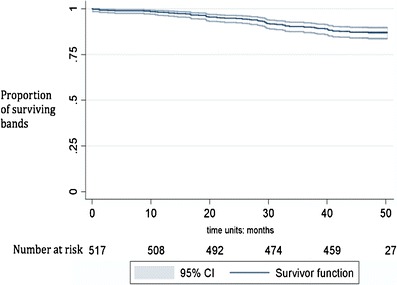
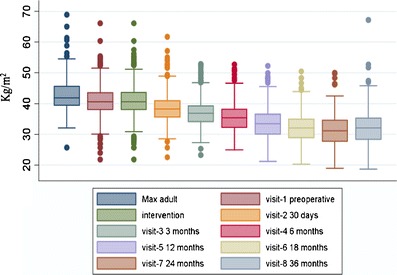
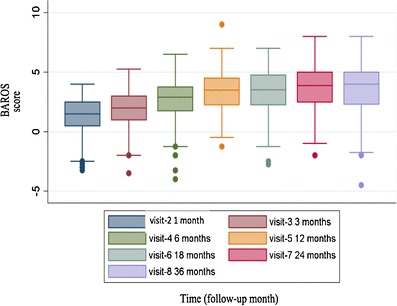
The study objective was to ascertain outcomes with the Swedish adjustable gastric band (SAGB) on an intention-to-treat basis in multiple centers across the French social health insurance system. SAGB results at 3-year follow-up are reported. The noncomparative, observational, prospective, consecutive cohort study design sought a 500-patient minimum recruitment geographically representative of continental France. Safety (adverse events [AEs], device-related morbidity, and mortality) and effectiveness (change in body mass index [BMI, kilograms per square meter], percentage excess weight loss, comorbidities, quality of life [QoL]) were assessed. Adjustable gastric band survival was calculated. Thirty-one surgeons in 28 multidisciplinary teams/sites enrolled patients between September 2, 2007 and April 30, 2008. SAGB was successfully implanted in 517 patients: 88.0 % female; mean age, 37.5 years; obesity duration, 15.3 years (baseline: mean BMI, 41.0; comorbidities, 773 in 74.3 % of patients; Bariatric Analysis and Reporting Outcome System (BAROS), 1.4; EuroQoL 5-Dimensions (EQ-5D), 0.61; EuroQoL-visual analog scale (EQ-VAS), 52.3). At 3 years: BMI, 32.2 (mean change, -9.0; p < 0.0001); excess weight loss, 47.4 %; comorbidities, 161 in 27.2 %; BAROS, 3.6 (+2.2, p < 0.0001); EQ-5D, 0.84 (+0.22, p < 0.0001); EQ-VAS, 73.4 (+21.4, p < 0.0001). SAGB-induced weight loss was associated with substantially improved QoL. One death occurred and was unrelated to the treatment. No AE was reported in 68.3 % of patients, and no confirmed device-related AE in 77.0 %. Overall AE rate was 0.19 per patient year. Device retention was 87.0 %. Analysis of patients lost to follow-up showed a nonsignificant effect on overall study results. In a prospective, consecutive cohort, "real-world", nationwide study, the Swedish Adjustable Gastric Band was found safe and effective at 3-year follow-up.
研究目的是以意向治疗为基础,确定法国社会健康保险体系中多个中心的瑞典可调节胃束带(SAGB)的结果。报告了 3 年随访时的 SAGB 结果。这项非比较、观察性、前瞻性、连续队列研究设计旨在招募至少 500 名患者,这些患者在地理上代表了法国大陆。安全性(不良事件[AE]、与设备相关的发病率和死亡率)和有效性(体重指数[BMI,千克/平方米]的变化、超重减轻百分比、合并症、生活质量[QoL])得到了评估。计算了可调胃束带的存活率。28 个多学科团队/地点的 31 名外科医生于 2007 年 9 月 2 日至 2008 年 4 月 30 日期间招募患者。517 名患者成功植入 SAGB:88.0%为女性;平均年龄 37.5 岁;肥胖持续时间 15.3 年(基线:平均 BMI 为 41.0;74.3%的患者有 773 种合并症;肥胖治疗结果系统(BAROS)为 1.4;欧洲五维健康量表(EQ-5D)为 0.61;欧洲五维健康量表视觉模拟量表(EQ-VAS)为 52.3)。3 年后:BMI 为 32.2(平均变化-9.0;p<0.0001);超重减轻 47.4%;合并症 27.2%,161 例;BAROS 为 3.6(+2.2,p<0.0001);EQ-5D 为 0.84(+0.22,p<0.0001);EQ-VAS 为 73.4(+21.4,p<0.0001)。SAGB 诱导的体重减轻与生活质量的显著改善相关。发生了 1 例死亡,与治疗无关。68.3%的患者未报告任何 AE,77.0%的患者未报告任何确认的与设备相关的 AE。总体 AE 发生率为每患者年 0.19。设备保留率为 87.0%。对失访患者的分析显示,对整体研究结果无显著影响。在一项前瞻性、连续队列、“真实世界”、全国性研究中,瑞典可调节胃束带在 3 年随访时被发现安全有效。