• 文献检索
  • 文档翻译
  • 深度研究
  • 学术资讯
  • Suppr Zotero 插件Zotero 插件
  • 邀请有礼
  • 套餐&价格
  • 历史记录
应用&插件
Suppr Zotero 插件Zotero 插件浏览器插件Mac 客户端Windows 客户端微信小程序
定价
高级版会员购买积分包购买API积分包
服务
文献检索文档翻译深度研究API 文档MCP 服务
关于我们
关于 Suppr公司介绍联系我们用户协议隐私条款
关注我们

Suppr 超能文献

核心技术专利:CN118964589B侵权必究
粤ICP备2023148730 号-1Suppr @ 2026

文献检索

告别复杂PubMed语法,用中文像聊天一样搜索,搜遍4000万医学文献。AI智能推荐,让科研检索更轻松。

立即免费搜索

文件翻译

保留排版,准确专业,支持PDF/Word/PPT等文件格式,支持 12+语言互译。

免费翻译文档

深度研究

AI帮你快速写综述,25分钟生成高质量综述,智能提取关键信息,辅助科研写作。

立即免费体验

丹麦五家医院全球触发工具审查经验:实施研究。

Experiences with global trigger tool reviews in five Danish hospitals: an implementation study.

机构信息

Department of Pulmonary Medicine and Infectious diseases, Hilleroed Hospital, Hilleroed, Denmark.

出版信息

BMJ Open. 2012 Oct 12;2(5). doi: 10.1136/bmjopen-2012-001324. Print 2012.

DOI:10.1136/bmjopen-2012-001324
PMID:23065451
原文链接:https://pmc.ncbi.nlm.nih.gov/articles/PMC3488702/
Abstract

OBJECTIVES

To describe experiences with the implementation of global trigger tool (GTT) reviews in five Danish hospitals and to suggest ways to improve the performance of GTT review teams.

DESIGN

Retrospective observational study.

SETTING

The measurement and monitoring of harms are crucial to campaigns to improve the safety of patients. Increasingly, teams use the GTT to review patient records and measure harms in English and non-English-speaking countries. Meanwhile, it is not clear as to how the method performs in such diverse settings.

PARTICIPANTS

Review teams from five Danish pilot hospitals of the national Danish Safer Hospital Programme.

PRIMARY AND SECONDARY OUTCOME MEASURES

We collected harm rates, background and anecdotal information and reported patient safety incidents (PSIs) from five pilot hospitals currently participating in the Danish Safer Hospital Programme. Experienced reviewers categorised harms by type. We plotted harm rates as run-charts and applied rules for the detection of patterns of non-random variation.

RESULTS

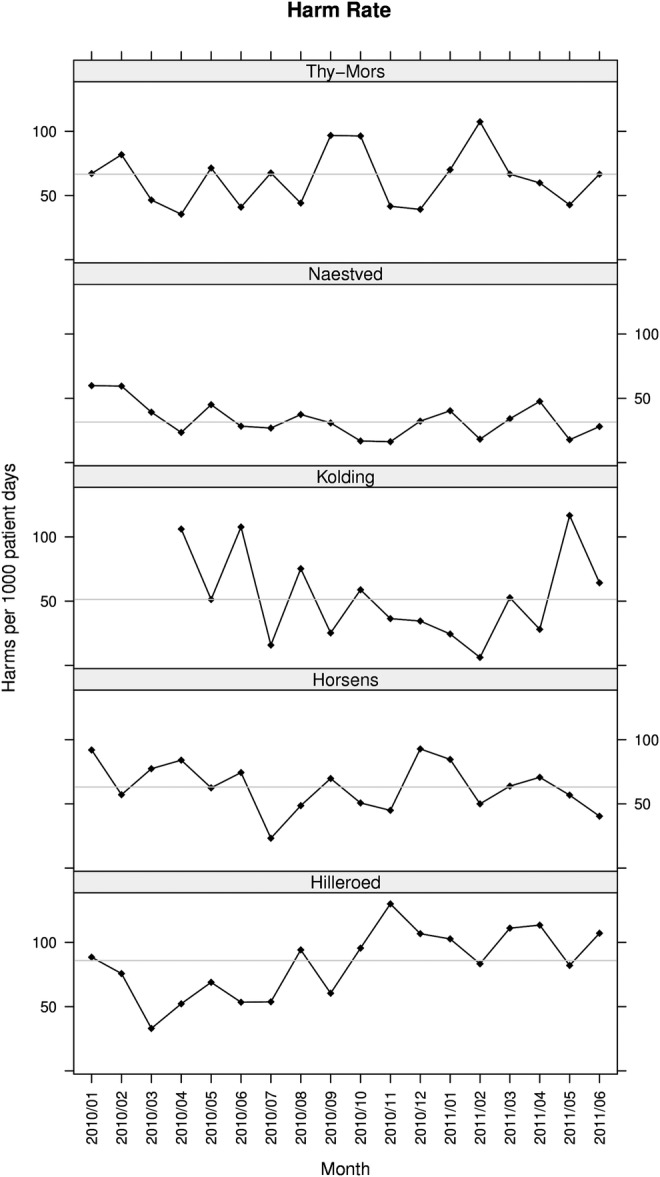
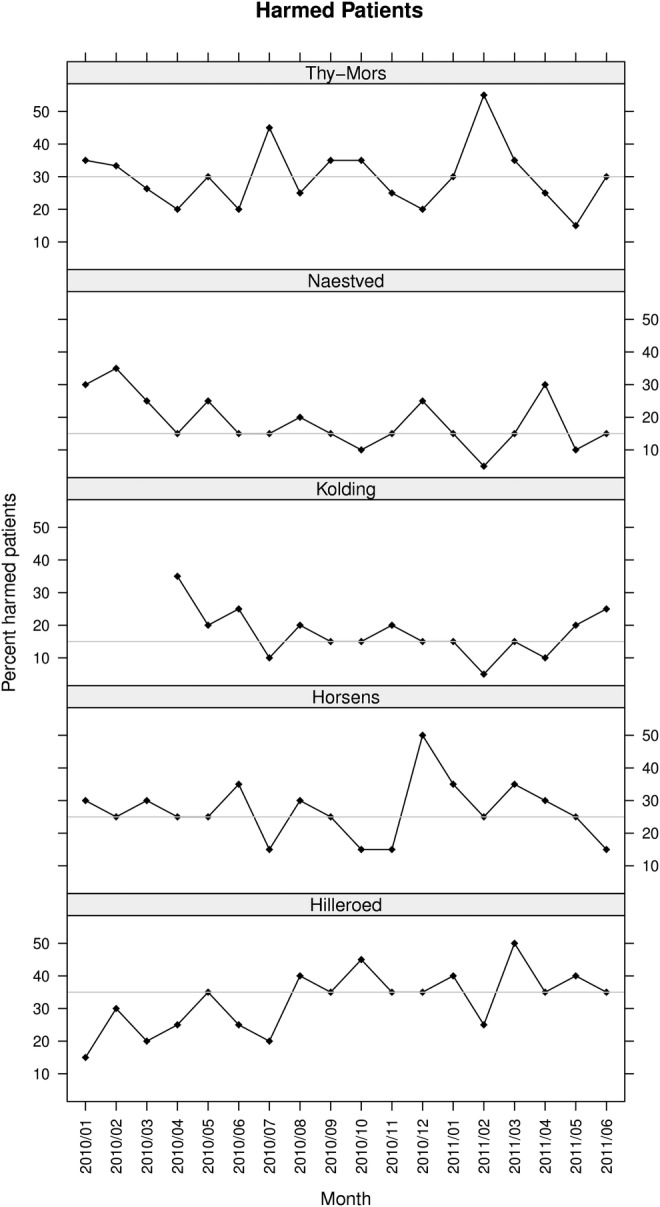
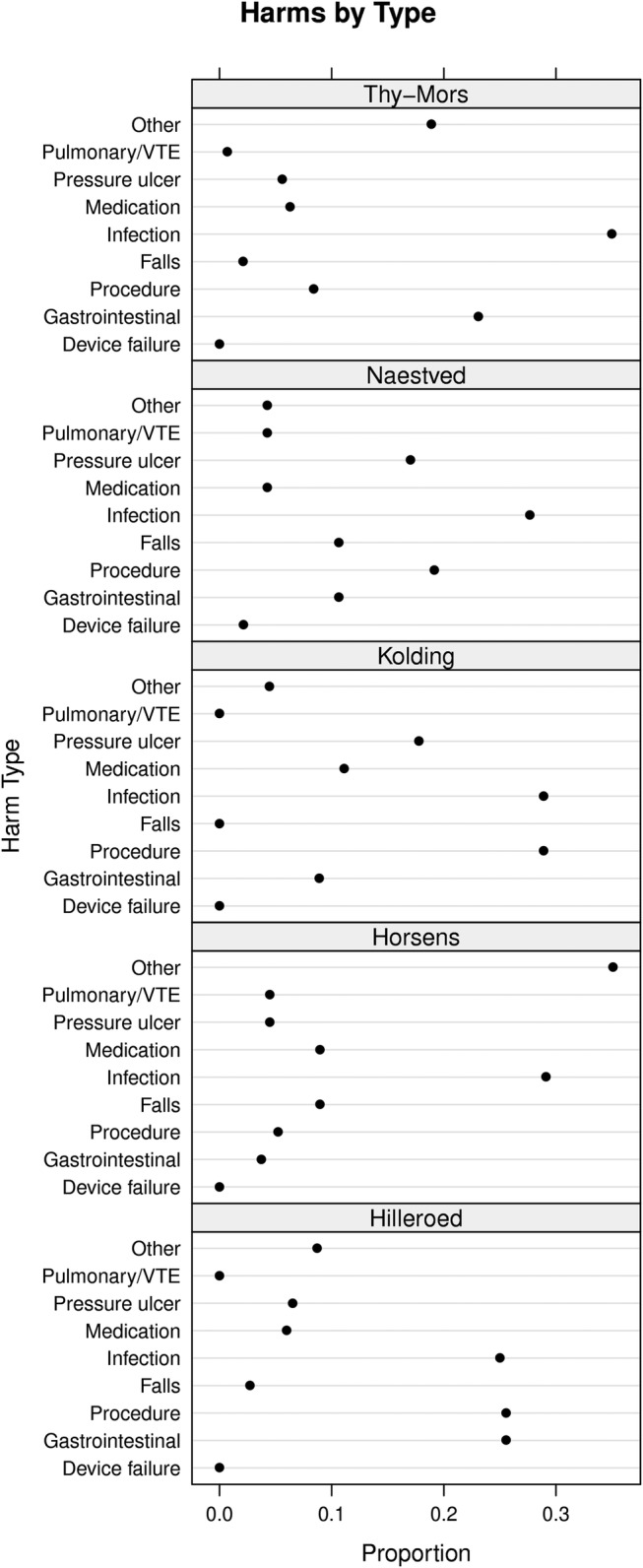
The hospitals differed in size but had similar patient populations and activity. PSIs varied between 3 and 12 per 1000 patient-days. The average harm rate for all hospitals was 60 per 1000 patient-days ranging from 34 to 84. The percentage of harmed patients was 25 and ranged from 18 to 33. Overall, 96% of harms were temporary. Infections, pressure ulcers procedure-related and gastrointestinal problems were common. Teams reported differences in training and review procedures such as the role of the secondary reviewer.

CONCLUSIONS

We found substantial variation in harm rates. Differences in training, review procedures and documentation in patient records probably contributed to these variations. Training reviewers as teams, specifying the roles of the different reviewers, training records and a database for findings of reviews may improve the application of the GTT.

摘要

目的

描述在丹麦的五家医院实施全球触发工具(GTT)审查的经验,并提出改进 GTT 审查团队绩效的方法。

设计

回顾性观察研究。

地点

测量和监测危害对于提高患者安全的运动至关重要。越来越多的团队使用 GTT 来审查患者记录并衡量英语和非英语国家的危害。与此同时,对于该方法在如此多样化的环境中的表现,目前还不清楚。

参与者

来自丹麦国家更安全医院计划的五家丹麦试点医院的审查团队。

主要和次要结果测量

我们收集了五个试点医院目前参与丹麦更安全医院计划的危害率、背景和轶事信息,并报告了患者安全事件(PSIs)。有经验的审查员根据类型对危害进行分类。我们将危害率绘制成运行图表,并应用了用于检测非随机变异模式的规则。

结果

医院的规模不同,但患者人群和活动相似。PSIs 介于每 1000 个患者日 3 至 12 个之间。所有医院的平均伤害率为每 1000 个患者日 60 个,范围为 34 至 84。受伤害患者的比例为 25%,范围为 18%至 33%。总体而言,96%的伤害是暂时的。感染、压疮、与手术相关的和胃肠道问题很常见。团队报告了培训和审查程序方面的差异,例如二级审查员的角色。

结论

我们发现伤害率存在很大差异。培训、审查程序和患者记录中的文档差异可能导致了这些差异。对审查员进行团队培训、明确不同审查员的角色、培训记录以及审查结果数据库可能会提高 GTT 的应用。
https://cdn.ncbi.nlm.nih.gov/pmc/blobs/d34f/3488702/abedc3a755e0/bmjopen2012001324f05.jpg
https://cdn.ncbi.nlm.nih.gov/pmc/blobs/d34f/3488702/b70f4f152a35/bmjopen2012001324f01.jpg
https://cdn.ncbi.nlm.nih.gov/pmc/blobs/d34f/3488702/ca8f12f43a91/bmjopen2012001324f02.jpg
https://cdn.ncbi.nlm.nih.gov/pmc/blobs/d34f/3488702/bba7b979ce73/bmjopen2012001324f03.jpg
https://cdn.ncbi.nlm.nih.gov/pmc/blobs/d34f/3488702/eb01c611f48e/bmjopen2012001324f04.jpg
https://cdn.ncbi.nlm.nih.gov/pmc/blobs/d34f/3488702/abedc3a755e0/bmjopen2012001324f05.jpg
https://cdn.ncbi.nlm.nih.gov/pmc/blobs/d34f/3488702/b70f4f152a35/bmjopen2012001324f01.jpg
https://cdn.ncbi.nlm.nih.gov/pmc/blobs/d34f/3488702/ca8f12f43a91/bmjopen2012001324f02.jpg
https://cdn.ncbi.nlm.nih.gov/pmc/blobs/d34f/3488702/bba7b979ce73/bmjopen2012001324f03.jpg
https://cdn.ncbi.nlm.nih.gov/pmc/blobs/d34f/3488702/eb01c611f48e/bmjopen2012001324f04.jpg
https://cdn.ncbi.nlm.nih.gov/pmc/blobs/d34f/3488702/abedc3a755e0/bmjopen2012001324f05.jpg

相似文献

1
Experiences with global trigger tool reviews in five Danish hospitals: an implementation study.丹麦五家医院全球触发工具审查经验:实施研究。
BMJ Open. 2012 Oct 12;2(5). doi: 10.1136/bmjopen-2012-001324. Print 2012.
2
Assessment of adverse events in medical care: lack of consistency between experienced teams using the global trigger tool.医疗保健中不良事件的评估:使用全球触发工具的经验丰富团队之间缺乏一致性。
BMJ Qual Saf. 2012 Apr;21(4):307-14. doi: 10.1136/bmjqs-2011-000279. Epub 2012 Feb 23.
3
4
Assessment of the global trigger tool to measure, monitor and evaluate patient safety in cancer patients: reliability concerns are raised.评估全球触发工具以衡量、监测和评估癌症患者的患者安全:可靠性令人担忧。
BMJ Qual Saf. 2013 Jul;22(7):571-9. doi: 10.1136/bmjqs-2012-001219. Epub 2013 Feb 27.
5
Test-Retest Reliability of an Experienced Global Trigger Tool Review Team.经验丰富的全球触发工具审查团队的重测可靠性。
J Patient Saf. 2021 Oct 1;17(7):e593-e598. doi: 10.1097/PTS.0000000000000433.
6
Does adding an appended oncology module to the Global Trigger Tool increase its value?在全球触发工具中添加附加的肿瘤学模块会增加其价值吗?
Int J Qual Health Care. 2014 Oct;26(5):553-60. doi: 10.1093/intqhc/mzu072. Epub 2014 Jul 30.
7
The association between patient-reported incidents in hospitals and estimated rates of patient harm.患者报告的医院事件与估计的患者伤害发生率之间的关联。
Int J Qual Health Care. 2015 Feb;27(1):26-30. doi: 10.1093/intqhc/mzu087. Epub 2014 Nov 21.
8
Is inter-rater reliability of Global Trigger Tool results altered when members of the review team are replaced?当审查团队成员被替换时,全球触发工具结果的评分者间信度会改变吗?
Int J Qual Health Care. 2016 Sep;28(4):492-6. doi: 10.1093/intqhc/mzw054. Epub 2016 Jun 9.
9
Implementation of the trigger review method in Scottish general practices: patient safety outcomes and potential for quality improvement.苏格兰常规医疗实践中触发式审查方法的实施:患者安全结果和质量改进的潜力。
BMJ Qual Saf. 2017 Apr;26(4):335-342. doi: 10.1136/bmjqs-2015-004093. Epub 2016 Mar 30.
10
Strengths and weaknesses of working with the Global Trigger Tool method for retrospective record review: focus group interviews with team members.使用全球触发工具方法进行回顾性病历审查的优势和劣势:团队成员的焦点小组访谈。
BMJ Open. 2013 Sep 24;3(9):e003131. doi: 10.1136/bmjopen-2013-003131.

引用本文的文献

1
Experiences of the development and use of a Paediatric Oncology Trigger Tool.儿科肿瘤触发工具的开发与使用经验
BMJ Open Qual. 2025 May 15;14(2):e003306. doi: 10.1136/bmjoq-2025-003306.
2
A scoping review of the methodological approaches used in retrospective chart reviews to validate adverse event rates in administrative data.回顾性图表审查中用于验证行政数据中不良事件发生率的方法学方法的范围综述。
Int J Qual Health Care. 2024 May 10;36(2). doi: 10.1093/intqhc/mzae037.
3
Establishing a trigger tool based on global trigger tools to identify adverse drug events in obstetric inpatients in China.

本文引用的文献

1
'Global trigger tool' shows that adverse events in hospitals may be ten times greater than previously measured.“全球触发工具”显示,医院中的不良事件可能比之前测量的高出十倍。
Health Aff (Millwood). 2011 Apr;30(4):581-9. doi: 10.1377/hlthaff.2011.0190.
2
Multiple component patient safety intervention in English hospitals: controlled evaluation of second phase.英文医院多环节患者安全干预措施:第二阶段对照评估
BMJ. 2011 Feb 3;342:d199. doi: 10.1136/bmj.d199.
3
Large scale organisational intervention to improve patient safety in four UK hospitals: mixed method evaluation.
建立基于全球触发工具的触发工具,以识别中国产科住院患者的药物不良事件。
BMC Health Serv Res. 2024 Jan 15;24(1):72. doi: 10.1186/s12913-023-10449-z.
4
Variation in detected adverse events using trigger tools: A systematic review and meta-analysis.使用触发工具检测到的不良事件的变化:系统评价和荟萃分析。
PLoS One. 2022 Sep 1;17(9):e0273800. doi: 10.1371/journal.pone.0273800. eCollection 2022.
5
Using the Global Trigger Tool in surgical and neurosurgical patients: A feasibility study.使用全球触发工具对手术和神经外科患者进行研究:一项可行性研究。
PLoS One. 2022 Aug 16;17(8):e0272853. doi: 10.1371/journal.pone.0272853. eCollection 2022.
6
National and Institutional Trends in Adverse Events Over Time: A Systematic Review and Meta-analysis of Longitudinal Retrospective Patient Record Review Studies.随着时间的推移,国家和机构不良事件趋势:系统评价和纵向回顾性患者记录回顾研究的荟萃分析。
J Patient Saf. 2021 Mar 1;17(2):141-148. doi: 10.1097/PTS.0000000000000804.
7
Applying the Global Trigger Tool in German Hospitals: A Pilot in Surgery and Neurosurgery.在德国医院应用全球触发工具:外科和神经外科的初步尝试。
J Patient Saf. 2020 Dec;16(4):e340-e351. doi: 10.1097/PTS.0000000000000576.
8
Adverse events in deceased hospitalised cancer patients as a measure of quality and safety in end-of-life cancer care.以死亡住院癌症患者的不良事件作为衡量终末期癌症关怀质量和安全的指标。
BMC Palliat Care. 2020 Jun 1;19(1):76. doi: 10.1186/s12904-020-00579-0.
9
Describing adverse events in Swiss hospitalized oncology patients using the Global Trigger Tool.使用全球触发工具描述瑞士住院肿瘤患者的不良事件。
Health Sci Rep. 2020 May 12;3(2):e160. doi: 10.1002/hsr2.160. eCollection 2020 Jun.
10
Development of an Adverse Event Surveillance Model for Outpatient Surgery in the Veterans Health Administration.退伍军人健康管理局门诊手术不良事件监测模型的开发。
Health Serv Res. 2018 Dec;53(6):4507-4528. doi: 10.1111/1475-6773.13037. Epub 2018 Aug 27.
大规模组织干预以提高英国四家医院的患者安全:混合方法评估。
BMJ. 2011 Feb 3;342:d195. doi: 10.1136/bmj.d195.
4
The run chart: a simple analytical tool for learning from variation in healthcare processes.运行图:从医疗流程的变化中学习的简单分析工具。
BMJ Qual Saf. 2011 Jan;20(1):46-51. doi: 10.1136/bmjqs.2009.037895.
5
Temporal trends in rates of patient harm resulting from medical care.医疗导致的患者伤害发生率的时间趋势。
N Engl J Med. 2010 Nov 25;363(22):2124-34. doi: 10.1056/NEJMsa1004404.
6
Measuring hospital adverse events: assessing inter-rater reliability and trigger performance of the Global Trigger Tool.测量医院不良事件:评估全球触发工具的评价者间可靠性和触发性能。
Int J Qual Health Care. 2010 Aug;22(4):266-74. doi: 10.1093/intqhc/mzq026. Epub 2010 Jun 9.
7
A comparison of hospital adverse events identified by three widely used detection methods.三种广泛使用的检测方法所识别的医院不良事件的比较。
Int J Qual Health Care. 2009 Aug;21(4):301-7. doi: 10.1093/intqhc/mzp027.
8
Is health care getting safer?医疗保健是否变得更安全了?
BMJ. 2008 Nov 13;337:a2426. doi: 10.1136/bmj.a2426.
9
Detection of adverse events in surgical patients using the Trigger Tool approach.使用触发工具方法检测外科手术患者的不良事件。
Qual Saf Health Care. 2008 Aug;17(4):253-8. doi: 10.1136/qshc.2007.025080.
10
The incidence and nature of in-hospital adverse events: a systematic review.住院不良事件的发生率及性质:一项系统综述
Qual Saf Health Care. 2008 Jun;17(3):216-23. doi: 10.1136/qshc.2007.023622.