Department of Internal Medicine, University of Tor Vergata, Rome, Italy.
Diabetes Care. 2013 Mar;36(3):683-9. doi: 10.2337/dc12-0763. Epub 2012 Oct 15.
Patients with the metabolic syndrome (MetS) have impaired insulin-induced enhancement of vasodilator responses. The incretin hormone glucagon-like peptide 1 (GLP-1), beyond its effects on blood glucose, has beneficial actions on vascular function. This study, therefore, aimed to assess whether GLP-1 affects insulin-stimulated vasodilator reactivity in patients with the MetS.
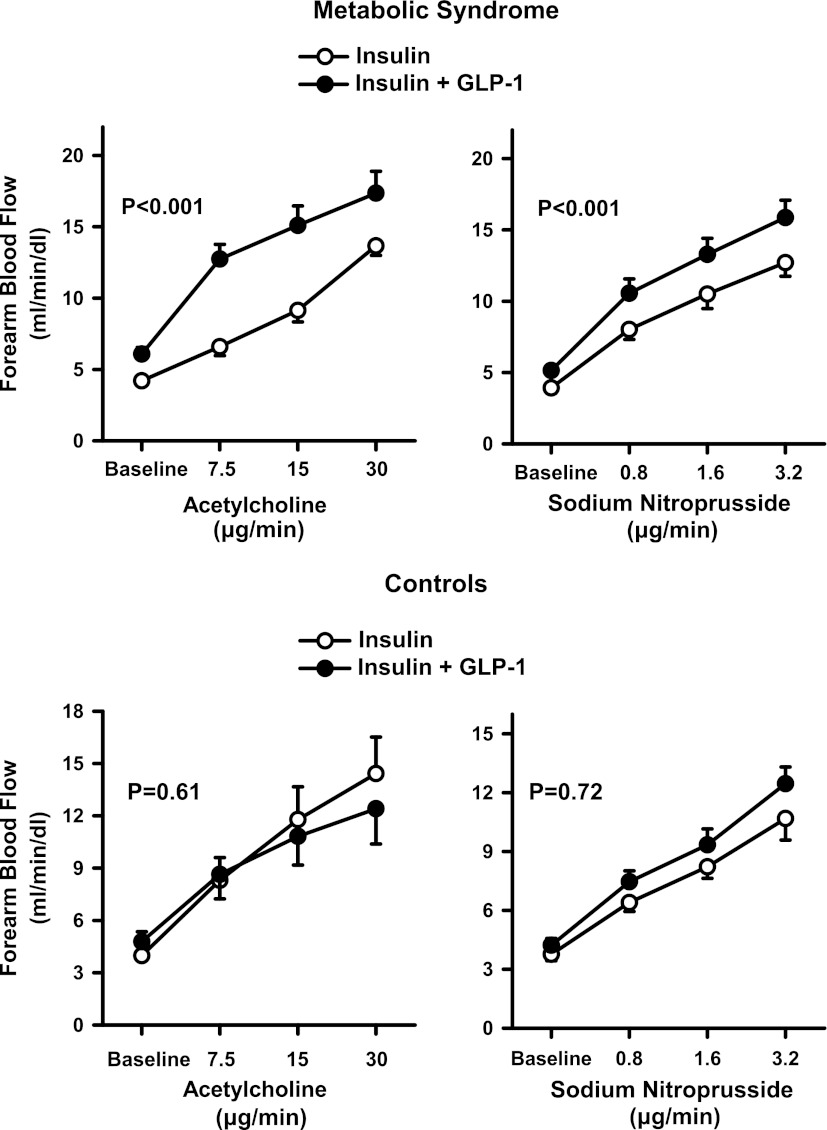
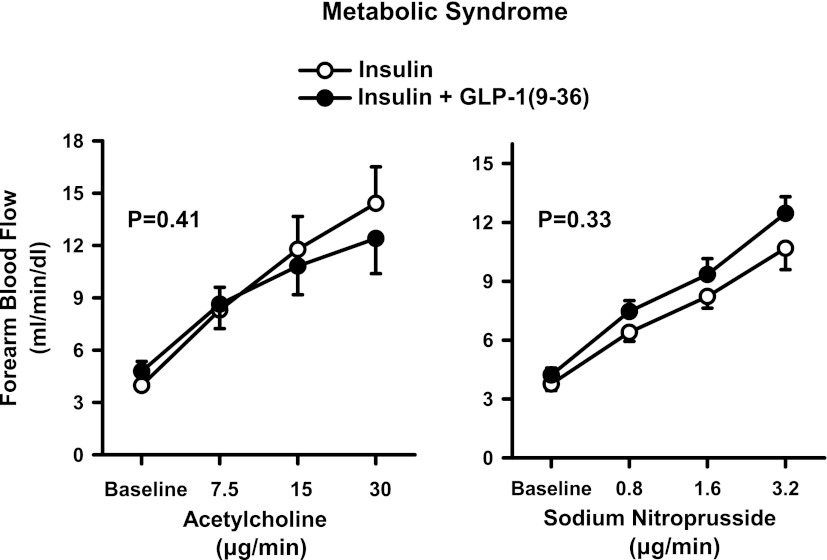
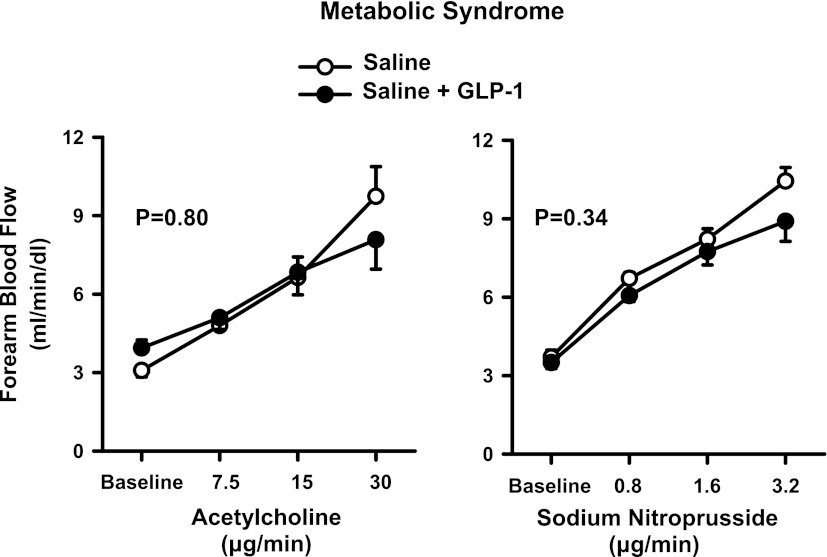
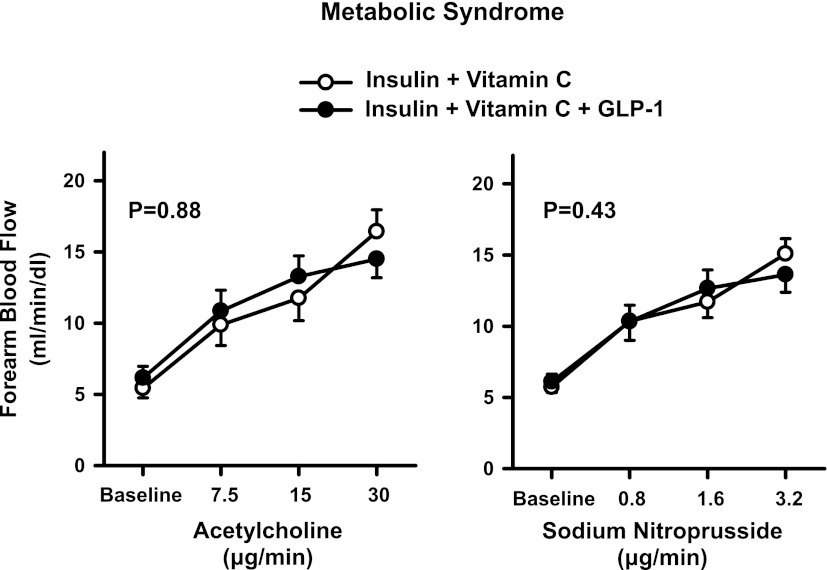
Forearm blood flow responses to acetylcholine (ACh) and sodium nitroprusside (SNP) were assessed in MetS patients before and after the addition of GLP-1 to an intra-arterial infusion of saline (n = 5) or insulin (n = 5). The possible involvement of oxidative stress in the vascular effects of GLP-1 in this setting was investigated by infusion of vitamin C (n = 5). The receptor specificity of GLP-1 effect during hyperinsulinemia was assessed by infusing its metabolite GLP-1(9-36) (n = 5). The metabolic actions of GLP-1 were also tested by analyzing forearm glucose disposal during hyperinsulinemia (n = 5).
In MetS patients, GLP-1 enhanced endothelium-dependent and -independent responses to ACh and SNP, respectively, during hyperinsulinemia (P < 0.001 for both), but not during saline (P > 0.05 for both). No changes in vasodilator reactivity to ACh and SNP were seen after GLP-1 was added to insulin and vitamin C (P > 0.05 for both) and after GLP-1(9-36) was given during hyperinsulinemia (P > 0.05 for both). Also, GLP-1 did not affect forearm glucose extraction and uptake during hyperinsulinemia (P > 0.05 for both).
In patients with the MetS, GLP-1 improves insulin-mediated enhancement of endothelium-dependent and -independent vascular reactivity. This effect may be influenced by vascular oxidative stress and is possibly exerted through a receptor-mediated mechanism.
代谢综合征(MetS)患者的胰岛素诱导血管舒张反应受损。肠促胰岛素激素胰高血糖素样肽 1(GLP-1)除了对血糖的作用外,还对血管功能具有有益作用。因此,本研究旨在评估 GLP-1 是否影响 MetS 患者的胰岛素刺激血管舒张反应。
在 MetS 患者中,在向生理盐水(n=5)或胰岛素(n=5)的动脉内输注中加入 GLP-1 前后,评估乙酰胆碱(ACh)和硝普钠(SNP)引起的前臂血流反应。通过输注维生素 C(n=5)研究 GLP-1 在这种情况下对血管作用的氧化应激的可能参与。通过输注其代谢物 GLP-1(9-36)(n=5)评估 GLP-1 在高胰岛素血症期间的受体特异性。还通过分析高胰岛素血症期间的前臂葡萄糖摄取来测试 GLP-1 的代谢作用(n=5)。
在 MetS 患者中,GLP-1 在高胰岛素血症期间分别增强了内皮依赖性和非依赖性对 ACh 和 SNP 的反应(均 P <0.001),但在生理盐水时则没有(均 P >0.05)。当 GLP-1 加入胰岛素和维生素 C 时(均 P >0.05)以及在高胰岛素血症期间给予 GLP-1(9-36)时(均 P >0.05),对 ACh 和 SNP 的血管舒张反应没有变化。此外,GLP-1 在高胰岛素血症期间也不影响前臂葡萄糖摄取和摄取(均 P >0.05)。
在 MetS 患者中,GLP-1 改善了胰岛素介导的内皮依赖性和非依赖性血管舒张反应的增强。这种作用可能受到血管氧化应激的影响,并且可能通过受体介导的机制发挥作用。