Department of Surgery, East Tennessee State University, Quillen College of Medicine, Johnson City, Tennessee, USA.
PLoS Pathog. 2012;8(10):e1002967. doi: 10.1371/journal.ppat.1002967. Epub 2012 Oct 11.
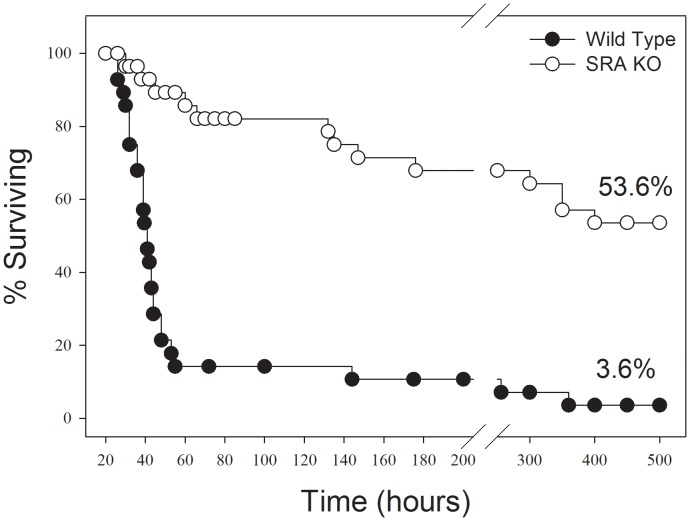
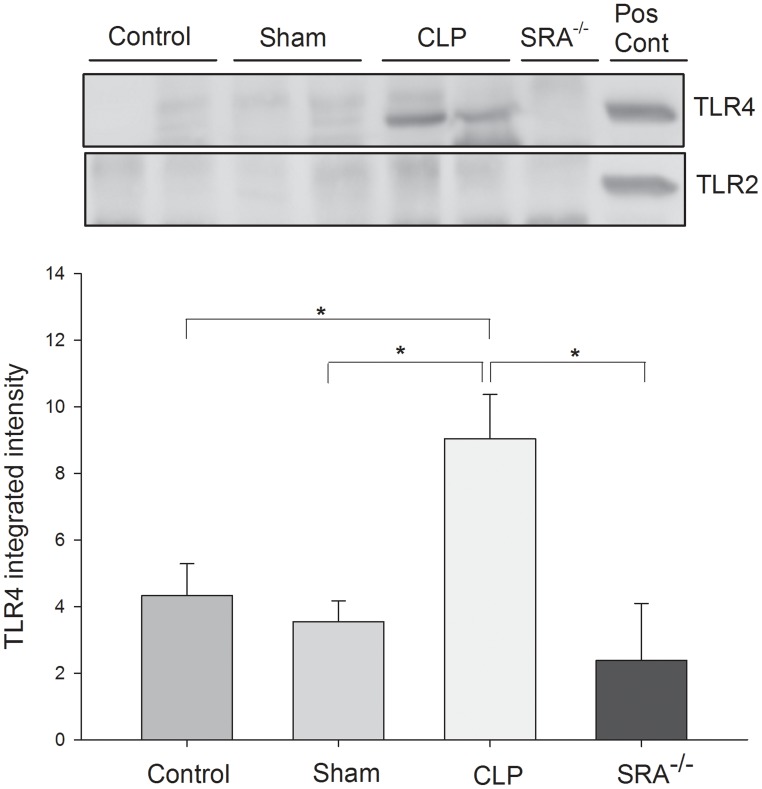
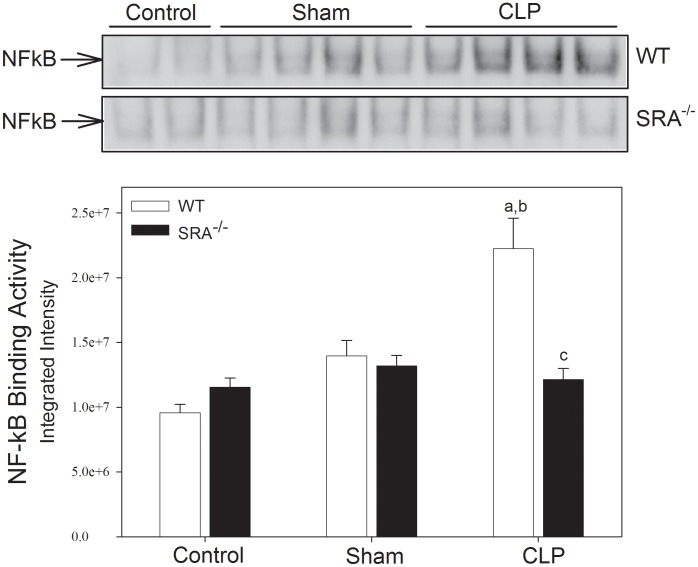
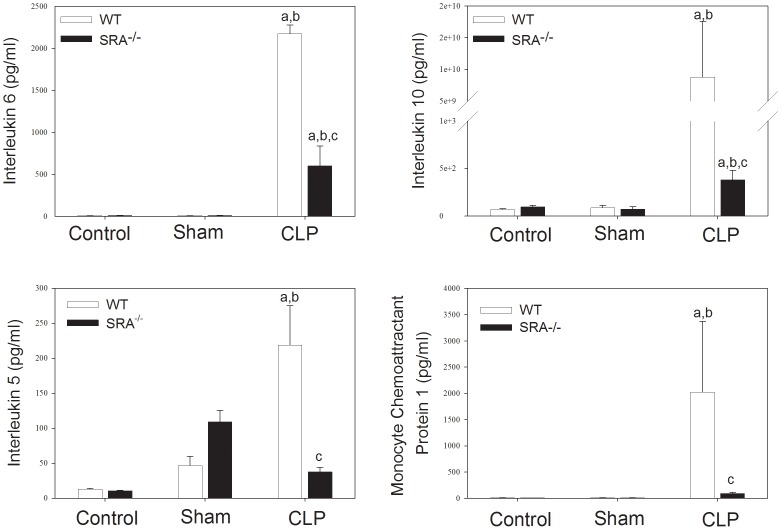
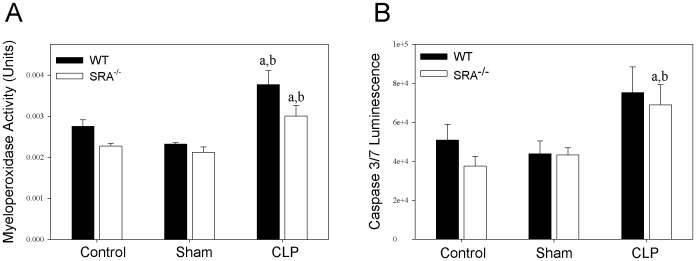
Sepsis is a frequent complication in critical illness. The mechanisms that are involved in initiation and propagation of the disease are not well understood. Scavenger receptor A (SRA) is a membrane receptor that binds multiple polyanions such as oxidized LDL and endotoxin. Recent studies suggest that SRA acts as a pattern recognition receptor in the innate immune response. The goal of the present study was to determine the role of SRA in polymicrobial sepsis. SRA deficient (SRA(-/-)) and C57BL/6JB/6J (WT) male mice were subjected to cecal ligation and puncture (CLP) to induce polymicrobial sepsis. NFκB activity, myeloperoxidase activity, and co-association of SRA with toll like receptor (TLR) 4 and TLR2 was analyzed in the lungs. Spleens were analyzed for apoptosis. Serum cytokines and chemokines were assayed. Blood and peritoneal fluid were cultured for aerobic and anaerobic bacterial burdens. Long-term survival was significantly increased in SRA(-/-) septic mice (53.6% vs. 3.6%, p < 0.05) when compared to WT mice. NFκB activity was 45.5% lower in the lungs of SRA(-/-) septic mice versus WT septic mice (p < 0.05). Serum levels of interleukin (IL)-5, IL-6, IL-10 and monocyte chemoattractant protein -1 were significantly lower in septic SRA(-/-) mice when compared to septic WT mice (p < 0.05). We found that SRA immuno-precipitated with TLR4, but not TLR2, in the lungs of WT septic mice. We also found that septic SRA(-/-) mice had lower bacterial burdens than WT septic mice. SRA deficiency had no effect on pulmonary neutrophil infiltration or splenocyte apoptosis during sepsis. We conclude that SRA plays a pivotal, and previously unknown, role in mediating the pathophysiology of sepsis/septic shock in a murine model of polymicrobial sepsis. Mechanistically, SRA interacts with TLR4 to enhance the development of the pro-inflammatory phenotype and mediate the morbidity and mortality of sepsis/septic shock.
脓毒症是危重病的常见并发症。目前,人们对其发病机制尚不完全了解。清道夫受体 A(SRA)是一种膜受体,可与多种多阴离子结合,如氧化型 LDL 和内毒素。最近的研究表明,SRA 在天然免疫反应中作为模式识别受体发挥作用。本研究旨在确定 SRA 在多微生物脓毒症中的作用。对 SRA 缺陷(SRA(-/-))和 C57BL/6JB/6J(WT)雄性小鼠进行盲肠结扎和穿孔(CLP)以诱导多微生物脓毒症。分析肺组织 NFκB 活性、髓过氧化物酶活性以及 SRA 与 Toll 样受体(TLR)4 和 TLR2 的共结合。分析脾脏凋亡情况。检测血清细胞因子和趋化因子。血液和腹腔液进行需氧和厌氧细菌负荷培养。与 WT 小鼠相比,SRA(-/-)脓毒症小鼠的长期存活率显著提高(53.6% vs. 3.6%,p < 0.05)。与 WT 脓毒症小鼠相比,SRA(-/-)脓毒症小鼠肺组织 NFκB 活性降低 45.5%(p < 0.05)。与 WT 脓毒症小鼠相比,SRA(-/-)脓毒症小鼠血清白细胞介素(IL)-5、IL-6、IL-10 和单核细胞趋化蛋白-1 水平显著降低(p < 0.05)。我们发现,在 WT 脓毒症小鼠的肺组织中,SRA 与 TLR4 而不是 TLR2 免疫沉淀。我们还发现,SRA(-/-)脓毒症小鼠的细菌负荷低于 WT 脓毒症小鼠。SRA 缺失对脓毒症期间肺中性粒细胞浸润或脾细胞凋亡没有影响。我们的结论是,SRA 在介导多微生物脓毒症小鼠模型中脓毒症/脓毒性休克的病理生理学方面发挥着关键作用。从机制上讲,SRA 与 TLR4 相互作用,增强促炎表型的发展,并介导脓毒症/脓毒性休克的发病率和死亡率。