Fenner School of Environment and Society, The Australian National University, Canberra, Australian Capital Territory, Australia.
PLoS One. 2012;7(10):e41864. doi: 10.1371/journal.pone.0041864. Epub 2012 Oct 5.
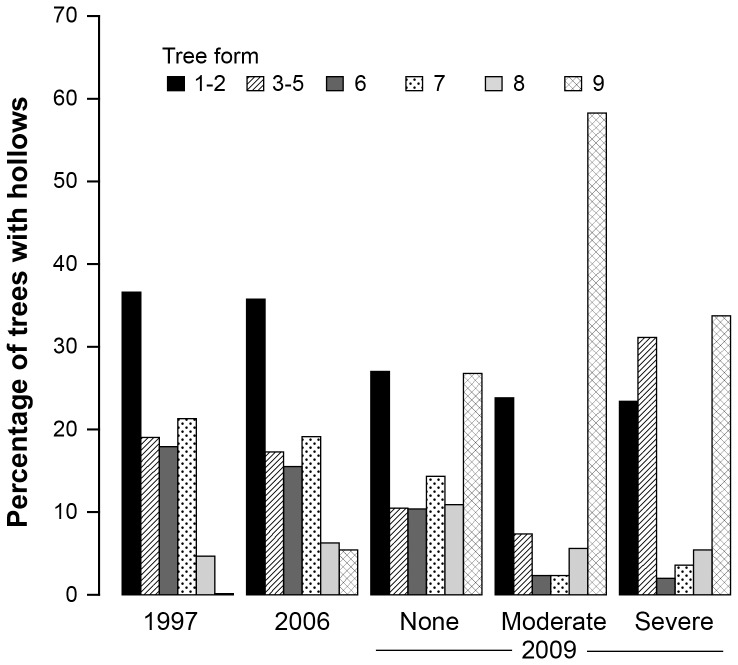
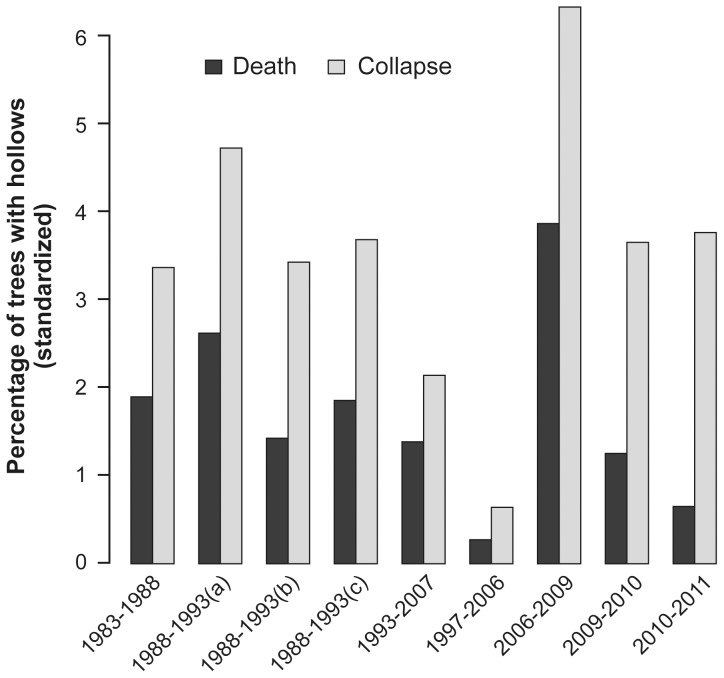
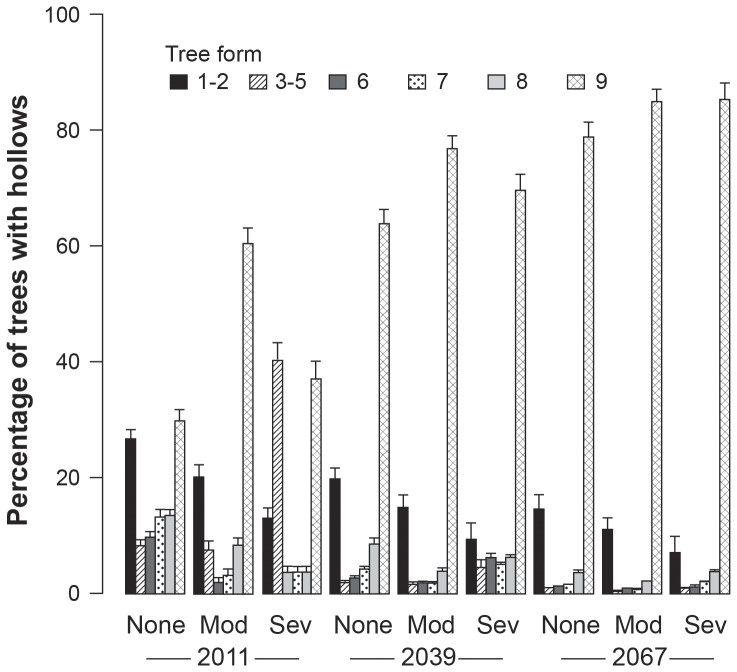
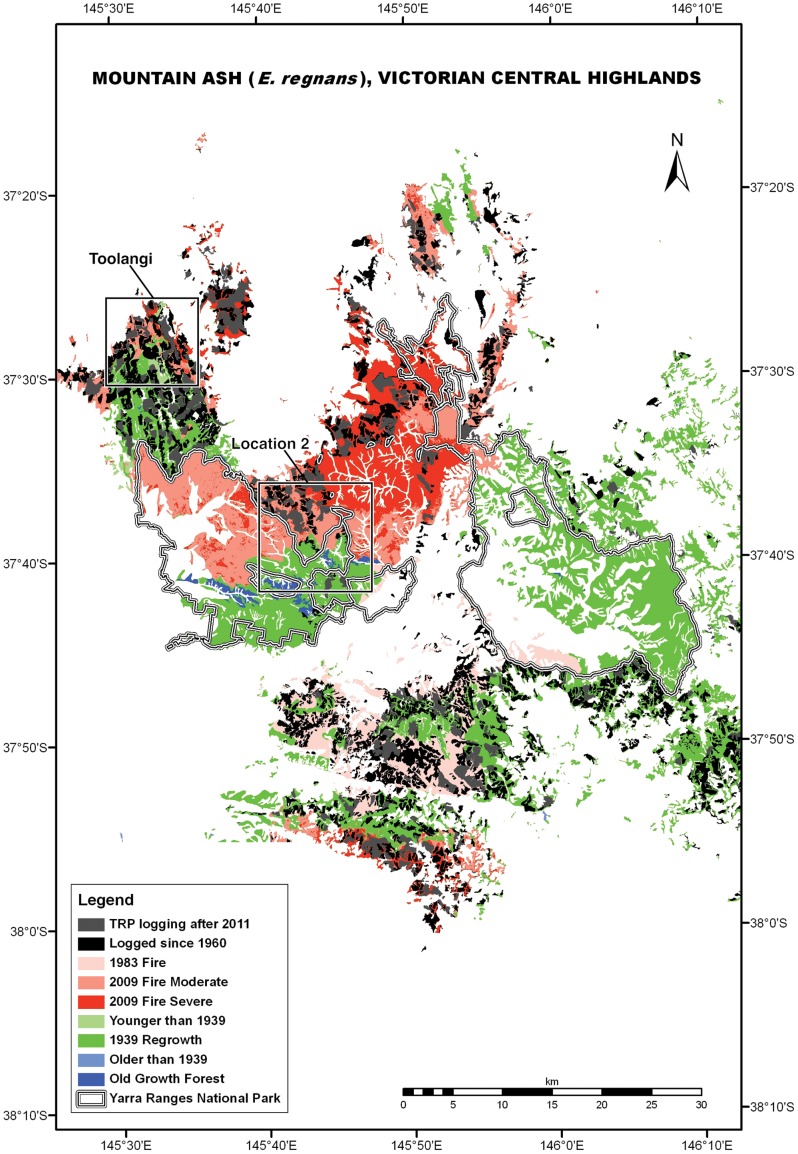
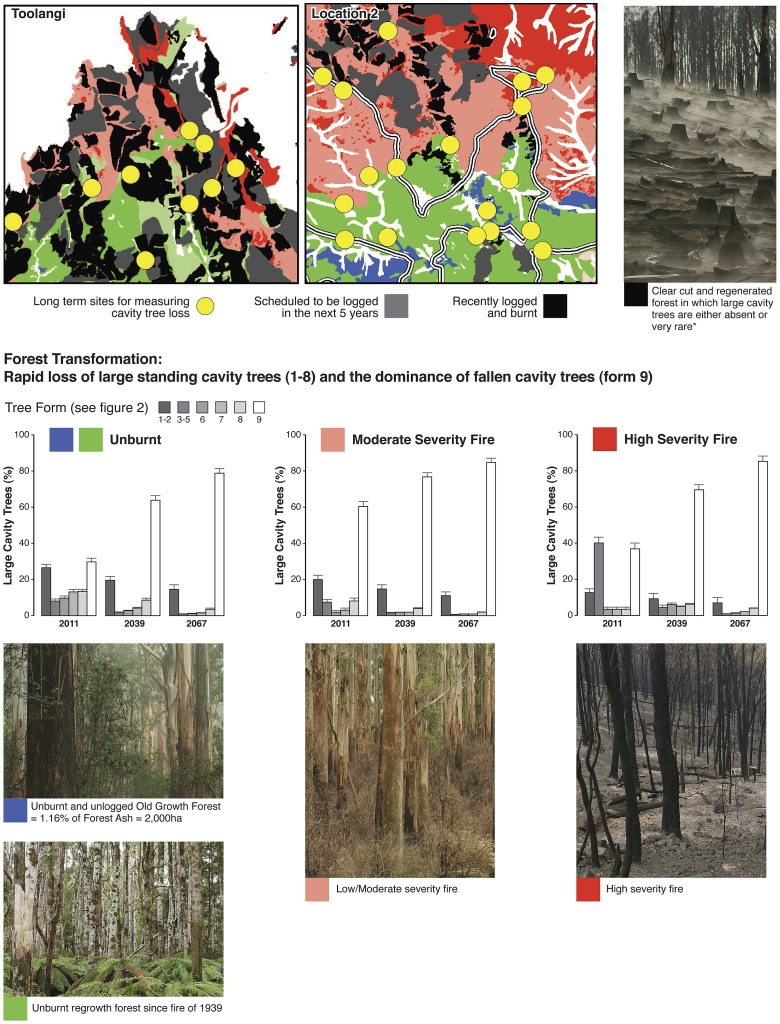
Large trees with cavities provide critical ecological functions in forests worldwide, including vital nesting and denning resources for many species. However, many ecosystems are experiencing increasingly rapid loss of large trees or a failure to recruit new large trees or both. We quantify this problem in a globally iconic ecosystem in southeastern Australia--forests dominated by the world's tallest angiosperms, Mountain Ash (Eucalyptus regnans). Tree, stand and landscape-level factors influencing the death and collapse of large living cavity trees and the decay and collapse of dead trees with cavities are documented using a suite of long-term datasets gathered between 1983 and 2011. The historical rate of tree mortality on unburned sites between 1997 and 2011 was >14% with a mortality spike in the driest period (2006-2009). Following a major wildfire in 2009, 79% of large living trees with cavities died and 57-100% of large dead trees were destroyed on burned sites. Repeated measurements between 1997 and 2011 revealed no recruitment of any new large trees with cavities on any of our unburned or burned sites. Transition probability matrices of large trees with cavities through increasingly decayed condition states projects a severe shortage of large trees with cavities by 2039 that will continue until at least 2067. This large cavity tree crisis in Mountain Ash forests is a product of: (1) the prolonged time required (>120 years) for initiation of cavities; and (2) repeated past wildfires and widespread logging operations. These latter factors have resulted in all landscapes being dominated by stands ≤72 years and just 1.16% of forest being unburned and unlogged. We discuss how the features that make Mountain Ash forests vulnerable to a decline in large tree abundance are shared with many forest types worldwide.
大树有空腔,为全球森林提供关键生态功能,包括为许多物种提供重要的筑巢和栖息资源。然而,许多生态系统正经历着大树快速消失或无法补充新大树的情况,甚至两者皆有。我们在澳大利亚东南部一个具有全球代表性的生态系统中量化了这个问题,该生态系统以世界上最高的开花植物山毛榉(Eucalyptus regnans)为主导。利用 1983 年至 2011 年间收集的一整套长期数据集,记录了影响大树活体树洞树死亡和倒塌以及有树洞死树腐烂和倒塌的树木、林分和景观水平因素。1997 年至 2011 年未燃烧地区树木死亡率的历史速率>14%,在最干旱时期(2006-2009 年)死亡率飙升。2009 年发生重大野火后,79%有树洞的大树活体死亡,57-100%的有树洞死树在燃烧地区被摧毁。1997 年至 2011 年之间的重复测量显示,在我们所有未燃烧或燃烧的地区,都没有新的大树活体树洞树的补充。大树活体树洞树逐渐腐烂状态的转移概率矩阵预测,到 2039 年,有树洞的大树将严重短缺,这种情况将持续到至少 2067 年。山毛榉森林中的这个大型树洞树危机是以下两个因素的产物:(1)形成树洞所需的时间延长(>120 年);(2)过去的野火和广泛的采伐作业。这些因素导致所有景观都由≤72 年的林分主导,只有 1.16%的森林未被燃烧和采伐。我们讨论了使山毛榉森林易受大树丰度下降影响的特征与世界上许多森林类型共有的特征。