Department of Neurology, Henry Ford Hospital, Detroit, MI 48202, USA.
Oncol Rep. 2013 Jan;29(1):67-72. doi: 10.3892/or.2012.2084. Epub 2012 Oct 17.
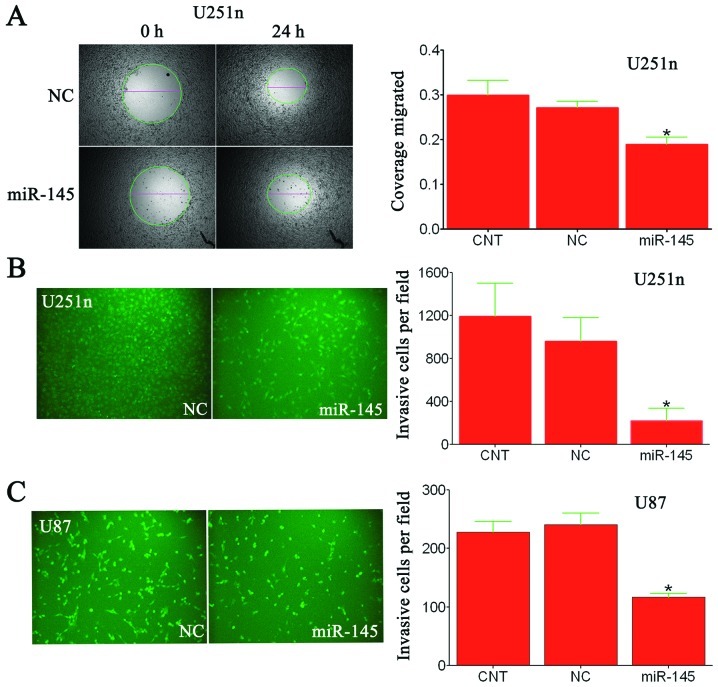
MicroRNAs are important regulators of gene expression and have been suggested to play a key role in tumorigenesis. In this study, we show that miR-145 is significantly downregulated in glioma cell lines compared to normal brain tissue and negatively regulates tumorigenesis. Restoration of miR-145 in glioma cells significantly reduced in vitro proliferation, migration and invasion. Also, overexpression of miR-145 reduced ADAM17 and EGFR expression. In addition, we tested the hypothesis that the miR-145-mediated suppression of cell proliferation, migration and invasion is, at least in part, due to silencing of ADAM17 and EGFR gene expression. Using luciferase reporters carrying the 3'-untranslated region of ADAM17 combined with western blotting, we identified ADAM17 as a direct target of miR-145. Collectively, these results suggest that as a tumor suppressor, miR-145 inhibits not only tumor proliferation, but also cell migration and invasion, and warrants further investigation.
微小 RNA 是基因表达的重要调节因子,被认为在肿瘤发生中发挥关键作用。在这项研究中,我们表明 miR-145 在神经胶质瘤细胞系中与正常脑组织相比显著下调,并负调控肿瘤发生。在神经胶质瘤细胞中恢复 miR-145 显著降低了体外增殖、迁移和侵袭。此外,过表达 miR-145 降低了 ADAM17 和 EGFR 的表达。此外,我们检验了假设,即 miR-145 对细胞增殖、迁移和侵袭的抑制作用至少部分是由于 ADAM17 和 EGFR 基因表达的沉默。使用携带 ADAM17 3'-非翻译区的荧光素酶报告基因载体和 Western blot,我们鉴定出 ADAM17 是 miR-145 的直接靶标。总之,这些结果表明,作为一种肿瘤抑制因子,miR-145 不仅抑制肿瘤增殖,而且抑制细胞迁移和侵袭,值得进一步研究。