Department of Psychiatry, Columbia University, New York, NY, USA.
Psychopharmacology (Berl). 2013 Mar;226(1):91-100. doi: 10.1007/s00213-012-2896-5. Epub 2012 Oct 19.
A major challenge in the pharmacological treatment of psychotic disorders is the effective management of the associated cognitive dysfunctions. Novel concepts emphasize a potential benefit of partial agonists acting upon dopamine D(2)-like receptors in ameliorating these cognitive deficits, and pre-clinical studies suggest that D(3)-receptor-preferring compounds can exert pro-cognitive effects.
The objective of the study was to use acute phencyclidine (PCP) treatment to model the cognitive deficits of schizophrenia in mice, and to test the efficacy of the novel, dopamine D(3)-receptor-preferring drug cariprazine in ameliorating the severity of PCP-triggered cognitive deficits.
One group of wild-type or D(3)-receptor knockout mice was acutely treated with either saline or phencyclidine (PCP, 1 mg/kg). A separate group of mice was treated with cariprazine prior to PCP administration. Both groups were then tested in three cognitive tasks: social interaction/recognition and recognition memory, spatial working memory, and attention-set-shifting.
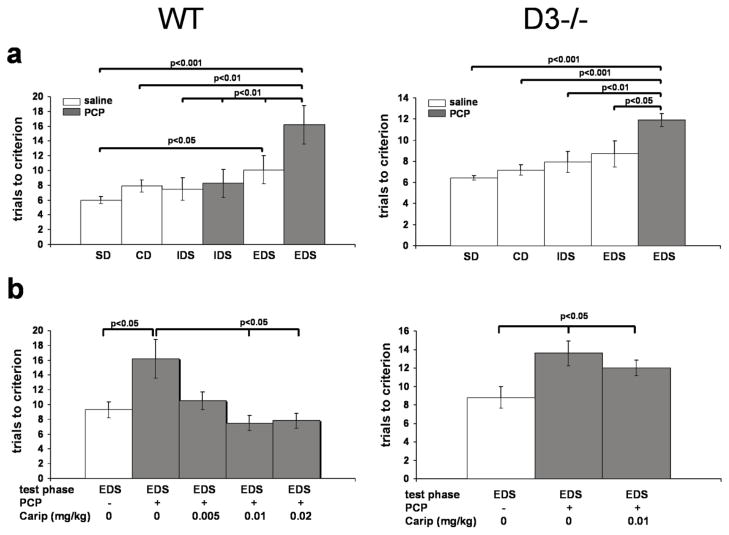
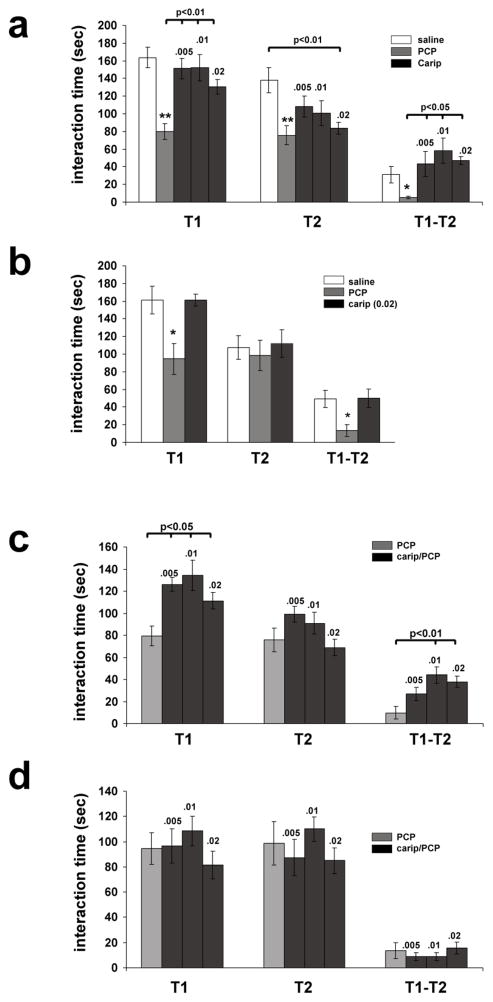
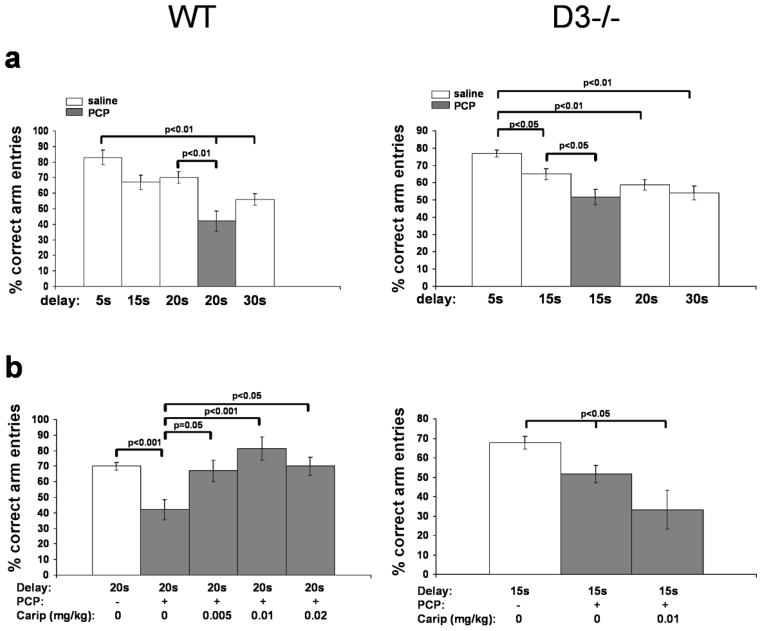
PCP effectively disrupted social recognition and social recognition memory, spatial working memory, and extradimensional attention set-shifting. Cariprazine pretreatment significantly attenuated the emergence of these cognitive deficits in PCP-treated wild-type mice, but not in PCP-treated D(3)-receptor knockout mice.
In an animal model of PCP-induced cognitive impairment, cariprazine pretreatment significantly diminished PCP-triggered cognitive deficits, and studies on knockout mice show that dopamine D(3) receptors contribute to this effect.
精神障碍的药物治疗的一个主要挑战是有效管理相关的认知功能障碍。新的概念强调多巴胺 D(2)-样受体的部分激动剂在改善这些认知缺陷方面的潜在益处,并且临床前研究表明 D(3)-受体优先化合物可以发挥促认知作用。
本研究的目的是使用急性苯环己哌啶(PCP)治疗来模拟精神分裂症的认知缺陷,并测试新型多巴胺 D(3)-受体优先药物卡利拉嗪改善 PCP 引发的认知缺陷严重程度的疗效。
一组野生型或 D(3)-受体敲除小鼠被急性给予生理盐水或苯环己哌啶(PCP,1 mg/kg)。另一组小鼠在给予 PCP 之前用卡利拉嗪治疗。然后,两组小鼠在三个认知任务中进行测试:社交互动/识别和识别记忆、空间工作记忆和注意力转换。
PCP 有效破坏了社交识别和社交识别记忆、空间工作记忆和外空间注意力转换。卡利拉嗪预处理显著减轻了 PCP 处理的野生型小鼠中这些认知缺陷的出现,但在 PCP 处理的 D(3)-受体敲除小鼠中没有。
在 PCP 诱导的认知障碍动物模型中,卡利拉嗪预处理显著减轻了 PCP 引发的认知缺陷,并且对敲除小鼠的研究表明多巴胺 D(3)受体有助于这种作用。