Kaye W, Wynne G, Marteau T, Dubin H G, Rallis S F, Simons R S, Evans T R
Cardiology Department, Royal Free Hospital School of Medicine, London.
J R Coll Physicians Lond. 1990 Jan;24(1):51-4.
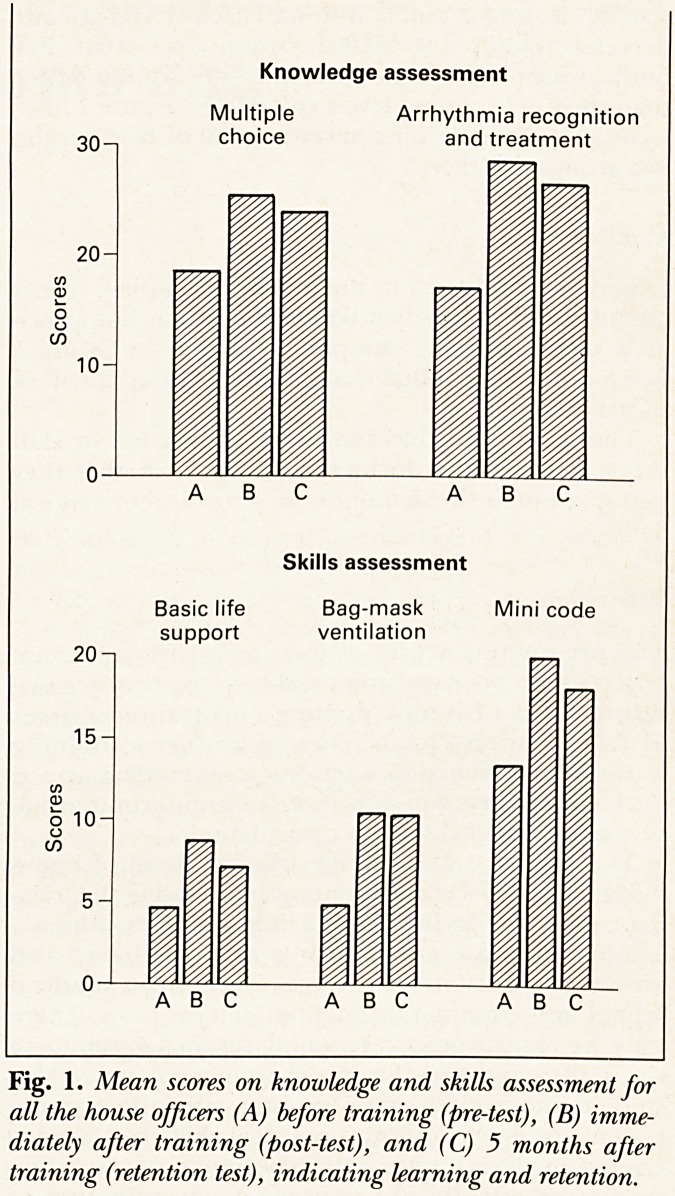
Preregistration house officers need to be able to manage the first 5-10 minutes of a cardiac arrest. A course has been designed based on the recommendations of the Resuscitation Council UK 1984 and the format of the American Heart Association advanced cardiac life support course. Fifty-nine newly qualified doctors from the same medical school class were studied in two consecutive groups: Group 1 (n = 31) were commencing their first post and Group 2 (n = 28), whose first preregistration post had been at other hospitals without practical resuscitation training, were commencing their second post. They were pretested and taught in three 2-hour sessions. Five months later they were tested to measure retention of knowledge and skills. Before training there was no difference in knowledge between the two groups but Group 1 were more skilled. The knowledge and skills of both groups immediately after training were significantly improved and at 5 months skills were subject to modest decay only. Experience of managing cardiac arrests was not a substitute for formal practical training.
预注册住院医师需要能够处理心脏骤停最初的5至10分钟。根据英国复苏委员会1984年的建议以及美国心脏协会高级心脏生命支持课程的形式设计了一门课程。对同一医学院班级的59名新获得资格的医生进行了连续两组研究:第1组(n = 31)开始他们的第一份工作,第2组(n = 28),其首次预注册工作是在其他没有实际复苏培训的医院进行的,正在开始他们的第二份工作。他们在三个两小时的课程中进行了预测试和授课。五个月后,对他们进行测试以衡量知识和技能的保留情况。培训前两组在知识方面没有差异,但第1组技能更熟练。两组在培训后立即的知识和技能都有显著提高,并且在5个月时技能仅出现适度衰退。处理心脏骤停的经验不能替代正规的实践培训。