
组蛋白去乙酰化酶 3 在 IL-1 信号转导中的共激活作用涉及 p65 NF-κB 的去乙酰化。
The coactivator role of histone deacetylase 3 in IL-1-signaling involves deacetylation of p65 NF-κB.
机构信息
Rudolf-Buchheim-Institute of Pharmacology, Institute of Biochemistry, Justus-Liebig-University Giessen, D-35392 Giessen, Germany.
出版信息
Nucleic Acids Res. 2013 Jan 7;41(1):90-109. doi: 10.1093/nar/gks916. Epub 2012 Oct 19.
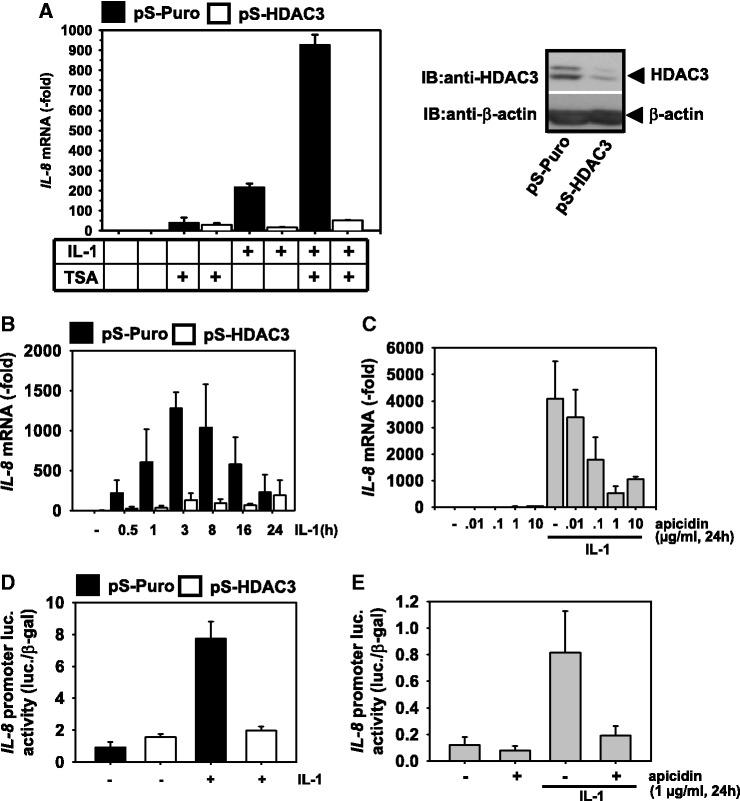
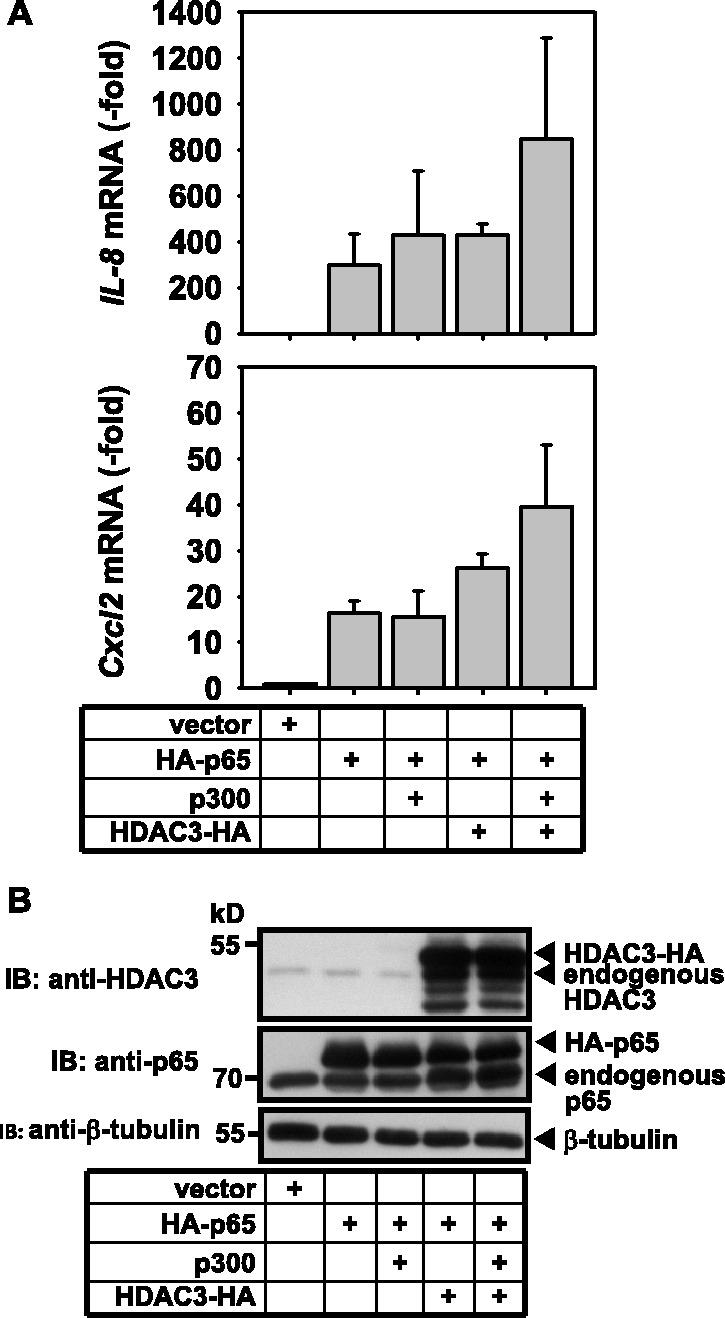
Histone deacetylase (HDAC) 3, as a cofactor in co-repressor complexes containing silencing mediator for retinoid or thyroid-hormone receptors (SMRT) and nuclear receptor co-repressor (N-CoR), has been shown to repress gene transcription in a variety of contexts. Here, we reveal a novel role for HDAC3 as a positive regulator of IL-1-induced gene expression. Various experimental approaches involving RNAi-mediated knockdown, conditional gene deletion or small molecule inhibitors indicate a positive role of HDAC3 for transcription of the majority of IL-1-induced human or murine genes. This effect was independent from the gene regulatory effects mediated by the broad-spectrum HDAC inhibitor trichostatin A (TSA) and thus suggests IL-1-specific functions for HDAC3. The stimulatory function of HDAC3 for inflammatory gene expression involves a mechanism that uses binding to NF-κB p65 and its deacetylation at various lysines. NF-κB p65-deficient cells stably reconstituted to express acetylation mimicking forms of p65 (p65 K/Q) had largely lost their potential to stimulate IL-1-triggered gene expression, implying that the co-activating property of HDAC3 involves the removal of inhibitory NF-κB p65 acetylations at K122, 123, 314 and 315. These data describe a novel function for HDAC3 as a co-activator in inflammatory signaling pathways and help to explain the anti-inflammatory effects frequently observed for HDAC inhibitors in (pre)clinical use.
组蛋白去乙酰化酶 (HDAC)3 作为包含视黄酸或甲状腺激素受体沉默介质 (SMRT) 和核受体共抑制因子 (N-CoR) 的共抑制复合物的辅助因子,已被证明在多种情况下抑制基因转录。在这里,我们揭示了 HDAC3 作为 IL-1 诱导基因表达的正调控因子的新作用。涉及 RNAi 介导的敲低、条件性基因缺失或小分子抑制剂的各种实验方法表明,HDAC3 对大多数 IL-1 诱导的人或鼠基因的转录具有正作用。这种效应独立于广谱 HDAC 抑制剂曲古抑菌素 A (TSA) 介导的基因调控效应,因此提示 HDAC3 具有 IL-1 特异性功能。HDAC3 对炎症基因表达的刺激作用涉及一种机制,该机制利用与 NF-κB p65 结合及其在各种赖氨酸上的去乙酰化。稳定重建表达乙酰化模拟形式 p65 (p65 K/Q) 的 NF-κB p65 缺陷细胞已大大丧失了刺激 IL-1 触发基因表达的潜力,这表明 HDAC3 的共激活特性涉及去除抑制性 NF-κB p65 在 K122、123、314 和 315 上的乙酰化。这些数据描述了 HDAC3 作为炎症信号通路中的共激活因子的新功能,并有助于解释在(临床前)临床使用中经常观察到的 HDAC 抑制剂的抗炎作用。




 Zotero 插件