Division of Clinical Immunology and Rheumatology, Academic Medical Center, University of Amsterdam, Amsterdam, The Netherlands.
Ann Rheum Dis. 2012 Mar;71(3):424-31. doi: 10.1136/ard.2011.154211. Epub 2011 Sep 27.
Histone deacetylase inhibitors (HDACi) display potent therapeutic efficacy in animal models of arthritis and suppress inflammatory cytokine production in rheumatoid arthritis (RA) synovial macrophages and tissue.
To determine the molecular mechanisms contributing to the suppressive effects of HDACi on RA synovial cell activation, using interleukin 6 (IL-6) regulation as a model.
RA fibroblast-like synoviocytes (FLS) and healthy donor macrophages were treated with IL-1β, tumour necrosis factor (TNF)α, lipopolysaccharide or polyinosinic:polycytidylic acid (poly(I:C)) in the absence or presence of the HDACi trichostatin A (TSA) or ITF2357 (givinostat). IL-6 production and mRNA expression was measured by ELISA and quantitative PCR (qPCR), respectively. Protein acetylation and the activation of intracellular signalling pathways were assessed by immunoblotting. The DNA-binding activity of nuclear factor κB (NFκB) and activator protein 1 (AP-1) components was measured by ELISA-based assays.
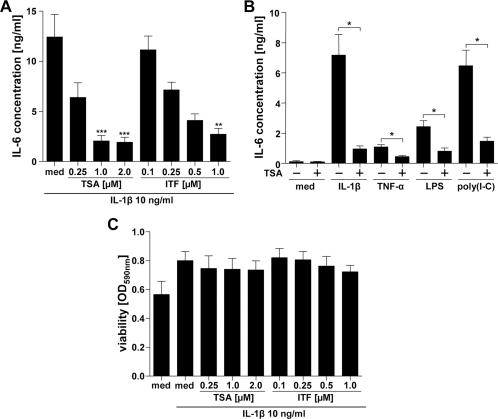
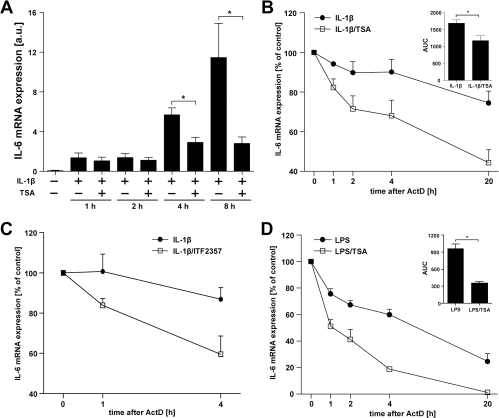
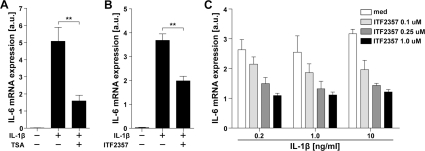
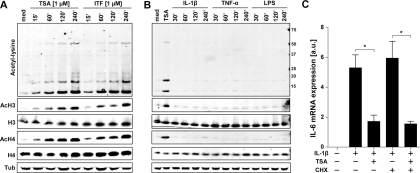
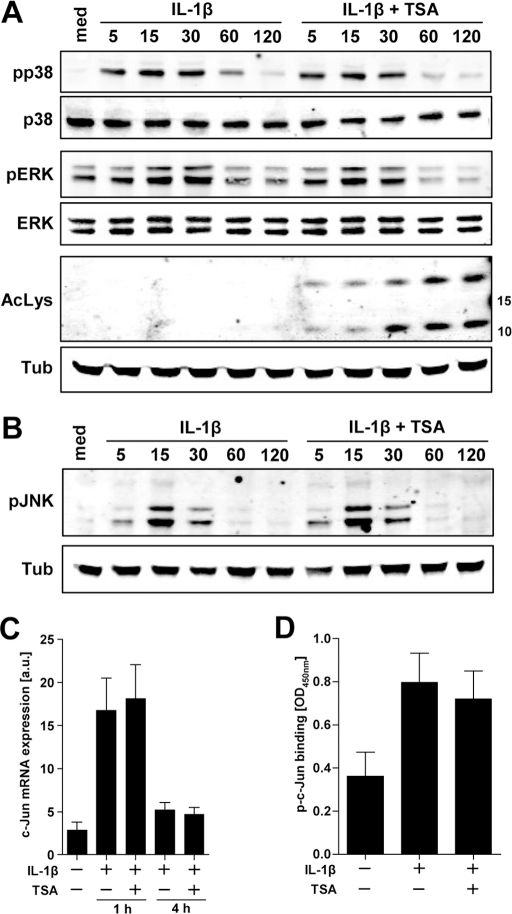
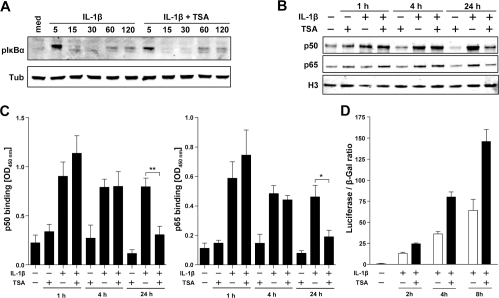
HDACi (0.25-1.0 μM) suppressed RA FLS IL-6 production induced by IL-1β, TNFα and Toll-like receptor ligands. Phosphorylation of mitogen-activated protein kinases and inhibitor of κBα (IκBα) following IL-1β stimulation were unaffected by HDACi, as were AP-1 composition and binding activity, and c-Jun induction. TSA induced a significant reduction in nuclear retention of NFκB in FLS 24 h after IL-1β stimulation, but this did not reduce NFκB transcriptional activity or correlate temporally with reductions in IL-6 mRNA accumulation. HDACi significantly reduced the stability of IL-6 mRNA in FLS and macrophages.
Our study identifies a novel, shared molecular mechanism by which HDACi can disrupt inflammatory cytokine production in RA synovial cells, namely the promotion of mRNA decay, and suggests that targeting HDAC activity may be clinically useful in suppressing inflammation in RA.
组蛋白去乙酰化酶抑制剂(HDACi)在关节炎动物模型中显示出强大的治疗效果,并抑制类风湿关节炎(RA)滑膜巨噬细胞和组织中炎性细胞因子的产生。
通过以白细胞介素 6(IL-6)调节为例,确定导致 HDACi 抑制 RA 滑膜细胞活化的分子机制。
用白细胞介素 1β(IL-1β)、肿瘤坏死因子(TNF)α、脂多糖或聚肌苷酸:聚胞苷酸(poly(I:C)) 处理 RA 成纤维样滑膜细胞(FLS)和健康供体巨噬细胞,在不存在或存在组蛋白去乙酰化酶抑制剂曲古抑菌素 A(TSA)或 ITF2357(givinostat)的情况下。通过酶联免疫吸附试验(ELISA)和定量聚合酶链反应(qPCR)分别测量 IL-6 的产生和 mRNA 表达。通过免疫印迹评估蛋白质乙酰化和细胞内信号通路的激活。通过基于 ELISA 的测定法测量核因子 κB(NFκB)和激活蛋白 1(AP-1)成分的 DNA 结合活性。
HDACi(0.25-1.0 μM)抑制了由 IL-1β、TNFα 和 Toll 样受体配体诱导的 RA FLS IL-6 产生。HDACi 对 IL-1β 刺激后丝裂原活化蛋白激酶和 IκBα 的磷酸化没有影响,AP-1 组成和结合活性以及 c-Jun 诱导也没有影响。TSA 在 IL-1β 刺激后 24 小时诱导 FLS 中 NFκB 的核保留显著减少,但这并未降低 NFκB 转录活性或与 IL-6 mRNA 积累的时间相关。HDACi 显著降低了 FLS 和巨噬细胞中 IL-6 mRNA 的稳定性。
我们的研究确定了一种新的、共同的分子机制,通过该机制,HDACi 可以破坏 RA 滑膜细胞中炎性细胞因子的产生,即促进 mRNA 衰变,并表明靶向 HDAC 活性可能在临床上有助于抑制 RA 中的炎症。