Department of Computer Science, Center for Bioinformatics and Computational Biology, University of Maryland, College Park, MD, USA.
BMC Bioinformatics. 2012 Oct 22;13:272. doi: 10.1186/1471-2105-13-272.
Early screening for cancer is arguably one of the greatest public health advances over the last fifty years. However, many cancer screening tests are invasive (digital rectal exams), expensive (mammograms, imaging) or both (colonoscopies). This has spurred growing interest in developing genomic signatures that can be used for cancer diagnosis and prognosis. However, progress has been slowed by heterogeneity in cancer profiles and the lack of effective computational prediction tools for this type of data.
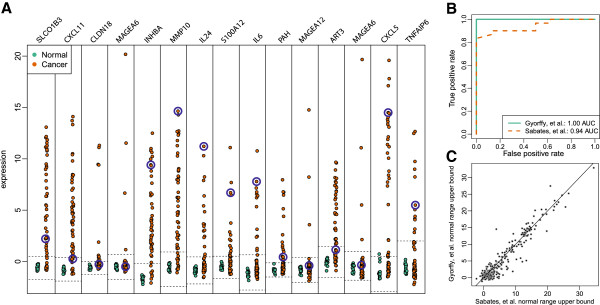
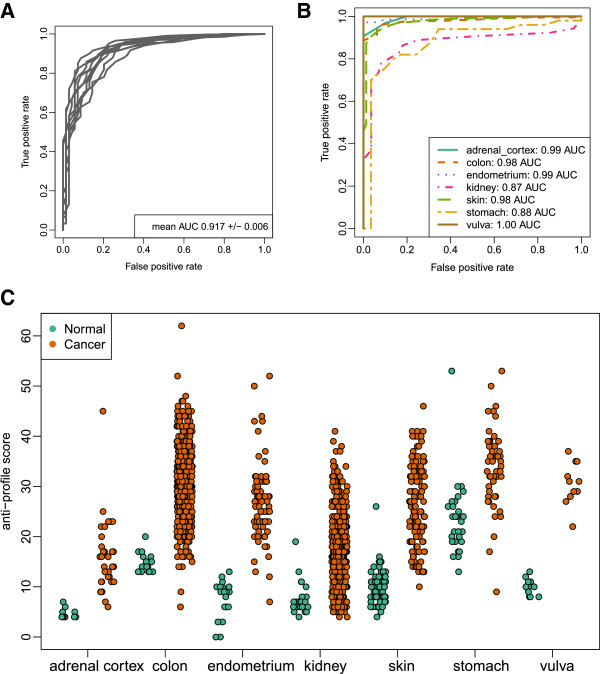
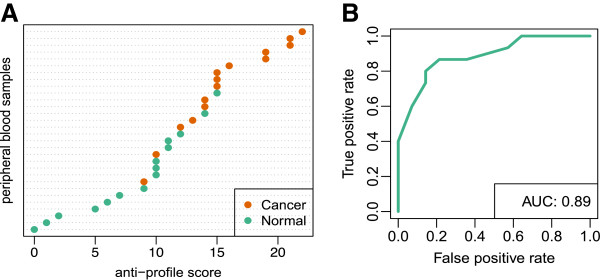
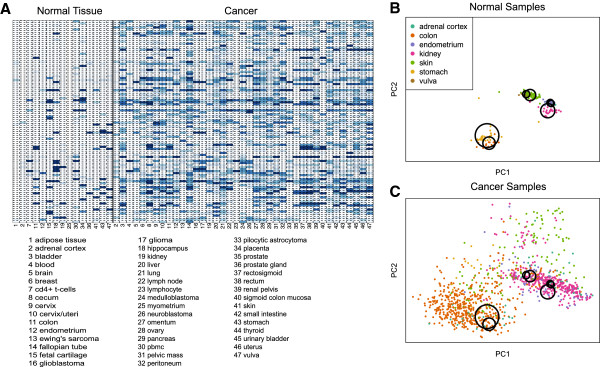
We developed anti-profiles as a first step towards translating experimental findings suggesting that stochastic across-sample hyper-variability in the expression of specific genes is a stable and general property of cancer into predictive and diagnostic signatures. Using single-chip microarray normalization and quality assessment methods, we developed an anti-profile for colon cancer in tissue biopsy samples. To demonstrate the translational potential of our findings, we applied the signature developed in the tissue samples, without any further retraining or normalization, to screen patients for colon cancer based on genomic measurements from peripheral blood in an independent study (AUC of 0.89). This method achieved higher accuracy than the signature underlying commercially available peripheral blood screening tests for colon cancer (AUC of 0.81). We also confirmed the existence of hyper-variable genes across a range of cancer types and found that a significant proportion of tissue-specific genes are hyper-variable in cancer. Based on these observations, we developed a universal cancer anti-profile that accurately distinguishes cancer from normal regardless of tissue type (ten-fold cross-validation AUC > 0.92).
We have introduced anti-profiles as a new approach for developing cancer genomic signatures that specifically takes advantage of gene expression heterogeneity. We have demonstrated that anti-profiles can be successfully applied to develop peripheral-blood based diagnostics for cancer and used anti-profiles to develop a highly accurate universal cancer signature. By using single-chip normalization and quality assessment methods, no further retraining of signatures developed by the anti-profile approach would be required before their application in clinical settings. Our results suggest that anti-profiles may be used to develop inexpensive and non-invasive universal cancer screening tests.
癌症的早期筛查可以说是过去五十年中最伟大的公共卫生进步之一。然而,许多癌症筛查测试具有侵入性(数字直肠检查)、昂贵(乳房 X 光检查、成像)或两者兼而有之(结肠镜检查)。这促使人们越来越关注开发基因组特征,以便用于癌症诊断和预后。然而,由于癌症特征的异质性以及缺乏针对这种类型数据的有效计算预测工具,进展一直较为缓慢。
我们开发了反式特征作为第一步,旨在将实验结果转化为预测和诊断特征,这些实验结果表明,特定基因表达的跨样本超变异性是癌症的一种稳定且普遍的特性。我们使用单芯片微阵列归一化和质量评估方法,开发了组织活检样本中结肠癌的反式特征。为了证明我们发现的转化潜力,我们在独立研究中,无需进一步的重新训练或归一化,将在组织样本中开发的特征应用于基于外周血基因组测量的结肠癌患者筛查(AUC 为 0.89)。该方法的准确性高于结肠癌商业外周血筛查测试的特征(AUC 为 0.81)。我们还证实了跨多种癌症类型存在超变基因,并且发现组织特异性基因中有很大一部分在癌症中是超变的。基于这些观察结果,我们开发了一种通用的癌症反式特征,可以准确地区分癌症与正常组织(十折交叉验证 AUC>0.92)。
我们引入了反式特征作为开发癌症基因组特征的新方法,该方法特别利用了基因表达的异质性。我们已经证明,反式特征可以成功地应用于开发基于外周血的癌症诊断方法,并使用反式特征开发了一种高度准确的通用癌症特征。通过使用单芯片归一化和质量评估方法,在将反式特征方法开发的特征应用于临床环境之前,无需对其进行进一步的重新训练。我们的结果表明,反式特征可用于开发廉价且非侵入性的通用癌症筛查测试。