Department of Community Dentistry, Institute of Dentistry, University of Oulu, Oulu, Finland.
BMC Oral Health. 2012 Oct 27;12:45. doi: 10.1186/1472-6831-12-45.
Dental general anaesthesia (DGA) is a very efficient treatment modality, but is considered only in the last resort because of the risks posed by general anaesthesia to patients' overall health. Health services and their treatment policies regarding DGA vary from country to country. The aims of this work were to determine the reasons for DGA in the Helsinki Public Dental Service (PDS) and to assess the role of patient characteristics in the variation in reasons and in the treatments given with special focus on preventive care.
The data covered all DGA patients treated in the PDS in Helsinki in 2010. The data were collected from patient documents and included personal background: age (<6, 6-12, 13-17, 18-68), gender, immigration, previous conscious sedation and previous DGA; medical background; reasons for DGA and treatments provided. Chi-square tests, Fisher's exact test, and logistic regression modelling were employed in the statistical analyses.
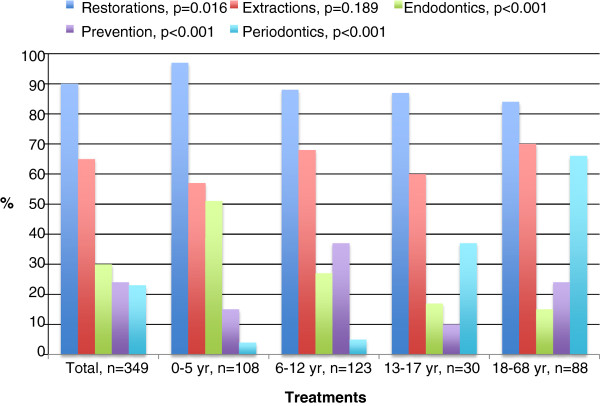
The DGA patients (n=349) were aged 2.3 to 67.2 years. Immigrants predominated in the youngest age group (p<0.001) and medically compromised patients among the adults (p<0.001) relative to the other age groups. The main reason for DGA was extreme non-cooperation (65%) followed by dental fear (37%) and an excessive need for treatment (26%). In total, 3435 treatments were performed under DGA, 57% of which were restorations, 24% tooth extractions, 5% preventive measures, 5% radiography, 4% endodontics and the remaining 5% periodontics, surgical procedures and miscellaneous. The reasons for DGA and the treatments provided varied according to age, immigration, previous sedation and DGA and medical background. The logistic regression model showed that previous sedation (OR 2.3; 95%CI 1.3-4.1; p=0.005) and extreme non-cooperation (OR 1.7; 95%CI 0.9-3.2; p=0.103) were most indicative of preventive measures given.
Extreme non-cooperation, dental fear and an excessive need for treatment were the main reasons for the use of comprehensive, conservative DGA in the Helsinki PDS. The reasons for the use of DGA and the treatments provided varied according to personal and medical background, and immigration status with no gender-differences. Preventive measures formed only a minor part of the dental care given under DGA.
牙科全身麻醉(DGA)是一种非常有效的治疗方式,但由于全身麻醉对患者整体健康带来的风险,通常仅作为最后的选择。各国的牙科全身麻醉服务及其治疗政策各有不同。本研究旨在确定赫尔辛基公共牙科服务(PDS)中使用 DGA 的原因,并评估患者特征在不同原因和具体治疗方法中的作用,特别关注预防保健。
本研究数据涵盖了 2010 年在赫尔辛基 PDS 接受 DGA 治疗的所有患者。数据从患者文件中收集,包括个人背景(<6、6-12、13-17、18-68 岁)、性别、移民、既往清醒镇静和既往 DGA;医疗背景;DGA 的原因和提供的治疗。统计分析采用卡方检验、Fisher 确切检验和逻辑回归模型。
DGA 患者(n=349)年龄为 2.3-67.2 岁。与其他年龄组相比,移民在最年轻的年龄组中占主导地位(p<0.001),而成年患者中身体状况较差的人占多数(p<0.001)。DGA 的主要原因是极度不合作(65%),其次是牙科恐惧(37%)和治疗需求过大(26%)。总共在 DGA 下进行了 3435 次治疗,其中 57%是修复治疗,24%是拔牙,5%是预防措施,5%是放射治疗,4%是牙髓治疗,其余 5%是牙周治疗、手术和其他。DGA 的原因和提供的治疗方法因年龄、移民、既往镇静和 DGA 以及医疗背景而异。逻辑回归模型显示,既往镇静(OR 2.3;95%CI 1.3-4.1;p=0.005)和极度不合作(OR 1.7;95%CI 0.9-3.2;p=0.103)是进行预防措施的最显著因素。
极度不合作、牙科恐惧和治疗需求过大是赫尔辛基 PDS 中使用全面、保守的 DGA 的主要原因。使用 DGA 的原因和提供的治疗方法因个人和医疗背景以及移民状况而异,而与性别无关。预防措施仅占 DGA 下牙科护理的一小部分。