University of Manchester Manchester, UK.
Front Neurosci. 2012 Oct 26;6:146. doi: 10.3389/fnins.2012.00146. eCollection 2012.
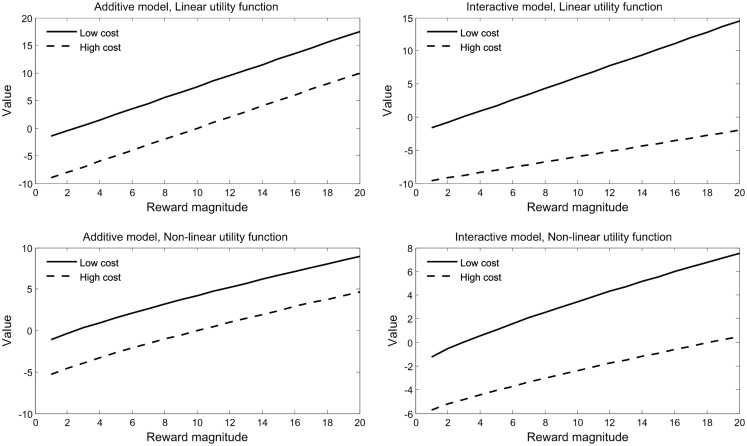
The things that we hold dearest often require a sacrifice, as epitomized in the maxim "no pain, no gain." But how is the subjective value of outcomes established when they consist of mixtures of costs and benefits? We describe theoretical models for the integration of costs and benefits into a single value, drawing on both the economic and the empirical literatures, with the goal of rendering them accessible to the neuroscience community. We propose two key assays that go beyond goodness of fit for deciding between the dominant additive model and four varieties of interactive models. First, how they model decisions between costs when reward is not on offer; and second, whether they predict changes in reward sensitivity when costs are added to outcomes, and in what direction. We provide a selective review of relevant neurobiological work from a computational perspective, focusing on those studies that illuminate the underlying valuation mechanisms. Cognitive neuroscience has great potential to decide which of the theoretical models is actually employed by our brains, but empirical work has yet to fully embrace this challenge. We hope that future research improves our understanding of how our brain decides whether mixed outcomes are worthwhile.
我们最珍视的东西往往需要牺牲,这正如格言所说的“没有付出,就没有收获”。但是,当结果由成本和收益混合而成时,如何确定它们的主观价值呢?我们借鉴了经济学和实证文献中的理论模型,将成本和收益整合为一个单一的价值,旨在使它们为神经科学界所接受。我们提出了两个关键的测试方法,它们超越了拟合优度,可用于在主导的加性模型和四种交互模型之间进行决策。首先,它们如何在没有奖励的情况下对成本进行决策;其次,它们是否可以预测当成本加入到结果中时,奖励敏感性会发生变化,以及变化的方向。我们从计算的角度对相关的神经生物学工作进行了选择性回顾,重点关注那些阐明基本估值机制的研究。认知神经科学具有很大的潜力来确定我们的大脑实际使用的理论模型是哪一个,但实证工作尚未完全接受这一挑战。我们希望未来的研究能够增进我们对大脑如何决定混合结果是否值得的理解。