Dundon Neil M, Shapiro Allison D, Babenko Viktoriya, Okafor Gold N, Grafton Scott T
Department of Psychological & Brain Sciences, University of California, Santa Barbara, Santa Barbara, CA, United States.
Department of Child and Adolescent Psychiatry, Psychotherapy and Psychosomatics, University of Freiburg, Freiburg im Breisgau, Germany.
Front Behav Neurosci. 2021 Feb 22;15:615796. doi: 10.3389/fnbeh.2021.615796. eCollection 2021.
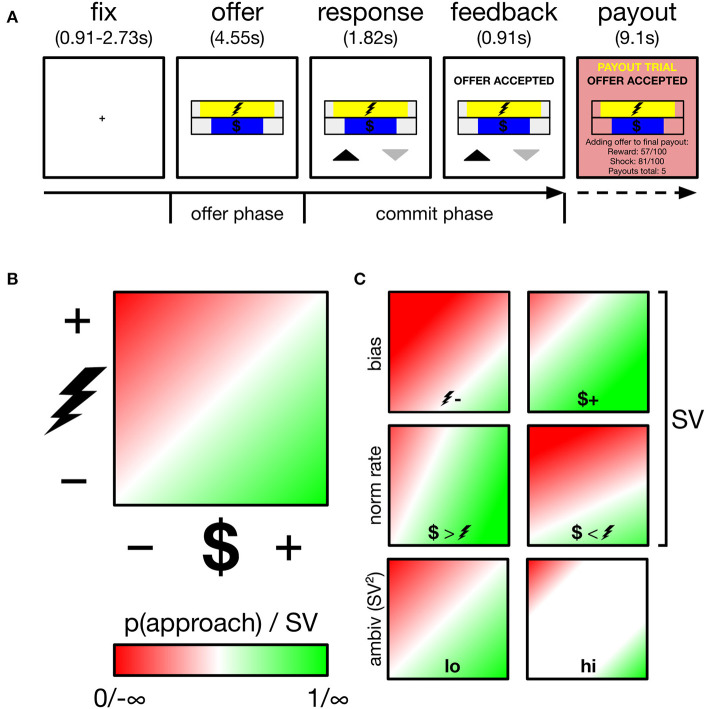
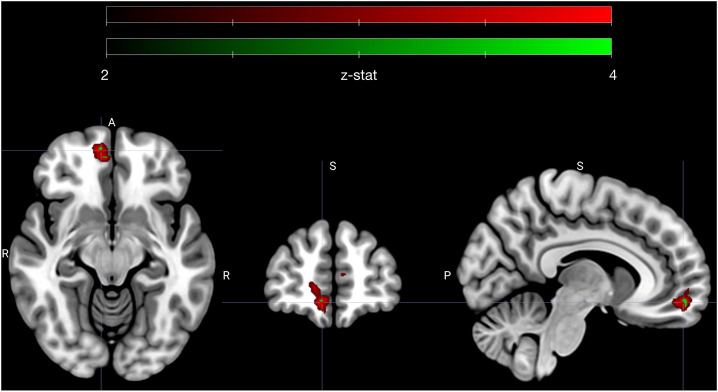
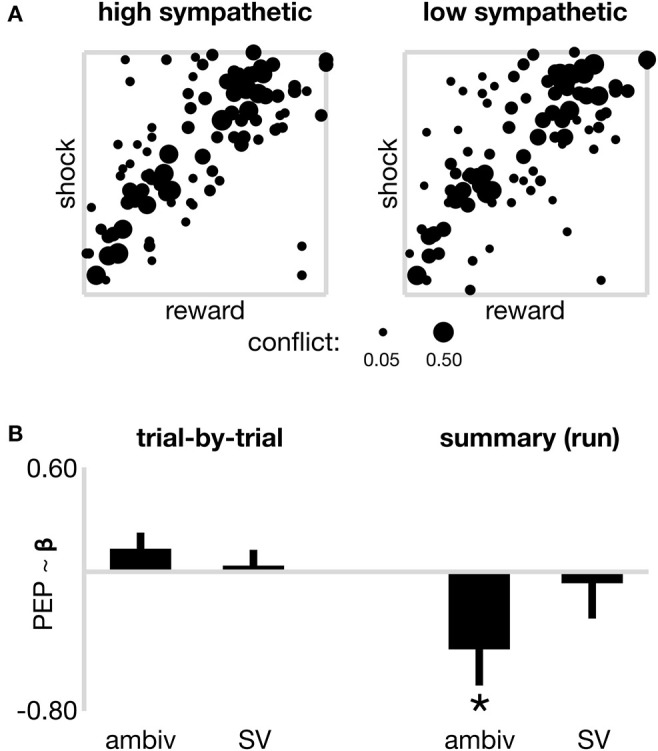
Anxiety is characterized by low confidence in daily decisions, coupled with high levels of phenomenological stress. Ventromedial prefrontal cortex (vmPFC) plays an integral role in maladaptive anxious behaviors via decreased sensitivity to threatening vs. non-threatening stimuli (fear generalization). vmPFC is also a key node in approach-avoidance decision making requiring two-dimensional integration of rewards and costs. More recently, vmPFC has been implicated as a key cortical input to the sympathetic branch of the autonomic nervous system. However, little is known about the role of this brain region in mediating rapid stress responses elicited by changes in confidence during decision making. We used an approach-avoidance task to examine the relationship between sympathetically mediated cardiac stress responses, vmPFC activity and choice behavior over long and short time-scales. To do this, we collected concurrent fMRI, EKG and impedance cardiography recordings of sympathetic drive while participants made approach-avoidance decisions about monetary rewards paired with painful electric shock stimuli. We observe first that increased sympathetic drive (shorter pre-ejection period) in states lasting minutes are associated with choices involving reduced decision ambivalence. Thus, on this slow time scale, sympathetic drive serves as a proxy for "mobilization" whereby participants are more likely to show consistent value-action mapping. In parallel, imaging analyses reveal that on shorter time scales (estimated with a trial-to-trial GLM), increased vmPFC activity, particularly during low-ambivalence decisions, is associated with decreased sympathetic state. Our findings support a role of sympathetic drive in resolving decision ambivalence across long time horizons and suggest a potential role of vmPFC in modulating this response on a moment-to-moment basis.
焦虑的特征是对日常决策缺乏信心,同时伴有高水平的现象学应激。腹内侧前额叶皮层(vmPFC)通过对威胁性与非威胁性刺激的敏感性降低(恐惧泛化),在适应不良的焦虑行为中发挥着不可或缺的作用。vmPFC也是需要对奖励和成本进行二维整合的趋近-回避决策中的关键节点。最近,vmPFC被认为是自主神经系统交感神经分支的关键皮层输入。然而,关于这个脑区在介导决策过程中信心变化引发的快速应激反应中的作用,我们知之甚少。我们使用了一个趋近-回避任务,来研究交感神经介导的心脏应激反应、vmPFC活动与长时和短时时间尺度上的选择行为之间的关系。为此,我们在参与者对与痛苦电击刺激配对的金钱奖励做出趋近-回避决策时,同时收集了功能磁共振成像(fMRI)、心电图(EKG)和阻抗心动图记录的交感神经驱动。我们首先观察到,持续数分钟的状态下交感神经驱动增加(射血前期缩短)与涉及减少决策矛盾心理的选择相关。因此,在这个缓慢的时间尺度上,交感神经驱动充当了“动员”的代理,即参与者更有可能表现出一致的价值-行动映射。同时,成像分析表明,在较短的时间尺度上(用逐次试验的广义线性模型估计),vmPFC活动增加,特别是在低矛盾心理决策期间,与交感神经状态降低相关。我们的研究结果支持交感神经驱动在解决长时间范围内的决策矛盾心理中的作用,并表明vmPFC在即时调节这种反应中可能发挥的作用。