Fachbereich Psychologie, Universität Konstanz Konstanz, Germany.
Front Psychol. 2012 Oct 26;3:434. doi: 10.3389/fpsyg.2012.00434. eCollection 2012.
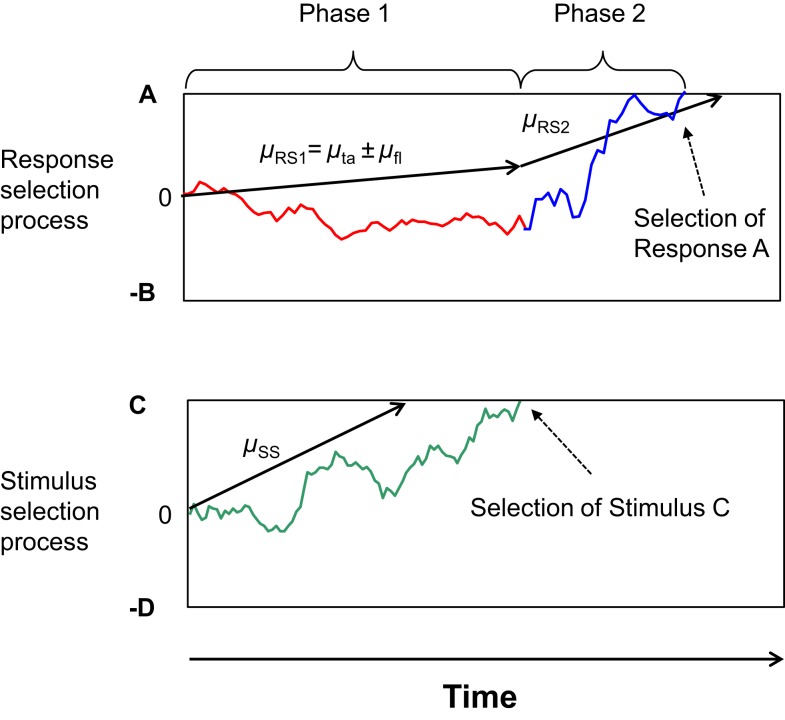
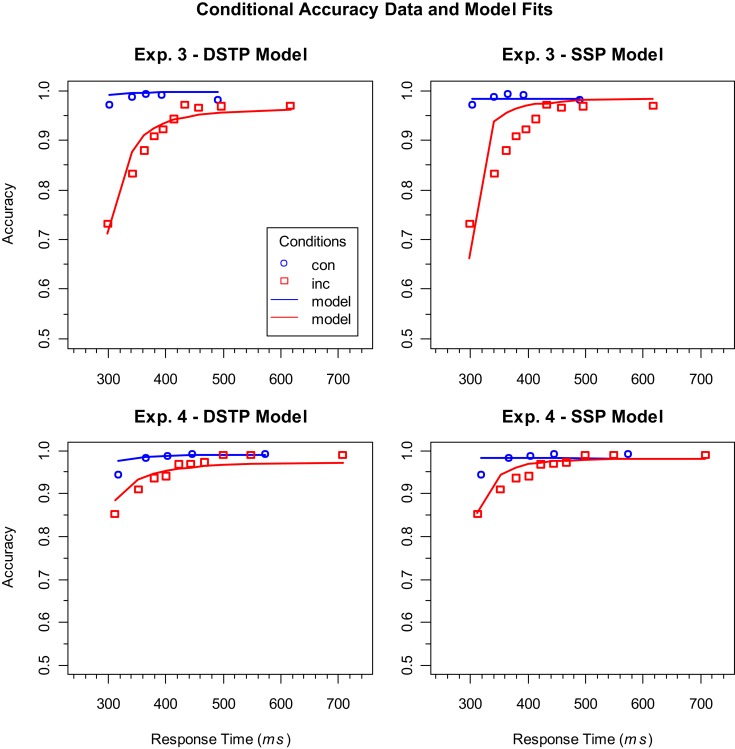
An important question is whether attentional selectivity improves discretely or continuously during stimulus processing. In a recent study, Hübner et al. (2010) found that the discrete Dual-Stage Two-Phase (DSTP) model accounted better for flanker-task data than various continuous-improvement models. However, in a subsequent study, White et al. (2011) introduced the continuous shrinking-spotlight (SSP) model and showed that it was superior to the DSTP model. From this result they concluded that attentional selectivity improves continuously rather than discretely. Because different stimuli and procedures were used in these two studies, though, we questioned that the superiority of the SSP model holds generally. Therefore, we fit the SSP model to Hübner et al.'s data and found that the DSTP model was again superior. A series of four experiments revealed that model superiority depends on the response-stimulus interval. Together, our results demonstrate that methodological details can be crucial for model selection, and that further comparisons between the models are needed before it can be decided whether attentional selectivity improves continuously or discretely.
一个重要的问题是注意的选择性是在刺激处理过程中离散地还是连续地提高。在最近的一项研究中,Hübner 等人(2010)发现离散的双阶段两阶段(DSTP)模型比各种连续改进模型更好地解释了侧抑制任务数据。然而,在随后的一项研究中,White 等人(2011)引入了连续收缩聚光灯(SSP)模型,并表明它优于 DSTP 模型。他们从这个结果得出结论,注意的选择性是连续提高的,而不是离散提高的。然而,由于这两项研究使用了不同的刺激和程序,我们质疑 SSP 模型的优越性是否普遍存在。因此,我们将 SSP 模型拟合到 Hübner 等人的数据中,发现 DSTP 模型再次占优。一系列四项实验表明,模型的优越性取决于反应-刺激间隔。总之,我们的结果表明,方法细节对于模型选择至关重要,在决定注意的选择性是连续提高还是离散提高之前,还需要对这些模型进行进一步比较。