School of Public Health, Taipei Medical University, Taipei, Taiwan.
PLoS One. 2012;7(10):e47773. doi: 10.1371/journal.pone.0047773. Epub 2012 Oct 24.
Endogenous estrogens play an important role in the overall cardiocirculatory system. However, there are no studies exploring the hormone metabolism and signaling pathway genes together on ischemic stroke, including sulfotransferase family 1E (SULT1E1), catechol-O-methyl-transferase (COMT), and estrogen receptor α (ESR1).
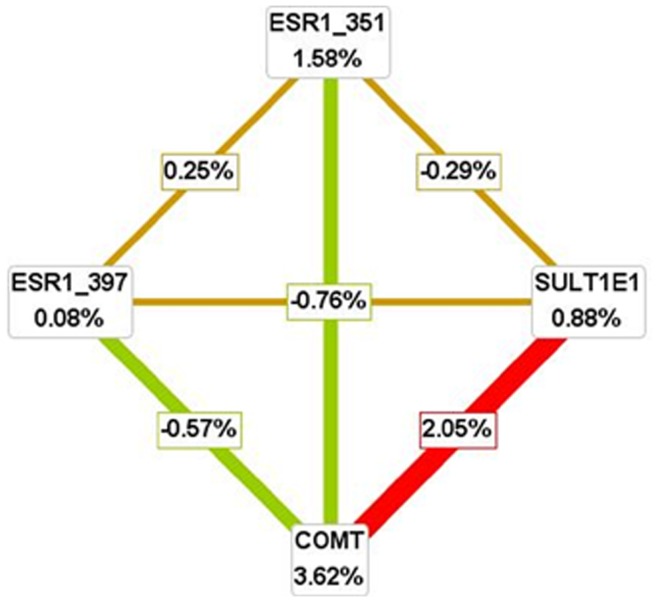
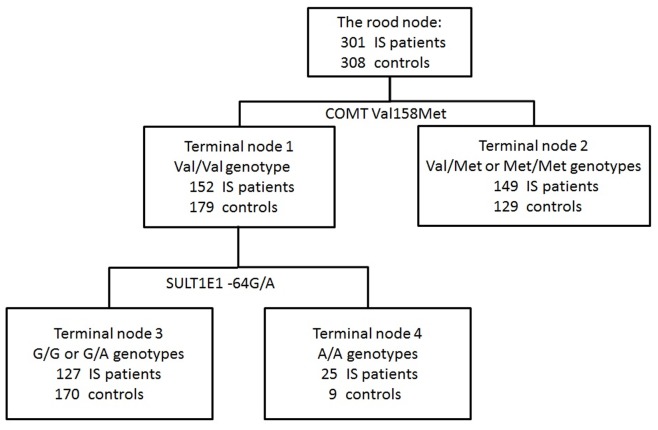
A case-control study was conducted on 305 young ischemic stroke subjects aged </= 50 years and 309 age-matched healthy controls. SULT1E1 -64G/A, COMT Val158Met, ESR1 c.454-397 T/C and c.454-351 A/G genes were genotyped and compared between cases and controls to identify single nucleotide polymorphisms associated with ischemic stroke susceptibility. Gene-gene interaction effects were analyzed using entropy-based multifactor dimensionality reduction (MDR), classification and regression tree (CART), and traditional multiple regression models.
COMT Val158Met polymorphism showed a significant association with susceptibility of young ischemic stroke among females. There was a two-way interaction between SULT1E1 -64G/A and COMT Val158Met in both MDR and CART analysis. The logistic regression model also showed there was a significant interaction effect between SULT1E1 -64G/A and COMT Val158Met on ischemic stroke of the young (P for interaction = 0.0171). We further found that lower estradiol level could increase the risk of young ischemic stroke for those who carry either SULT1E1 or COMT risk genotypes, showing a significant interaction effect (P for interaction = 0.0174).
Our findings support that a significant epistasis effect exists among estrogen metabolic and signaling pathway genes and gene-environment interactions on young ischemic stroke subjects.
内源性雌激素在整体心血管系统中发挥着重要作用。然而,目前尚无研究探讨激素代谢和信号通路基因共同对缺血性脑卒中的影响,这些基因包括磺基转移酶家族 1E(SULT1E1)、儿茶酚-O-甲基转移酶(COMT)和雌激素受体α(ESR1)。
本病例对照研究纳入了 305 名年龄≤50 岁的青年缺血性脑卒中患者和 309 名年龄匹配的健康对照者。对 SULT1E1-64G/A、COMT Val158Met、ESR1 c.454-397 T/C 和 c.454-351 A/G 基因进行基因分型,并比较病例组和对照组之间的单核苷酸多态性,以确定与缺血性脑卒中易感性相关的基因。采用基于熵的多因素降维分析(MDR)、分类回归树(CART)和传统多元回归模型分析基因-基因相互作用效应。
COMT Val158Met 多态性与女性青年缺血性脑卒中的易感性显著相关。MDR 和 CART 分析均显示 SULT1E1-64G/A 和 COMT Val158Met 之间存在双向相互作用。Logistic 回归模型也显示 SULT1E1-64G/A 和 COMT Val158Met 之间存在显著的交互作用,使青年缺血性脑卒中的发病风险增加(交互作用 P 值=0.0171)。我们进一步发现,携带 SULT1E1 或 COMT 风险基因型的个体,其雌二醇水平较低会增加青年缺血性脑卒中的发病风险,且存在显著的交互作用(交互作用 P 值=0.0174)。
本研究结果支持雌激素代谢和信号通路基因之间存在显著的上位效应,以及基因-环境相互作用对青年缺血性脑卒中患者的影响。