Laboratorio de Desarrollo en Plantas, Facultad de Ciencias , Universidad Nacional Autónoma de México , Circuito Exterior s/n, Ciudad Universitaria. Avenida Universidad 3000. Coyoacán, Distrito Federal, CP 04510 , México.
AoB Plants. 2012;2012:pls027. doi: 10.1093/aobpla/pls027. Epub 2012 Oct 30.
The deterioration of seasonally tropical dry forests will stop with the implementation of management plans for this ecosystem. To develop these plans, we require information regarding aspects such as germination and the presence of 'empty seeds' of representative species-like, for example, Bursera, a genus with a high number of endemic species of the Mesoamerican Hotspot-that would enable us to propagate its species. The main purpose of this study is to describe the phenological and structural characteristics of fruits of 12 Bursera species and provide useful data for future studies on germination and seed dispersal, and to acquire new and useful information to understand the phylogenetic relationships of the Burseraceae family.
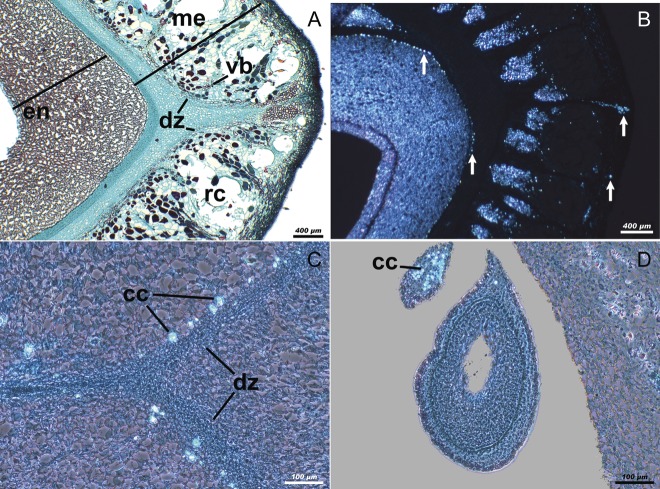
We described the phenology of fruit ripening in 12 species of Bursera. Fruits were collected from the study sites in three different stages of development. The histochemical and anatomical characteristics of fruits of all species were described with the use of inclusion techniques and scanning microscopy.
There is a time gap between the development of the ovary and the development of the ovule in the 12 studied species. The exposed pseudoaril during the dispersion stage is an indicator of the seed's maturity and the fruit's viability. The Bursera fruit shows the same structural pattern as that of Commiphora, as well as many similarities with species of the Anacardiaceae family. All species develop parthenocarpic fruits that retain the structural characteristics of the immature fruits: soft tissues rich in nitrogen compounds and few chemical and physical defences. Insects were found mainly inside the parthenocarpic fruits in eight species of Bursera.
The dispersion unit in Bursera consists of a seed, a lignified endocarp that protects the seed, and a pseudoaril that helps attract seed dispersers. The production of parthenocarpic fruits is energy saving; however, it is necessary to evaluate the potential benefits of this phenomenon.
通过实施针对这一生态系统的管理计划,季节性热带干燥森林的退化将得以停止。为了制定这些计划,我们需要了解代表物种(例如,Bursera,中美洲热点地区特有物种数量众多的属)的萌发和“空种子”存在等方面的信息,以便我们能够繁殖其物种。本研究的主要目的是描述 12 种 Bursera 属植物果实的物候学和结构特征,为今后关于萌发和种子传播的研究提供有用数据,并获取新的有用信息,以了解该属植物的系统发育关系。
我们描述了 12 种 Bursera 属植物果实的成熟物候。从研究地点收集处于不同发育阶段的果实。使用包埋技术和扫描显微镜描述了所有物种果实的组织化学和解剖学特征。
在 12 种研究物种中,卵巢和胚珠的发育之间存在时间间隔。在传播阶段暴露的假假种皮是种子成熟和果实活力的指标。Bursera 果实与 Commiphora 具有相同的结构模式,与漆树科许多物种也有许多相似之处。所有物种都发育出半自主性果实,保留了未成熟果实的结构特征:富含氮化合物的软组织和很少的化学和物理防御。在 Bursera 的 8 个物种中,昆虫主要存在于半自主性果实内。
Bursera 的传播单位由种子、木质化的内果皮(保护种子)和假假种皮组成,假假种皮有助于吸引种子传播者。半自主性果实的产生是节能的;然而,有必要评估这种现象的潜在好处。